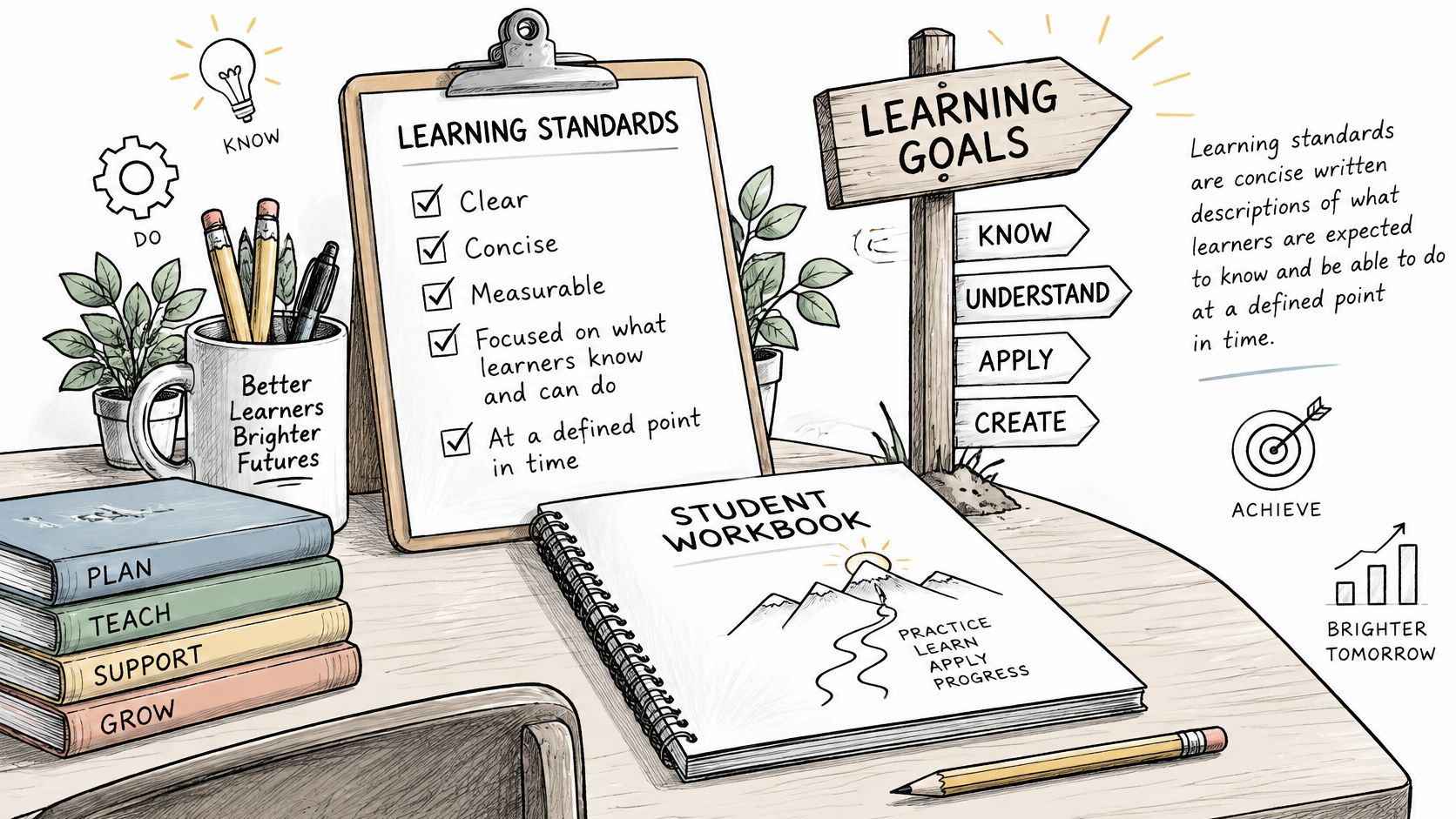
Learning standards are concise written descriptions of what a learner should know or be able to do at a defined point, such as the end of a course, grade or grade span, and they don't prescribe how to teach it.
If someone finishes a course but can't perform the task it was meant to teach, have they met the learning goal? That question exposes the difference between covering content and demonstrating learning.
A classroom teacher and a workplace trainer face the same design problem. Before choosing worksheets, videos or activities, they need to decide what successful learning will look like. Learning standards give them that destination.
Table of Contents
- Start with what the learner must demonstrate - Where learning objectives fit - What a shared target makes possible - Consistency without identical delivery - The classroom and forklift connection - Choose evidence that fits the setting - Qualification levels describe increasing capability - Digital competence and workplace requirements - Build the map before production - Preserve the connections through publishing - Replace passive maintenance with named responsibility - Review learning, not just completionWhat Learning Standards Are in Plain Terms
A learning standard describes an expected result, not a teaching activity. Think of it as a destination on a map: the learner needs to arrive somewhere specific, but the educator chooses the route.
The OECD Learning Compass glossary distinguishes intended learning outcomes from curricular content, teaching methods and assessment techniques. It also recognizes that education systems use related terminology, including learning objectives, curriculum guidelines and intended learning outcomes.
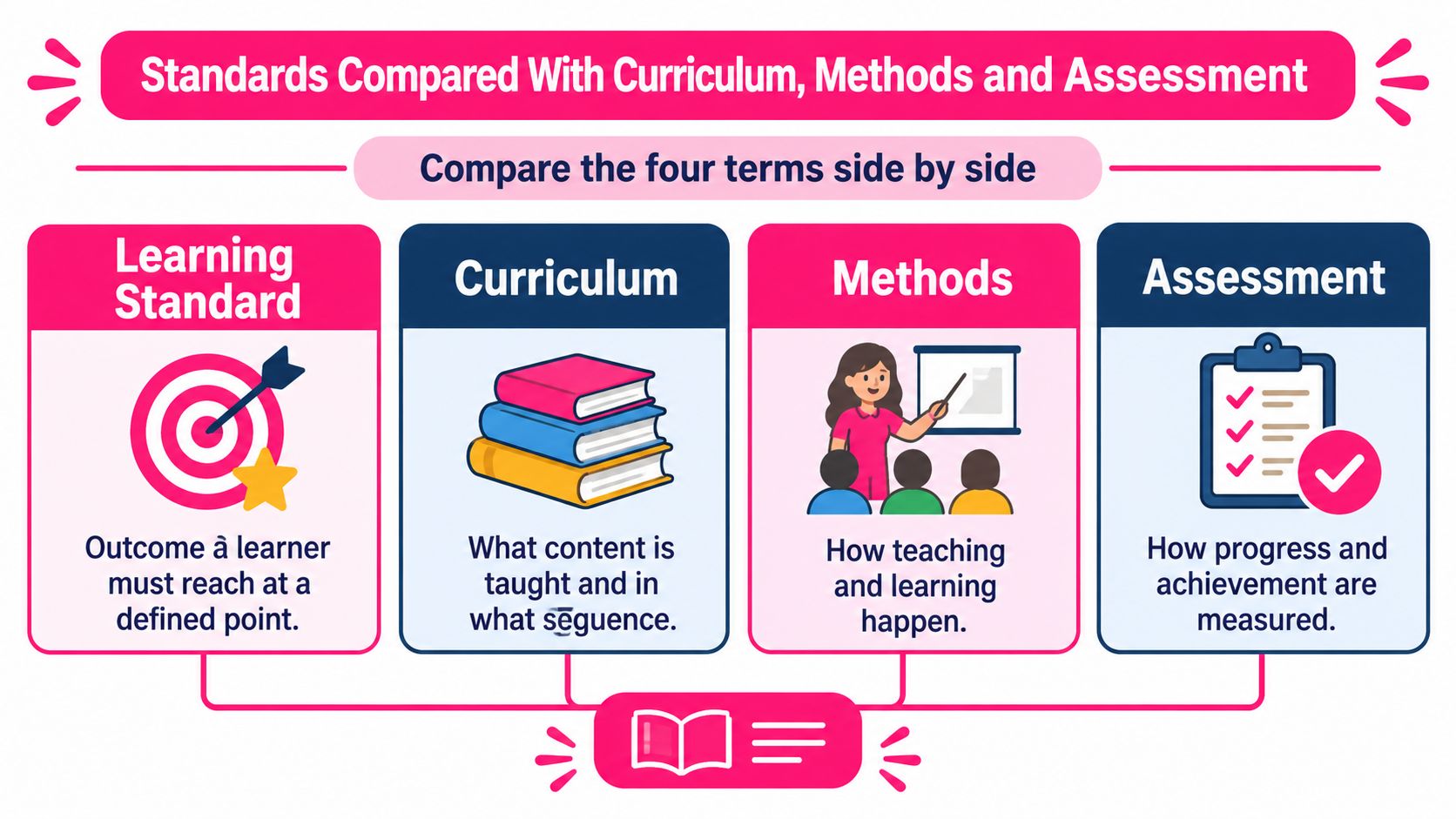
The illustration brings those connected ideas together.
Start with what the learner must demonstrate
Say a maintenance team needs employees to isolate a machine safely before servicing it. That expected performance gives the designer something concrete to work toward.
The designer might combine a short explanation, a demonstration and supervised practice. Another instructor might use coaching beside the equipment. Neither route changes the intended result.
Standards coordinate people's decisions. The subject specialist knows what accuracy requires, the designer knows what to teach, and the assessor knows what evidence to collect. Learners can also see what they're working toward instead of guessing what will appear on a test.
> Practical rule: Look for the result the learner must demonstrate, not the activity the instructor plans to deliver.
A useful first check is the sentence's verb. Explain, compare, apply and evaluate point toward observable learning; attend, watch and read usually describe participation.
That check isn't a complete definition, because a lesson objective can also describe an observable result. But it helps separate an outcome statement from an activity list. A standard still needs a defined scope, an appropriate level of expectation and a place within the governing framework.
Standards Compared With Curriculum, Methods and Assessment
Learning standards compared with related terms
| Term | What it specifies | Workplace example | |---|---|---| | Learning standard | The outcome a learner must reach at a defined point | Isolate a machine safely before servicing it | | Curriculum | The content, topics and sequence of teaching | An opening unit covers hazard classes; a later unit covers lockout steps | | Teaching method | How instruction is delivered | Short video followed by hands-on practice | | Assessment | How evidence of the outcome is collected and scored | Scenario quiz scored against the lockout standard |
The standard answers, “What must the learner achieve?” The curriculum answers, “What content will help them get there, and in what order?” Curriculum planning might include terminology, equipment-specific procedures and opportunities to practice.
The method concerns how instruction happens. The assessment concerns what evidence someone will collect and how they'll judge it. These choices should fit the outcome, but they aren't interchangeable with it.
The visual comparison makes those boundaries easier to recognize.
Where learning objectives fit
A learning objective usually translates a broader standard into a teachable, assessable target for a lesson or activity. For the machine-isolation example, an objective might ask learners to identify the correct isolation points on the equipment they use.
Terminology isn't universal, so don't rely on the label alone. Read the statement and check its scope. A broad expectation may require several objectives, while a carefully designed lesson may contribute to multiple standards.
A course called Safety Training isn't a standard. Its title doesn't tell an employee what to demonstrate or an assessor what acceptable performance looks like.
For another perspective on gathering evidence throughout learning, consider growth-focused assessment at Queens Online School. The useful design question is whether feedback helps learners close a specific gap, rather than merely receive a score.
The following video offers an additional explanation to consider alongside the comparison.
When building a course, use instructional design best practices to connect these decisions. A scenario quiz may reveal whether someone recognizes the correct procedure, but it doesn't by itself prove they can perform it safely.
Throughout this discussion, standard means the expected outcome, not the course, presentation or lesson plan used to teach it.
Why Standards Matter for Alignment, Assessment and Compliance
Consider a warehouse organization onboarding employees across different locations. Each site has its own instructors and operating conditions, but employees need to demonstrate the required capabilities wherever they work.
Without a shared target, an instructor might emphasize equipment terminology while another concentrates on incident reporting. Both sessions could be useful, yet neither training manager could confidently compare what employees learned.
What a shared target makes possible
Alignment gives the designer a reason for every learning activity. In the warehouse program, a demonstration belongs in the course because it prepares employees for a specified task, not because an old slide deck happens to contain it.
Assessment gives instructors a common reference for judging performance. Instead of deciding that an employee seems confident, they can check whether the employee recognizes hazards, selects an appropriate action and explains when to stop work.
Compliance becomes easier to document when the organization can connect an applicable requirement to instruction and evidence. A course catalogue shows what was offered; a documented mapping shows which requirement the training addresses and how the organization checked learning.
> A completed course is a record of participation. Evidence of competence requires a closer look at what the learner actually demonstrated.
Consistency without identical delivery
Consistency doesn't mean every warehouse instructor must use the same words. A local trainer can adapt examples to the equipment and working environment while retaining the expected performance and assessment criteria.
To make that distinction usable, give instructors:
- Required outcomes: The capabilities employees must demonstrate.
- Shared criteria: The features of acceptable performance.
- Local context: The equipment, procedures and escalation contacts relevant to the site.
A standard doesn't guarantee good teaching. An instructor can still explain a task poorly, give insufficient practice or choose an assessment that misses the important skill. What the standard provides is a basis for checking those choices.
Without that basis, course content can drift. Teams add slides, remove activities and revise quizzes without knowing which capability they've weakened. Eventually, a manager may have plenty of completion records but no clear answer to a basic question: Which evidence shows this employee can do the job?
K-12 and Corporate Standards Side by Side
| Dimension | K-12 standards | Corporate and professional standards | |---|---|---| | Who sets the standard | State or national education agencies | Regulators, certifying bodies or the employer | | Organised by | Grade level or grade span | Role, job task or certification | | Typical evidence of mastery | Unit tests, state assessments, portfolios | Observed performance, task checklists, certification exams | | Revision trigger | Adoption cycles and curriculum review | Changes in law, equipment or job tasks |
School and workplace standards differ in who authorizes the expectation and where learners must apply it. Their underlying design logic is closely related.
In schools, teachers work within the expectations adopted by the relevant education authority. In corporate learning, the training team must first establish whether an expectation comes from a legal requirement, professional qualification or internal operating procedure.
That distinction matters because an employer-created expectation isn't automatically a regulatory requirement. Record its authority accurately rather than presenting every internal preference as a legal obligation.
The classroom and forklift connection
Consider a hypothetical upper-elementary reading lesson. The expected outcome asks a learner to support an interpretation with evidence from a text. The teacher chooses a suitable passage, models the reasoning and checks the learner's explanation.
Now consider a forklift safety course. The expected outcome might concern recognizing an unsafe operating condition and responding appropriately. The trainer selects a relevant scenario, provides practice and arranges an appropriate performance check.
The subjects are different, but both designers must answer:
- What does successful performance involve?
- What practice prepares the learner for it?
- What evidence would justify saying the learner has achieved it?
Choose evidence that fits the setting
A written response can provide useful evidence of a learner's interpretation of a text. For a physical workplace task, an observer may need to watch the learner perform under appropriate conditions.
Neither setting should treat a convenient test format as automatically sufficient. A recognition question, an explanation and an observed task reveal different things.
Revision also needs an owner. School teams respond to adopted changes in educational expectations; workplace teams need to watch the requirements and operational conditions relevant to each role. Both benefit from a version history showing which expectation was taught and assessed.
For L&D teams asking what are learning standards in a corporate setting, the practical starting point is the job. Identify the role, task or governing obligation before creating the topic list. Otherwise, a polished course can leave the actual performance requirement untouched.
Real Examples From Schools, Europe and Workplace Regulation
Common learning standards and what they cover
| Framework | Setting | How it is structured | |---|---|---| | Common Core State Standards | US school mathematics and English language arts | Grade-by-grade expectations | | European Qualifications Framework (EQF) | Europe, all types of qualifications | Progressive levels with learning-outcome descriptors | | DigComp | European digital competence | Broad competence areas adapted to each purpose | | OSHA hazard communication standard | US workplace chemical safety | Requirements addressing hazard communication and employee training |
These examples aren't identical kinds of documents. A school standard, qualifications framework, competence framework and workplace regulation carry different authority, so trainers shouldn't treat them as interchangeable.
Common Core State Standards illustrate how school expectations can be organized around progress through mathematics and English language arts. For a training designer, the useful lesson is progression: an advanced task may depend on capabilities that need explicit teaching first.
Qualification levels describe increasing capability
The European Union recommendation establishing the EQF) dates from 2008 and defines 8 levels, ranging from basic knowledge and supervised simple tasks to frontier knowledge and advanced research or innovation capabilities. Its descriptors address knowledge, skills, and responsibility or autonomy.
The EQF helps people compare qualifications across national systems without requiring identical curricula. It focuses attention on what a person knows, understands and can do, rather than treating time spent studying as sufficient evidence of achievement.
For a role-based example to examine, explore business administration apprenticeship topics through MasteryMind. Use the topics as a starting point for asking which workplace performances learners must demonstrate, not as a substitute for checking the applicable qualification requirements.
Digital competence and workplace requirements
DigComp gives curriculum designers a broad digital-competence reference to adapt to their learners and context. A customer-support employee and a teacher may need different tasks and examples even when their learning addresses related capabilities.
Workplace regulation requires a different reading approach. For hazard communication training, begin with the applicable requirement and workplace hazards, then determine what instruction and evidence are necessary. Don't assume a general awareness course satisfies every obligation.
Use a compliance training requirements checklist to organize that review, while keeping the governing requirement authoritative.
The common lesson is scope before content. Confirm who the document applies to, what authority it carries and what performance it requires before assigning lessons to it.
How to Map Learning Standards to Training Content
A useful standards map connects an authoritative expectation to a lesson and to evidence of learning. It should let a reviewer inspect the connection without reconstructing the designer's reasoning.
UNESCO's discussion of learning assessments and skills data describes common proficiency descriptors as reference points for reporting across assessments. The design implication is important: shared expectations don't require every learner to take an identical test.
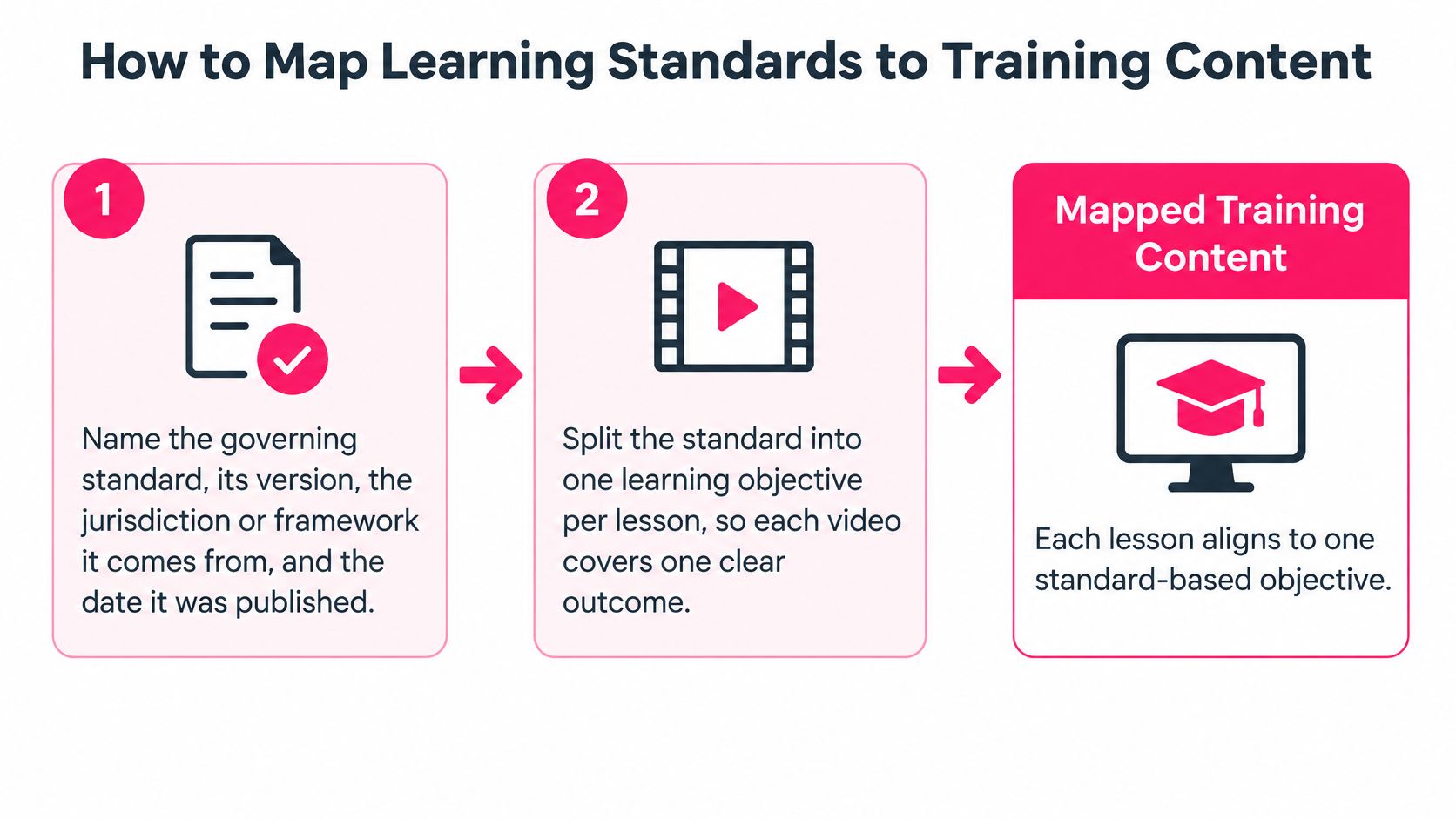
This visual shows the movement from a governing expectation to mapped content.
Build the map before production
1. Identify the governing document. Record its title, identifier, version, jurisdiction or framework, and publication date. Name the person responsible for confirming that it applies to the learners.
2. Translate the expectation into lesson objectives. Our implementation checklist recommends defining one clear learning objective per lesson before production. Use this guide to writing learning objectives to replace vague verbs such as understand with a demonstrable action.
3. Decide what evidence will count. A knowledge check can test understanding immediately after instruction; an observed task can reveal application. Use success criteria guidance from Kuraplan to make the features of successful performance visible to learners and assessors.
4. Standardize the script and visual structure. Our checklist recommends this approach so reviewers can approve faster. Keep the objective, demonstration, practice prompt and assessment connection easy to locate.
Preserve the connections through publishing
5. Tag the assets and learning records. Preserve the standard identifier, version, objective and evidence requirement with the content; retain completion state, score and relevant activity context in the associated learning records. This separates what competence means from the format used to teach it.
6. Test LMS delivery and tracking. We support SCORM and xAPI for LMS publishing. Confirm the configured workflow reports the completion and assessment information you need, rather than assuming that publishing a video proves successful tracking.
7. Publish and review performance. Examine incorrect answers, incomplete attempts and assessor feedback. Revise the explanation or practice where learners struggle, while checking whether the assessment itself is appropriate.
One standard traced to one lesson
| Element | Example | |---|---| | Learning standard | Isolate a machine safely before servicing it | | Learning objective | Apply lockout steps in order on an assigned machine | | Asset | Short lockout procedure video | | Assessment evidence | Scenario quiz scored against the lockout standard |
This example is a planning map, not a complete safety qualification. The quiz can reveal procedural understanding; a practical performance requirement needs suitable observed evidence as well.
When requirements change, use the identifiers to locate affected objectives, scripts and assessments. You shouldn't need to inspect every video manually to discover where a procedure appears.
> Traceability test: A reviewer should be able to move from the lesson to its objective, from the objective to the governing expectation, and from that expectation to appropriate assessment evidence.
If you use a video platform, verify which metadata fields it preserves and which records belong in the LMS or a separate controlled register. Don't assume every tag travels automatically with an exported file.
Keep Your Standards Map Current After Launch
A standards map isn't permanently valid just because someone approved it at launch. The framework may change, the workplace may change, or the assessment may no longer reflect the task employees perform.
The European Commission's announcement of DigComp 3.0, published in November 2025, highlights attention to artificial intelligence, cybersecurity, misinformation, digital wellbeing, and people's rights and responsibilities. The framework remains broad enough to require adaptation to a specific purpose.
That creates a practical ownership question. The framework publisher maintains the framework, but your organization needs someone to interpret changes, decide which roles are affected and authorize training updates.
Replace passive maintenance with named responsibility
Assign a framework owner, a subject reviewer and a publishing owner. These can be responsibilities rather than separate jobs, but each decision needs an accountable person.
For an AI-related lesson, a changed expectation might affect more than terminology. Reviewers may need to reconsider whether learners can recognize an inappropriate use, protect sensitive information and explain when human judgment is necessary.
Watch for these maintenance mistakes:
- Treating alignment as endorsement: Mapping a course to a framework doesn't mean its publisher approves the course. Document the relationship and avoid unsupported approval claims.
- Keeping a permanently compliant master course: Replace the assumption of permanent validity with modular, version-controlled lessons that reviewers can update selectively.
- Leaving the mapping in someone's head: Record the jurisdiction, version, review date and responsible owner in a shared, controlled register.
> Alignment is a documented design decision, not a badge that removes the need for review.
Review learning, not just completion
Completion records help identify participation gaps. They don't explain whether learners can apply a principle to an unfamiliar situation, make an ethical choice or stop an unsafe task.
For AI and safety topics, include scenarios that require a decision and a reason. Have reviewers examine the learner's reasoning against explicit criteria, rather than awarding credit only for recalling a definition.
Our implementation checklist recommends publishing, measuring completion and iterating every two weeks. Treat that as a content-improvement rhythm, not a promise that every governing requirement changes on the same schedule.
Start with a course that's difficult to maintain. Rebuild it as modular lessons, review engagement data weekly, and recheck the mapping whenever a relevant framework or workplace requirement changes. Record what changed, who approved it and which learners need updated instruction.
---
VideoLearningAI helps educators and training teams turn existing materials into structured, bite-sized training videos, with templates and LMS publishing support. Visit VideoLearningAI to build a standards-aligned lesson from a clear objective, then pair it with the evidence learners need to demonstrate success.