The most common advice about competency based training gets it backward. Teams are told to publish more lessons, add more quizzes, and watch completion climb. That only proves exposure. It doesn't prove a person can handle a different customer, a changed tool, or a busy shift without help.
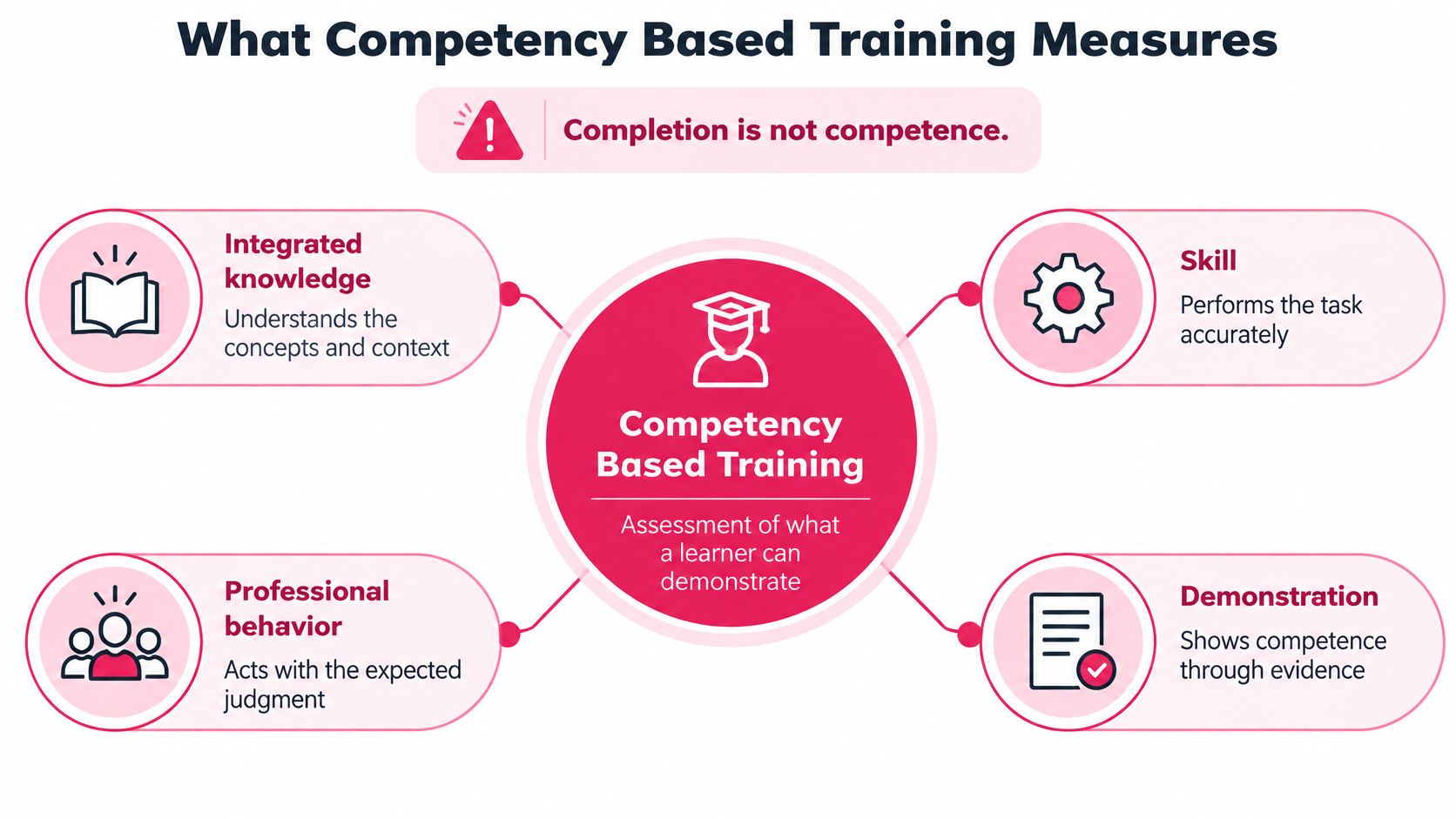
Completion is not competence. A finished module tells you someone clicked through content. It doesn't tell you whether they'd make the right decision under pressure, produce a usable work product, or repeat the skill two weeks later. If you build around that distinction from the start, your program will be smaller, sharper, and much easier to defend to managers and auditors.
Table of Contents
- What you can promise stakeholders - Apply the same test to different jobs - When to use competency based training - Why the effort is worth it in the right rows - The six steps in order - Starter competency template - Assessment risks and the design that answers them - Make the LMS record the right things - Five production rules you can apply this week - Equity is a design requirement, not a translation step - Build a five-part evidence stack - Run a two-week pilot on one roleWhat Competency Based Training Measures
Competency based training measures what a learner can demonstrate, not how long they sat in a course. You're assessing integrated knowledge, skill, and professional behavior applied to a real task. Attendance, seat time, and a completion tick are delivery records. They are not evidence of capability.
That distinction starts with language. "Communicates well" can't be observed, coached, or fairly judged. "Explains a billing error, offers the correct remedy, and logs the case so finance can audit it" can. One is a trait. The other names actions, a result, and an artifact someone can inspect.
What you can promise stakeholders
- Observable performance: Training ties to work a manager can watch, so it's clear what changed on the job.
- Portable language: Standard outcome wording travels across sites and employers instead of staying inside one course.
- Earlier gap detection: Each learner is judged against a written standard, so gaps surface before full rollout.
- Focused learning time: People spend time on what they can't yet do, not on content they've already mastered.
This isn't a new e-learning trend. As a Wiley history of competency-based education records, the U.S. Office of Education funded 10 colleges and universities in 1968 to develop competency-oriented teacher programs. The model spread through vocational and adult programs in the 1970s, then into online and direct-assessment formats from the late 1990s.
Apply the same test to different jobs
A support agent closes a live ticket with the right resolution and notes. A technician performs a lockout procedure in the correct sequence. An analyst finishes a system workflow and leaves the record in the correct end state. In each case, you're not asking whether they watched training. You're asking whether the work is right.
High-risk fields make the point obvious. A resource on competency assessment for aesthetic clinics shows the same logic outside corporate L&D, where sign-off has to rest on demonstrated practice, not attendance alone.
> Practical rule: Before you build any content, write one performance sentence. Name who does what, under which conditions, to which standard.
If you can't write that sentence, you don't have a competency yet. You have a topic.
When Seat Time Is the Wrong Metric
Use this model when the job has an observable end state and a wrong outcome costs money, safety, or compliance. Keep time-based or campaign learning for awareness and culture, where there's no single fair pass mark. The decision matters more than the build, because competency assessment takes rater time you shouldn't spend everywhere.
When to use competency based training
| Situation | Better model | Why | Minimum evidence | |---|---|---|---| | New-hire task with a clear end state | Competency based | A wrong output has a business cost | One observed task against a written standard | | Safety or regulatory procedure | Competency based | A completion click is not safe performance | Repeated observed procedure plus named sign-off | | Software or system workflow | Competency based | Click-through hides errors in the live tool | Work sample with the correct end state | | Awareness or culture session | Time-based or campaign | No single fair pass mark | Attendance or reflection, not a competency gate | | Vague leadership trait | Do not certify yet | The label is not a task | Rewrite as observable behaviors before any course | | One global checklist for every region | Competency based only after localization | The same rubric can be unfair across contexts | Localized scenarios and a check for uneven pass rates |
Read the first three rows as your strongest candidates. A new hire either produces the right output or they don't. A safety procedure either follows the required sequence or it creates risk. A software workflow either ends in the correct state or someone downstream fixes it.
The next two rows protect you from false precision. A values town hall can change conversation without justifying a pass or fail gate. A trait like "executive presence" shouldn't become a certification until someone rewrites it as behaviors two assessors could recognize the same way.
Why the effort is worth it in the right rows
The wider workforce picture explains the pressure. The OECD skills-first workforce report reports that only around 4 in 10 adults across OECD countries participate in formal or non-formal learning for job-related purposes, while employers face increasing difficulty filling positions because of talent shortages. The same report finds two-thirds of OECD countries have made notable progress toward skills-first ecosystems that weigh demonstrated competencies over traditional credentials alone.
That doesn't mean every course needs a rubric. It means scarce learning time should go where demonstrated capability changes hiring, deployment, or risk decisions.
> Pick the task a manager would refuse to delegate until they'd seen it done. Treat only that task as in scope for your pilot.
How to Build the Program in Six Steps
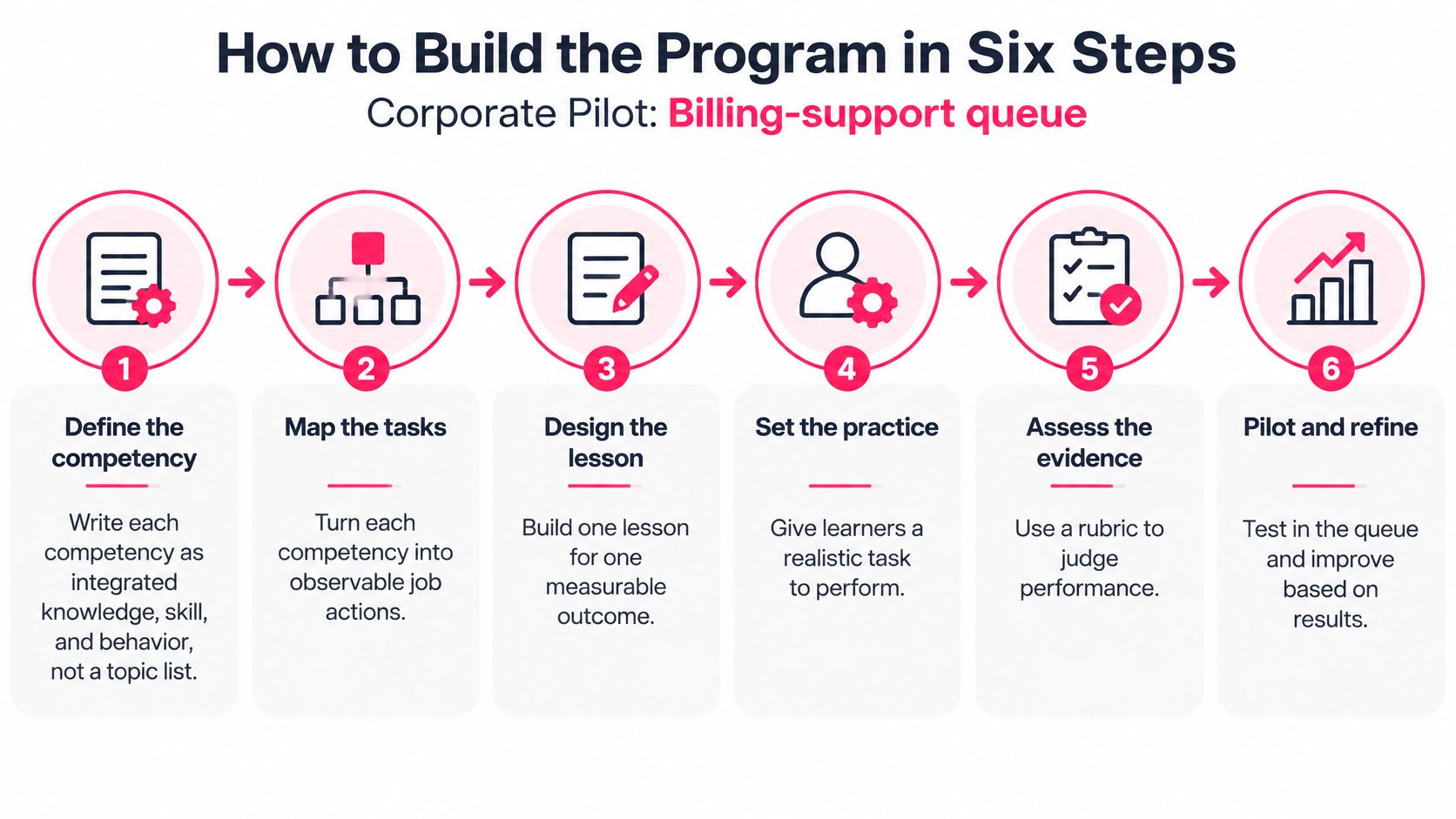
A billing-support pilot can look successful on paper while leaving agents unprepared for a difficult customer call. More lessons and quizzes may increase exposure, but competence has to show up in the work. Start with one contained task that matters to customers and finance, then build practice and evidence around it.
The six steps in order
1. Define the competency. Describe the knowledge, skills, and behaviors required together, rather than listing course topics. In billing support, an agent must understand invoice rules, resolve the dispute, and communicate clearly and calmly. 2. Turn it into authentic work. Have learners resolve a disputed invoice in a realistic call scenario. Questions about billing rules can check recall, but they do not show whether someone can apply those rules with a customer. 3. Set criteria and supervision levels. Specify what correct performance looks like and how much oversight the learner needs. Progress from direct observation to indirect review, then independent work. 4. Collect repeated observations. Gather evidence across occasions and assessors. One manager's impression can reflect a single unusually easy or difficult case. 5. Give specific feedback. Identify the behavior that needs work and assign practice targeted to it. “Review the course” does not tell an agent how to improve a weak remedy or an incomplete case log. 6. Decide progression from evidence over time. Look for a consistent pattern across demonstrations before authorizing independent work. A quiz score can show understanding; it cannot establish that the skill holds up during a real customer interaction.
Step 4 deserves careful attention. In an Academic Medicine implementation study of entrustable professional activities, researchers analyzed more than 32,000 assessments. Four assessors across four occasions produced an overall dependability coefficient of 0.75. The proportion of learners reaching indirect supervision ranged from 11.3% to 100% across activities.
That variation is a reason to look beyond completion rates. Some competencies may be demonstrated sooner than others; others may reveal unclear criteria, insufficient practice, or a task that calls for more careful judgment. A dashboard should show where learners are progressing and what evidence supports the decision.
Short video lessons can teach knowledge and procedures, but they cannot establish workplace competence on their own. Use them as preparation for realistic practice and assessment. To place a pilot alongside onboarding and role progression, build an HR training and development plan that connects the learning to the wider people plan.
Starter competency template
| Field | Billing-support example | |---|---| | Competency statement | Explains a billing error, offers the correct remedy, and logs the case for finance audit | | Task | Resolve a disputed invoice on a recorded call | | Conditions | Live queue, customer on the phone, billing system open | | Standard | Correct remedy in one call with a complete case log | | Assessor | Trained team lead plus one peer assessor | | Evidence type | Recorded call review and case-log audit |
Complete one set of fields for each competency before producing lessons. If the assessor or evidence type is blank, the program still lacks a clear way to judge performance.
Assessment Rules That Survive an Audit
A large pile of ratings can still be invalid. That's the main technical risk here. Workplace judgments shift with assessor bias, context, relationships, and loose rating scales. One observer on one day is a weak basis for a promotion decision or a compliance sign-off.
Published benchmarks show how much structure dependable judgment can take. A Wiley review of workplace-based assessment reports that at least five assessments conducted by five raters were required to reach adequate reliability of Ep2 ≥ 0.80 in one EPA-based program. It also reports a multisite study with interclass correlations ranging from 0.68 to 0.91 for a structured entrustment scale.
You may not need that exact volume for every corporate task. You do need to stop pretending one tidy exercise settles the question.
Assessment risks and the design that answers them
| Risk | Safer design | Signal it is working | |---|---|---| | One observer on one occasion | Several raters and repeated observations | Structured entrustment ratings with interclass correlations from 0.68 to 0.91 | | Loose scale words | Shared behavioral anchors and assessor calibration | At least five assessments by five raters before treating Ep2 0.80 as adequate | | Checklist compliance without transfer | Performance in a realistic case | Learner can adapt steps when the customer, tool, or pressure changes | | Ranking people against each other | Criterion decision against the written standard | Rating distributions audited for harsh and lenient raters | | Vague competency label | One observable task and a pass standard | Feedback names the missed behavior, not a personality trait | | Premature sign-off | Remediation before authorization | Record shows evidence, assessor, context, remediation, and final authorization |
Premature sign-off is the failure managers feel first. A learner passes a controlled exercise, then stalls when the customer is angry, the system looks different, or time runs short. Your design has certified familiarity, not capability.
Make the LMS record the right things
Give each competency a stable ID. Store every assessment as a dated record linked to that ID. Keep performance evidence, assessor identity, context, remediation, and final authorization in separate fields.
That separation matters. Lesson completions should never flow into the sign-off field by default. Our guide to audit trail requirements for training records covers the record structure that helps you keep those categories clean.
Run a quarterly audit of rating distributions and feedback quality. Look for raters who pass everyone, raters who fail everyone, and comments that praise attitude instead of naming behavior. Fix calibration before the dashboard starts telling a confident story the evidence can't support.
Lessons That Prepare People for the Real Task
Treat content as preparation, not proof. A good lesson makes the task more learnable. It doesn't replace observation of that task.
Five production rules you can apply this week
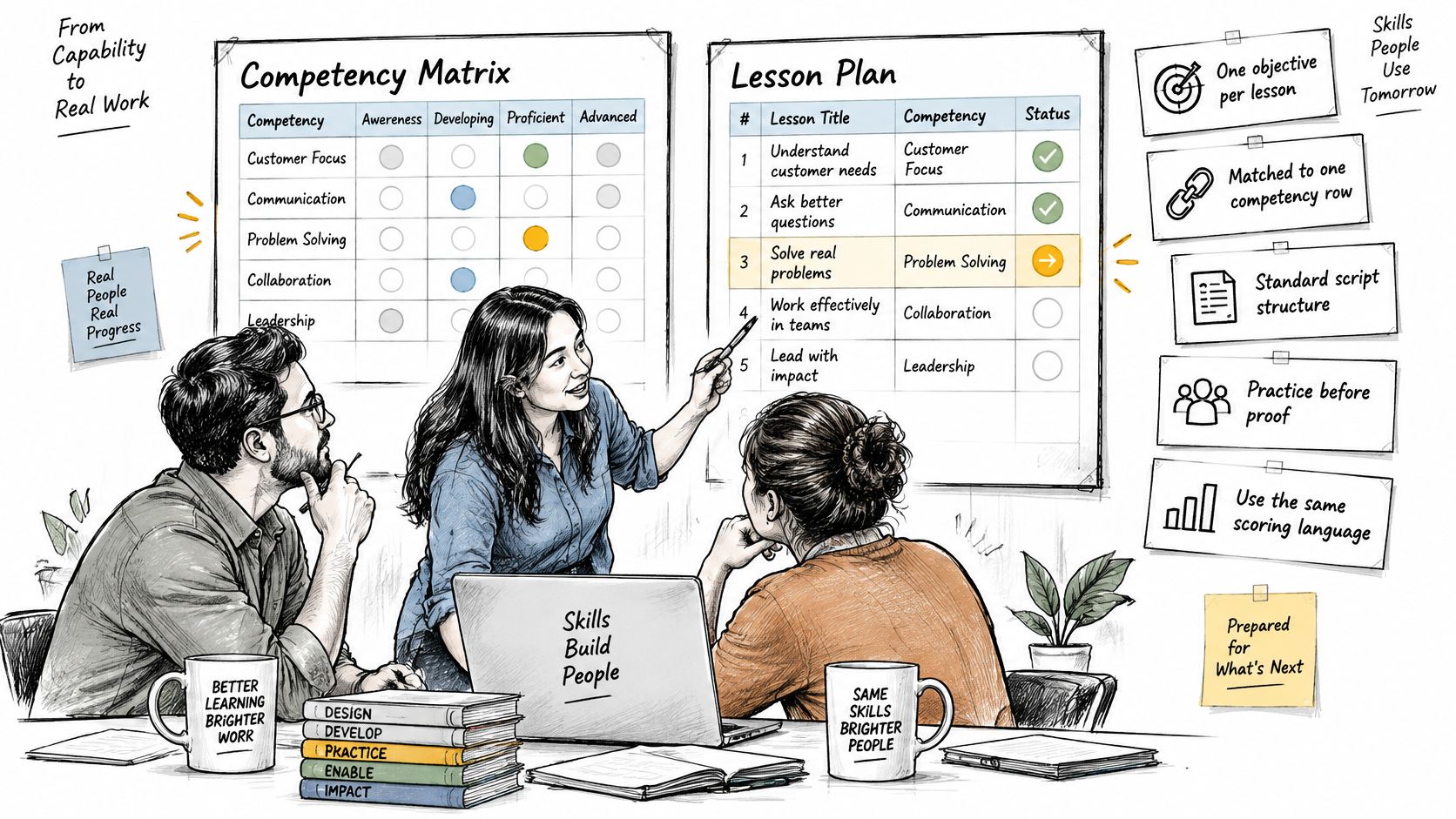
1. One objective per lesson. Match each lesson to one row of the competency so remediation can target the exact missed behavior. 2. Use a standard script structure. Set context, show the demonstration, give a practice prompt, then check knowledge. Reviewers approve faster when the structure doesn't change every time. 3. Keep procedure videos short enough to finish. Test length against completion in your own LMS. Compress only until each step is still doable without guessing. 4. Use scenarios for the decision. Branching prompts let learners choose a remedy, escalate, or ask for missing information. A manager observation still supplies the sign-off. 5. Publish an accessible version beside the polished cut. Provide captions and a low-bandwidth option so access doesn't depend on a studio file or a fast connection.
For the scenario layer, our explanation of what scenario-based training involves helps separate a decision exercise from a passive video with questions bolted on.
Equity is a design requirement, not a translation step
A framework that works at headquarters can fail somewhere else. The 2025 Oregon legislative report on competency-based education identifies funding misalignment, inadequate systems for individualized longitudinal tracking, insufficient staff development in assessment and competency mapping, and weak outcome data as barriers to scaling.
Global implementation adds language and cultural mismatch, limited connectivity, and tools that assume one well-resourced workplace. Standardization can reduce quality when it imports another labor market's assumptions into your rubric.
Localize the customer, currency, regulation, and tool. Train assessors before the rubric travels. Check whether pass rates differ by region, language, accessibility need, or role, and rewrite the global template when they diverge without a job-related reason.
Fields with clear employment gates show why context matters. Material on drone pilot training and employment pathways illustrates how demonstrated skill connects to a defined occupational route, where generic exposure wouldn't be enough for either learner or employer.
> Before release, confirm four things. The objective, the localized scenario, the accessible format, and the named assessor.
Keep context in the evidence record rather than reducing everything to a binary completion status. Without context, you can't tell whether a gap reflects the learner, the scenario, the assessor, or the working conditions.
Prove Job Transfer Before You Scale
A completion record works like an attendance sheet. It confirms exposure, while the test is whether the skill survives a different customer, tool, site, or busy shift.
Competency assessment is not self-validating. The NCVER review of competency-based assessment validity requires evidence across content, reliability, stability, generalizability, practicality, and consequences. Research on workplace transfer also measures it in fragments, splitting evidence across learner characteristics, training design, organizational support, context, and outcomes. A learner can perform in a controlled scenario and still struggle on the live queue.
Build a five-part evidence stack
Each layer closes a different gap between practice and work.
1. Scenario demonstration: Shows the procedure under controlled conditions. 2. Supervisor observation: Shows it on the actual queue, floor, or system. 3. Delayed reassessment: Shows whether it held two to four weeks later. 4. Work sample: Shows the quality of the artifact the job leaves behind. 5. Operational indicator: Shows the business effect, such as reopen rate, safety incidents, or handle time without a quality drop.
More videos and quizzes can raise exposure and still miss all five. The VideoLearningAI implementation checklist therefore calls for one clear learning objective per lesson before production, then publishing, measuring completion, and iterating every two weeks. A first version can launch in days when teams reuse templates and review engagement data weekly. Each cycle should change the lesson when evidence exposes a weakness, rather than adding more content.
Run a two-week pilot on one role
During week one, publish the lesson set and capture scenario demonstrations. During week two, record supervisor observations, review rating distributions, revise the weakest lesson, and schedule delayed reassessments for two to four weeks later. Treat an unexpected spread in ratings as a prompt to inspect how the rubric was applied before deciding whether the lesson or learner caused the gap.
Report three numbers separately. Completion tells you who was exposed. Demonstration tells you who performed under assessment conditions. Transfer tells you who kept performing at work. One blended percentage hides whether the problem was participation, assessment, or durability.
The guide to measuring training effectiveness explains how to keep those measures separate as the pilot grows. Hold scale until one competency shows delayed workplace evidence, rather than only a finished module. That result earns expansion.
---
Turn each competency into a short, focused video lesson without a studio or editing backlog, then pair it with the rubric and workplace evidence required for sign-off. VideoLearningAI is an AI-powered platform for creating professional-looking training videos in minutes with no video editing skills required, using templates for onboarding, compliance, sales enablement, and customer education. Start with one observable task, build the lesson around it, and prove transfer before you scale.