A manager asks for a course because a team missed a target. That request may point to a genuine skill gap, but it may just as easily point to a broken process, missing tools, unrealistic workload, or incentives that reward the wrong behavior. A course request is a hypothesis, not a needs analysis. To conduct training needs analysis well, start by testing whether instruction can plausibly change the business result, then gather evidence before producing a lesson.
Table of Contents
- Decide Whether Training Is the Right Fix
- How to Run the Analysis in Six Moves
- Collect Evidence Across Roles and Methods
- Score Gaps and Write Performance Objectives
- Pitfalls That Invalidate the Analysis
- Publish Only the Gaps You Can Prove
Decide Whether Training Is the Right Fix
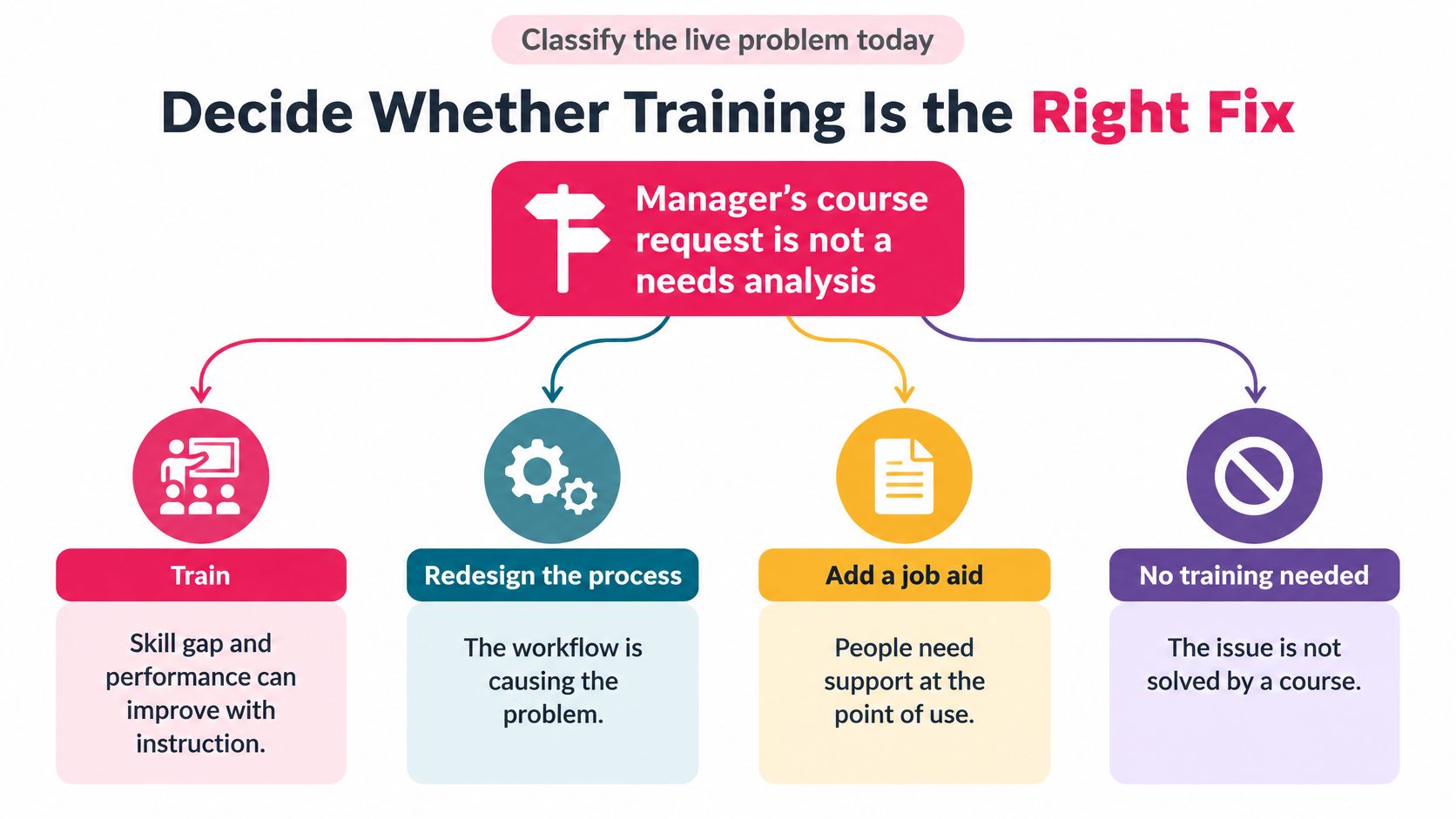
Classify the live problem before you commission content. A support team misses refund service-level agreements because agents don't know which policy applies: train them on the decision and check their understanding. If agents know the policy but it's buried several CRM clicks deep, add a job aid or redesign the workflow. If agents learned the new step but supervisors never discuss it or make room to practise, coach the managers. If the metric already meets its agreed standard, take no action.
| What the evidence usually shows | Likely cause | Intervention | Training? | |---|---|---|---| | People can't perform the step when asked, even with the tool open | Missing knowledge or skill | Short lesson plus a knowledge check | Yes | | People know the step, but the system hides it or the SOP conflicts | Process or tool design | Redesign the workflow or create a job aid | No | | Skill exists in a pilot group but fades after the workshop | No manager follow-up or practice time | Coach managers and schedule practice | Only with a transfer plan | | Errors cluster where incentives reward speed over the new behavior | Incentive or workload conflict | Change targets, staffing, or time allowed | No | | The business metric is already at the standard | No material gap | Don't produce content | No |
For the refund example, check the case records, listen to how agents explain the policy, and watch them handle a realistic request. If they choose the wrong route even when the policy is visible and the CRM is working, instruction may address the cause. If they choose correctly in a scenario but struggle in live work because the policy is hard to find, a video won't fix the interface.
Strategic diagnosis is often missing from TNA guidance. A 2025 systematic review of 101 training needs analysis publications from 2009–2024 found that research often focuses on individual-level gaps and is weakly aligned with organizational strategy. Start with one business outcome, such as reducing onboarding time, improving first-pass compliance, or improving sales-conversation quality. Then test whether knowledge or skill is the cause, rather than assuming that a reported capability gap calls for a course.
> Decision rule: If the workflow, tools, workload, incentives, or manager behavior prevent people from applying a skill, address those conditions before making a lesson.
A job aid can be the better answer when people need a prompt at the moment of work. For practical examples of that approach, see job aids that reduce training time. In a sales context, teams assessing consultative conversation skills may also find this guide to strengthen value discovery skills for SEs useful when defining the behavior they want sales engineers to demonstrate.
Lock down one outcome and one target population before sending a survey. A company-wide questionnaire about “sales skills” is too broad to establish whether a particular behavior affects a particular result.
How to Run the Analysis in Six Moves
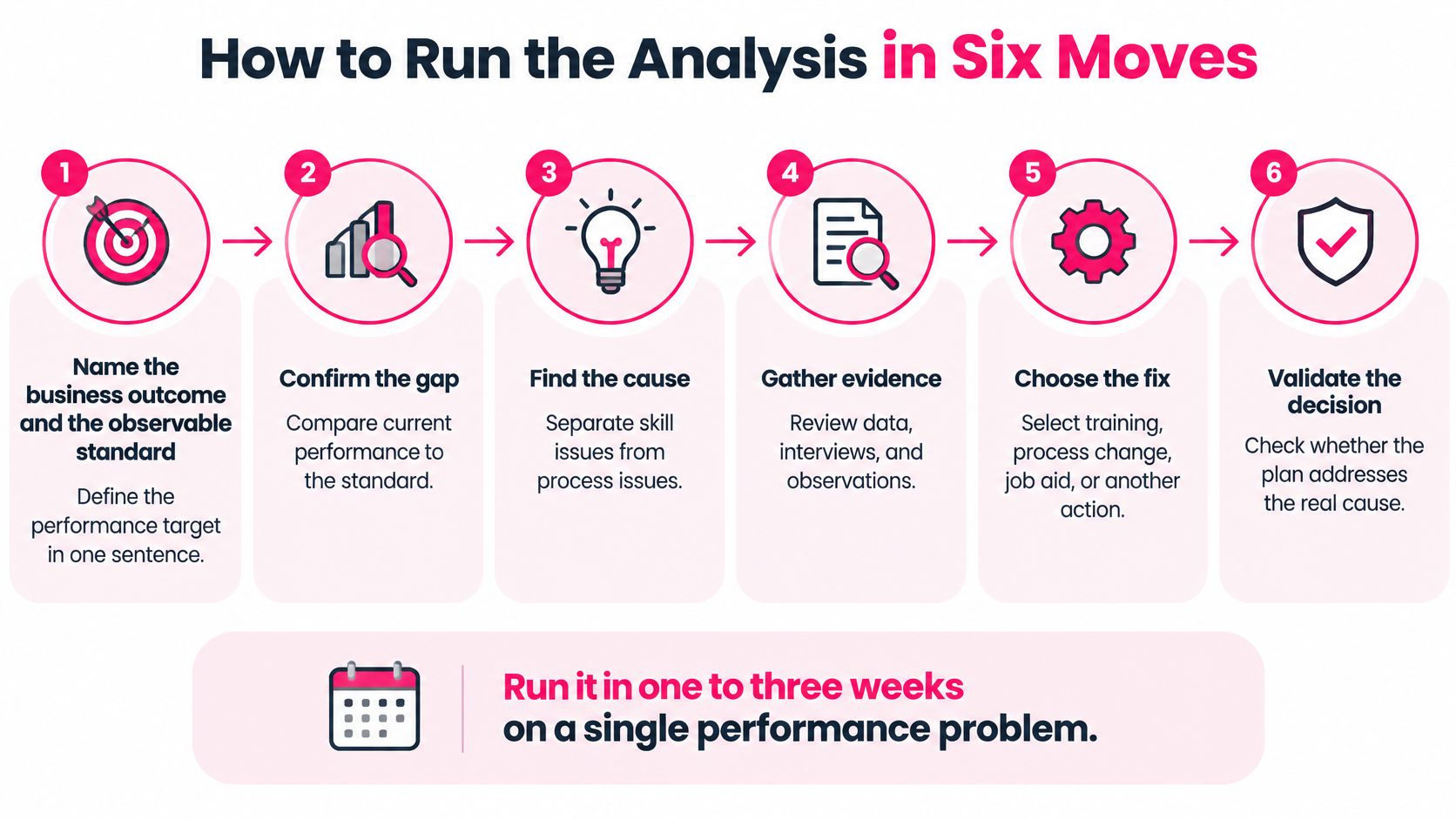
Use this sequence for one performance problem. McGehee and Thayer's Organization–Task–Person model, established in 1961, connects business needs, job requirements, and workforce capability. The U.S. Government Accountability Office's description of the model frames person analysis as comparing the knowledge, skills, and abilities a job requires with what employees currently possess.
1. Name the outcome and standard. Write one sentence that states what should improve and what acceptable performance looks like. For example: “The compliance team closes each exception within one business day, with no critical documentation errors.” That sentence gives the analysis a target; “improve compliance” doesn't.
2. Confirm the business connection. Identify the goal, risk, customer promise, or site priority affected by the gap, and name the decision maker who must approve the response. If late exceptions threaten a customer commitment, note who owns that commitment and which operating metric reflects the delay.
3. Define the work. List the duties and required knowledge, skills, and abilities using the job description, SOP, and input from a strong performer. For an exception, the tasks might include checking the supporting records, applying the correct rule, entering a disposition, and documenting the rationale. Don't use an existing course catalogue as your task inventory.
4. Measure current performance by group. Compare the standard with actual results, then segment by role, site, tenure, and proficiency. A company-wide average can conceal a location where new hires repeatedly make the same critical error.
5. Diagnose the cause. Send each observed gap through the decision map. If employees can't select the correct disposition when the records and system are available, a lesson may help. If a queue backlog leaves them no time to complete the documentation, examine workload and process design instead.
6. Prioritize and define the behavior. Keep only gaps that instruction can reasonably address. For each one, write an objective that states the behavior, the conditions, and the performance criterion. “Given a live exception and the current SOP, the analyst applies the correct disposition and records the rationale with no critical errors” is testable; “understand compliance” isn't.
Run the analysis as a focused project, and file a one-page brief with the outcome, population, evidence, likely cause, and train-or-not decision. Don't open a production tool until that brief exists. If the finding supports a lesson, the objective should be specific enough to guide both instruction and assessment.
A short overview of this decision-led workflow can help teams align on the sequence:
Collect Evidence Across Roles and Methods
One manager's opinion can identify a concern, but it can't establish its cause. A confidence survey has the same limitation: employees may feel confident without performing the task correctly, or may feel unsure while following the procedure accurately. Build a small evidence plan for the named population and combine methods that answer different questions.
| Method | Best for | Sample prompt or pull | Main limit | |---|---|---|---| | KPI and error review | Where and how often performance fails | Error rate, time to complete, and first-pass compliance by role and site | Can't explain why | | Short role survey | Spread of confidence and task frequency across a large population | “How often do you complete this task without help?” Never to always | Self-report bias | | Structured interview | Causes and workarounds | “Walk me through the last time this failed.” | Slow to scale | | Task observation | Whether the critical steps happen | Use a five-step checklist on a live or simulated task | Observer effect | | Scenario or knowledge test | Skill versus confidence | Score a realistic case against a pass mark set in advance | Needs a valid item set | | Compliance or customer data | External risk and recurring complaints | Pull audit findings or ticket themes tied to a behavior | May lag the current process |
Start with the performance records. Pull errors, time to completion, or first-pass compliance by role and site; then ask a short survey question to estimate how widely the issue may occur. In interviews, ask performers, supervisors, and a subject-matter expert, “Walk me through the last time this failed.” That prompt tends to surface the actual steps, workarounds, and barriers rather than a general opinion about training.
Observe a representative task against a checklist of the required steps. If the numbers show a high error rate but people can complete the task correctly under observation, investigate whether the live system, queue pressure, or incentives differ from the observed conditions. Add a realistic scenario test when self-reported confidence and performance records disagree. For externally visible risks, review audit findings and customer-contact themes alongside internal measures.
Sample frontline employees as well as managers, and include relevant sites, tenure groups, and proficiency levels. A 2021 systematic review of 33 studies using the Hennessy-Hicks Training Needs Analysis questionnaire across 18 countries identified individual, team or unit, and organizational needs as recurring levels of analysis. It also found that 23 studies, or 69.7%, adapted the questionnaire, while 4 studies, or 12.1%, used the original English version. For global programs, adapt wording to local language, job context, and performance standards while keeping the underlying question intact.
Write a one-page method plan naming the population, evidence source, owner, and question each method will answer. A clear record of course completion can be useful for administration, but it doesn't show whether people can do the work; this guide to certificate issuance advice from CertSeal offers context on the distinction between documenting completion and assessing capability.
Score Gaps and Write Performance Objectives
Score only gaps that have survived the cause check. A scoring system helps a team compare confirmed skill gaps consistently, but it shouldn't turn an unsupported concern into a training priority. First segment the findings by role and location; then rate each gap from 1 to 5 on business impact, risk, frequency, population affected, urgency, feasibility, and cost versus benefit.
| Criterion | 1 means | 5 means | Refund-policy example | |---|---|---|---:| | Business impact | Nice-to-have quality | Direct hit on revenue, safety, or compliance | 5 | | Risk if ignored | Low and reversible | Regulatory, safety, or customer-loss exposure | 5 | | Frequency | Rare task | Daily or weekly task | 4 | | Population affected | A handful of people | A whole role or region | 3 | | Urgency | Can wait a quarter | Needed this month | 4 | | Feasibility | No access to learners or experts | Audience, SME, and content source are available | 4 | | Cost versus benefit | Expensive relative to the gain | A short lesson beats the error cost | 4 |
Here, the confirmed gap scores 29 out of 35: 5 + 5 + 4 + 3 + 4 + 4 + 4. Use 24 out of 35 or higher as a practical cutoff for the ranked backlog, with an override for critical safety or regulatory behavior. The cutoff is a management rule, not proof that a course will work. Teams should still document why each score fits the evidence.
Once a gap qualifies, write an objective with a specific behavior, conditions, and criterion. For example: “Given a live refund request and the current policy, the agent applies the correct path and documents the case with zero critical errors.” Then name the assessment and the operational measure that would indicate progress: scenario accuracy, time to completion, first-pass compliance, or manager-observed behavior. Video views and satisfaction ratings don't demonstrate job performance.
The work environment also matters. The meta-analysis of 32 studies involving 5,487 participants found that peer support strongly predicted motivation to transfer learning, while feedback and coaching most strongly predicted actual transfer. That's why each priority should carry a transfer note: who will brief the learner, where practice will happen, what feedback the manager will provide, and whether employees have the time, tools, and incentives to use the skill. The same source reports that a 2025 organizational training survey identified resistance to change as the leading barrier to addressing skills shortages, cited by 27% of employers and 25% of employees.
For teams mapping capability across roles before ranking individual gaps, MyCulture.ai's team skill-gap assessment resource can help structure the inventory. For turning a confirmed need into a measurable objective, use this guide to write learning objectives.
Pitfalls That Invalidate the Analysis
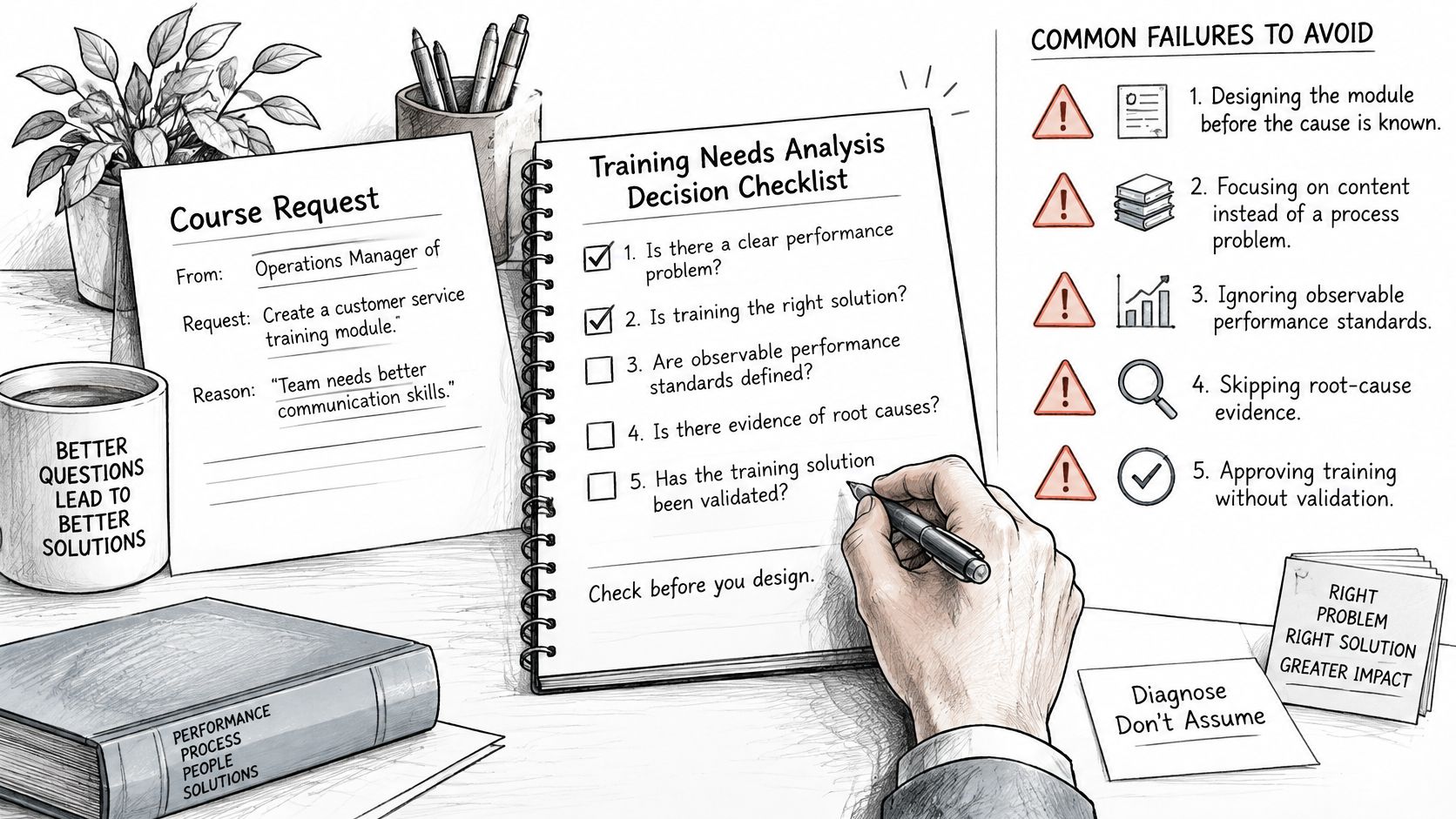
The most expensive mistake is designing a module before diagnosing the cause. Once a team has written a script, booked a vendor, or announced a course, it becomes harder to recommend a process fix instead. Correct it by checking the outcome, workflow, and evidence before anyone drafts content.
Use these checks before approving a training plan:
- Don't treat confidence as skill. Pair self-report with an observed task or realistic scenario; compare what employees say they can do with what they demonstrate.
- Don't sample only willing managers. Include frontline performers, sites, and relevant job groups. A survey-only convenience sample may miss the people who encounter the failure most often.
- Don't set the success metric after launch. Establish the baseline and select a post-training behavior measure and business indicator during the analysis.
- Don't blame low completion without checking the conditions. Confirm that managers made time for practice and that employees had access to the tools and opportunity to apply the skill.
- Don't smooth over conflicting evidence. If an interview says the task is clear but error records show repeat mistakes, observe the task or inspect the record before deciding what it means.
The CDC's guidance on conducting a training needs analysis advises teams to define the gap before discussing solutions, identify decision makers, involve diverse learner representatives, review existing evidence, and then choose suitable methods. Put evaluation in the same plan. Where feasible, use a pre-test and post-test, and consider a retrospective pre-test when learners may not have understood the performance standard beforehand. Recheck retention and workplace behavior at spaced intervals instead of treating course completion as the result.
> If you can't name the behavior and the business number, you don't have a training need yet.
A practical analysis should leave no unanswered question about what will be measured, who owns the follow-up, or what would cause the team to revise its recommendation. If implementation effort, success conditions, or evaluation plans remain unresolved, the analysis isn't ready to support production.
Publish Only the Gaps You Can Prove
A ranked backlog is not a production order. Start with the strongest one or two objectives, then match the format to the behavior. A single policy decision with a right-or-wrong answer may fit a short video followed by a knowledge check. A conversation skill needs a realistic scenario and manager observation, not a lecture that describes good communication. A broken workflow still needs a workflow fix, not a video explaining how to tolerate it.
Use the existing SOP, policy page, or approved slide deck as the source. Give each lesson one clear learning objective, then structure the script around the work: context, demonstration, practice prompt, and check. Standardizing that structure makes review easier and helps subject-matter experts focus on accuracy rather than presentation choices.
Choose a template that fits the audience and objective, such as onboarding, compliance, sales enablement, or customer education. Publish through the LMS so completion and knowledge-check results can be tracked, but compare those results with the baseline measure from the analysis. If the target behavior is correct refund routing, check routing accuracy; completion alone can't show whether agents now choose the right path.
On Monday, take four concrete actions:
- Lock the objective. Write the behavior, conditions, and performance criterion in one sentence.
- Pull the baseline. Record the current business or behavior measure and name its data owner.
- Draft from approved material. Reuse the policy, SOP, or existing training content instead of starting from a blank page.
- Schedule the transfer support. Put the manager pre-brief, workplace practice, and post-training discussion on the calendar.
Measure both completion and the target behavior, then review the evidence on a regular cycle and revise the lesson when results point to a remaining skill gap. For a fuller view of how to connect learning measures to workplace results, see how to measure training effectiveness. VideoLearningAI's workflow can help turn an already-proven objective and existing course materials into a short training video, with LMS publishing support; keep the business measure, not the video, at the center of the decision.
---
If your TNA has confirmed a skill gap and produced a measurable objective, VideoLearningAI can help turn existing materials into a polished, bite-sized training video without requiring video-editing skills. Choose a template for onboarding, compliance, sales enablement, or customer education, publish through your LMS, and use your baseline measure to judge whether the lesson supports the intended behavior.