A 100% completion rate doesn't prove that your organization is compliant. It proves that employees were assigned something, opened it, and generated a record. An auditor, regulator, or investigator may need much more: evidence that the right people received role-specific instruction, understood the decisions involved, remained competent, and applied the requirements in daily work.
That distinction changes how L&D teams should approach compliance training requirements in 2026. The mature program isn't a calendar of annual courses. It's an operational workflow connecting regulatory obligations to assignments, assessments, expiry controls, supervision, behavioral evidence, and an audit-ready record.
Table of Contents
- What regulators actually need to see - Replace the completion mindset - A sector comparison - Map the trigger, not just the topic - Build the course from the risk outward - Configure the record as a control - A controlled production workflow - Where automation helps and where it doesn't - What the evidence file should contain - Walk the audit before the auditor doesRethinking the Compliance Completion Myth
Completion is useful, but it's only the first layer of proof. A learner can finish a video without understanding how to handle a suspicious transaction, report a hazard, protect confidential information, or escalate a conflict. Treating the click as the outcome creates a comfortable dashboard while leaving the underlying risk largely untested.
Recent evidence illustrates the measurement problem. 13% of organizations don't measure training effectiveness at all, only 44% use comprehension testing, and just 37% track misconduct trends after training (LRN's 2025 Global Study on E&C Program Maturity.pdf)). Those figures point to a program that records activity more readily than it demonstrates changed decisions.
> Practical rule: Completion tells you who passed through the training process. It doesn't, by itself, tell you whether the process reduced a specific risk.
What regulators actually need to see
The operational meaning of compliance training differs by sector, but several expectations recur:
- Role relevance: The assignment should match the employee's duties, authority, location, and exposure to risk.
- Competence evidence: The organization should test understanding or observe performance where the regulation requires more than attendance.
- Continuity: Training needs to be reviewed when responsibilities change and renewed when a qualification or policy expires.
- Traceability: Records should connect the employee, course version, assignment reason, completion date, result, and any remediation.
- Supervision: Managers and qualified reviewers may need to confirm that the employee can perform the regulated activity safely or competently.
Language access is part of this design. If employees work across languages, poor translation can turn an apparently complete course into an ineffective control. Teams evaluating how to translate safety training should consider terminology, local context, captions, assessment wording, and whether the translated version preserves the decisions learners must make.
Replace the completion mindset
A more defensible question is not “Did everyone finish?” It's “Can we show that the correct employees received the correct instruction, demonstrated understanding, and had their competence managed over time?”
That means separating administrative evidence from behavioral evidence. Administrative evidence includes enrolment, attendance, scores, and renewal dates. Behavioral evidence can include scenario decisions, manager observations, policy-search patterns, escalation records, or documented application of a procedure. None of these should be presented as automatic proof that training caused a change. Together, however, they create a more credible connection between the training intervention and the risk it addresses.
Core Regulatory Mandates Across Industries
Compliance training has no universal syllabus. The requirement follows the activity being performed, the employee's role, the hazard or regulated risk, and the jurisdiction governing the work. A financial-services firm may need to demonstrate continuing competence and retain records for years. A construction employer may need instruction linked to specific hazards, worker activities, and refresher intervals.
In the United Kingdom, the Financial Conduct Authority's Training and Competence regime requires firms carrying out regulated activities to ensure employees have the skills, knowledge, and expertise required for their roles. Firms should assess training needs when an employee starts a role and at regular intervals, including when responsibilities change. For activities covered by the FCA qualification framework, employees generally need an appropriate qualification within 48 months of starting the regulated activity. Firms must also retain auditable records covering recruitment, training, competence assessments, supervision, and qualifications. The retention period is at least 5 years after an employee stops performing a MiFID-related activity, at least 3 years for non-MiFID activities, and indefinite for pension-transfer specialists (FCA Training and Competence requirements). Qualification, supervision, and retention therefore belong in one controlled lifecycle, not separate course settings.
A sector comparison
| Industry sector | Primary regulator | Key training mandate | Record retention | |---|---|---|---| | Regulated financial services in the UK | Financial Conduct Authority | Role-based qualification, continuing competence assessment, periodic training review, and supervision | At least 5 years after stopping a MiFID-related activity, at least 3 years for non-MiFID activities, and indefinitely for pension-transfer specialists | | U.S. construction and other OSHA-covered work | Federal OSHA | Hazard-specific instruction, including fall protection and training requirements tied to worker activities | Varies by applicable OSHA provision and training type | | High-risk occupational programs | Federal OSHA | Defined refresher or competency intervals for applicable activities, such as hazardous-waste work and specified first-aid training | Varies by applicable provision, with deadlines tied to the record type |
Federal OSHA's 2024 enforcement figures show why training records require the same operational discipline as physical safety controls. The agency conducted 34,696 inspections in fiscal year 2024. Standard 29 CFR 1926.503, covering training related to fall protection, ranked seventh among OSHA's ten most-cited standards, with 2,050 violations (OSHA's 2024 top safety violations reporting).
Map the trigger, not just the topic
For each requirement, document what activates it. Common triggers include hiring into a regulated role, taking on a new responsibility, operating equipment, entering a hazardous environment, or reaching the end of a qualification interval. Assign an owner and due date, then define the assessment method, renewal rule, escalation path, and retention period. An LMS can automate these assignments, but only if the underlying trigger logic is specific.
Annual training may suit one risk and fail to meet another requirement. OSHA materials identify different cadences, including annual refresher training for certain hazardous-waste personnel, specified first-aid training recurring at least every three years, and CPR training recurring annually (OSHA Training Requirements in OSHA Standards). Store the requirement attached to each assignment, rather than applying one blanket renewal setting across every course. Pair completion data with scenario results, practical checks, or manager confirmation where the work demands evidence of behavior, not just attendance.
Designing Legally Defensible Training Programs
A defensible course starts with a defensible requirement map. Before writing a script or selecting a template, identify the regulation, internal policy, job hazard, or control that justifies the assignment. Then convert that obligation into observable learning objectives.
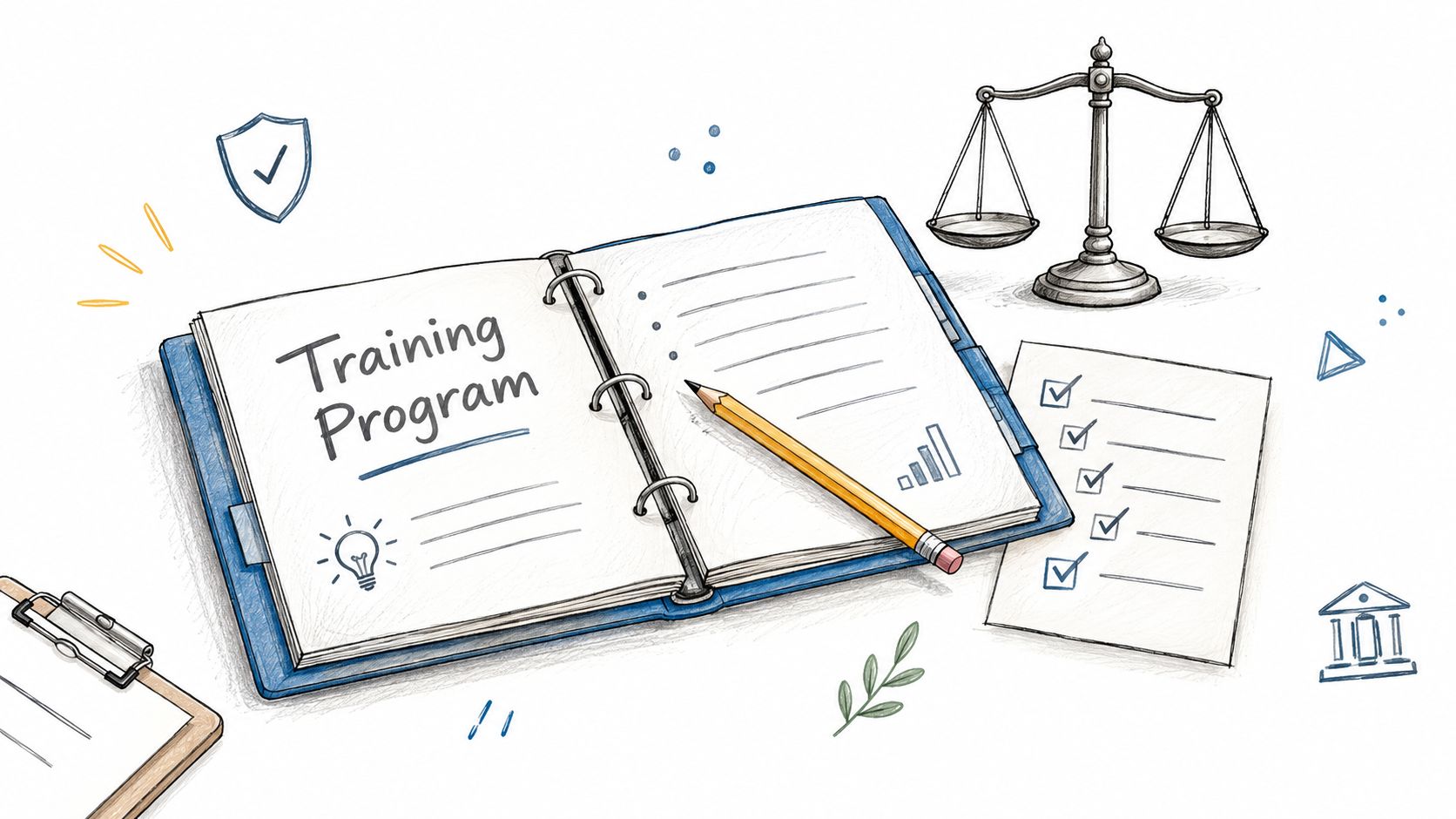
!An open notebook titled Training Program with a pencil, legal scales, and a checklist on a desk.
A useful objective describes what the employee must do, not what the course will discuss. “Understand data security” is difficult to test. “Identify the approved escalation route after receiving a suspected phishing message” gives the designer something concrete to teach and the LMS something meaningful to assess.
Build the course from the risk outward
Use this sequence:
1. Identify the decision: What action must the employee take, avoid, document, or escalate? 2. Identify the audience: Which roles perform the activity, supervise it, or encounter the risk? 3. Define the evidence: Will a knowledge check, scenario response, practical demonstration, manager observation, or qualification record prove competence? 4. Create the content: Use the minimum policy and regulatory material needed to support the decision. 5. Set the control: Define assignment timing, pass criteria, retakes, renewal, and escalation. 6. Archive the version: Preserve the content and objectives that applied when the learner completed it.
Microlearning works well when it follows the structure of the job. A short lesson can explain one rule, show one realistic choice, and ask the employee to select the appropriate response. Several targeted lessons can be easier to maintain than one large annual module, especially when a policy changes in only one area.
A bespoke build may be appropriate where generic content doesn't reflect your procedures, terminology, or approval routes. Teams comparing production approaches can use Loresson's guide to bespoke courses as a reference point when deciding what should be custom-built and what can be sourced or adapted.
Revised Paragraph: A scenario should also expose the wrong decision. If every answer is obvious, the score says little about judgment. Use plausible alternatives, explain the consequence of each response, and route failed attempts into remediation rather than just recording a low mark.
Compliance software should support this design rather than flatten it into a completion report. Review compliance training software for the administrative capabilities your existing LMS may need, including assignments, assessments, renewal logic, and reporting.
A short video can introduce the decision, but it shouldn't carry the entire proof burden. Pair it with a knowledge check, a scenario, a policy reference, and a record of the learner's attempt. That combination gives employees a practical learning experience and gives auditors a clearer explanation of how the program addresses the stated risk.
Tracking Expirations and Behavioral Evidence
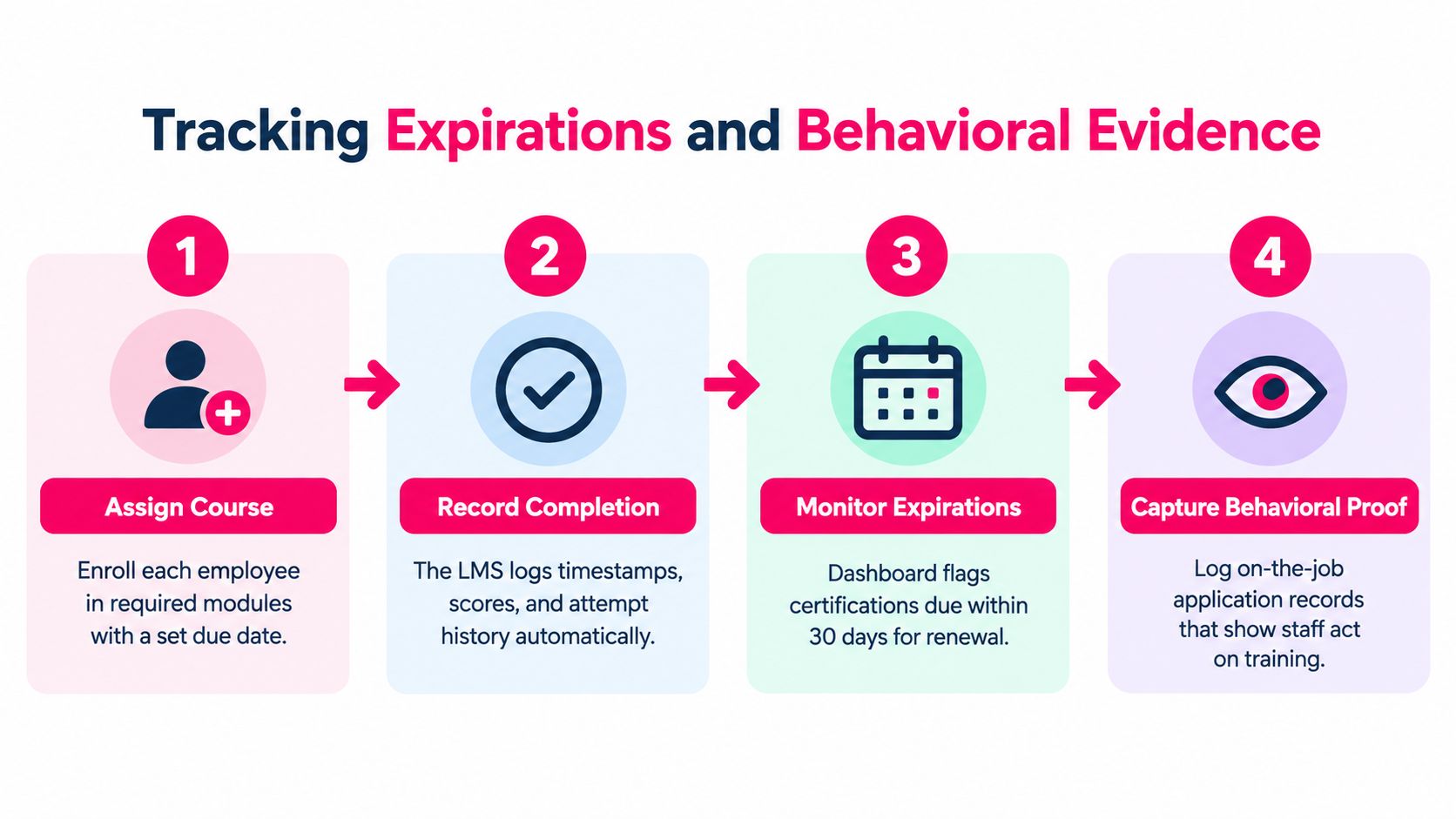
An LMS that shows only “completed” cannot establish whether a qualification is still valid. A defensible record connects the employee, assignment, requirement, completion event, expiry rule, and next operational action.
Renewal logic should reflect the rule that governs the work. A qualification may expire under a licensing requirement, an internal policy, or a role-specific authorization, even when the original course remains available. For example, an organization can set an internal policy expiry for a procedure that changes regularly, requiring employees to review the current version before they continue the activity. The LMS should calculate remaining validity, flag upcoming expirations, and identify the people responsible for resolving the gap.
Configure the record as a control
Each assignment should capture:
- Requirement identity: The regulation, policy, hazard, or role rule behind the course.
- Employee and role: The person, job, location, and activity covered.
- Validity logic: The completion date, renewal interval, expiry date, and escalation status.
- Assessment evidence: Score, attempt history, competency result, and remediation record.
- Provider details: Instructor, reviewer, external provider, or qualification authority where relevant.
- Content version: The course version and learning objectives in force at completion.
- Retention deadline: The date when the record may be archived or must continue to be preserved.
Automated alerts should reach the learner, manager, compliance owner, and HR administrator according to their responsibilities. A manager may need to remove an expired authorization from a work schedule, while a compliance owner needs a role-level view of unresolved gaps. If policy requires work to stop after expiry, the workflow must escalate to the operational owner and record the resulting action, not leave the issue as a notification.
Completion remains useful, but it is only one part of the evidence. Behavioral indicators can include performance in decision scenarios, willingness to report an issue, manager observations, and searches for relevant policies. Outcome indicators can include repeat violations, audit findings, hotline activity, and security incidents. Interpret these measures together. More reports after training may show that employees recognize problems and trust the reporting route.
> A quieter reporting channel does not automatically prove safer behavior. Employees may report less because they miss the issue, distrust the process, or face fewer concerns. Review decision quality and escalation access alongside incident trends.
The compliance documentation workflow should make records and behavioral evidence easy to retrieve while limiting unnecessary personal information. Store what the business and regulator require, restrict access by role, and document how observations are collected, reviewed, and linked to remediation. This turns microlearning, automated renewal tracking, and workplace evidence into an auditable workflow rather than a completion count.
Operationalizing Workflows with AI and Templates
Content production becomes a bottleneck when every regulatory update starts with a blank document. A scalable workflow begins with an approved source, a defined audience, and a repeatable lesson structure. AI can help draft the presentation layer, but legal, compliance, and subject-matter owners still need to approve the substance.
!Screenshot from https://www.videolearningai.com
Start by separating content authority from content production. The authoritative source may be a regulation, approved policy, safety procedure, or legal interpretation. The production workflow turns that material into a script, narration, visuals, captions, knowledge checks, and metadata. Never allow speed of production to obscure who approved the final learning objective or wording.
A controlled production workflow
First, create a requirement brief. Record the audience, risk, required behavior, jurisdiction, effective date, review owner, and renewal rule. This brief becomes the control document for the lesson.
Next, use a template deliberately. A compliance refresher might use a consistent sequence: why the rule matters, what changed, what the employee must do, a short scenario, and a confirmation question. Consistency helps employees recognize the format, while the scenario keeps the lesson connected to actual work.
Then, generate a draft and review it. VideoLearningAI can convert approved compliance material into structured, bite-sized training videos with scripts and visuals. Treat the generated output as a production draft, not legal advice. A subject-matter expert should verify terminology, examples, escalation routes, captions, translations, and references before publication.
Finally, publish with tracking metadata. Attach the course to the correct role or cohort, set the due date and validity period, define the pass rule, and package it for the organization's LMS using the required SCORM or xAPI workflow. The lesson isn't operational until the LMS can assign it, record the result, trigger renewal, and produce an audit trail.
Where automation helps and where it doesn't
Automation is useful for repeatable formatting, visual consistency, captions, localization workflows, and rapid adaptation of approved material. It can also help create variants for different employee groups without forcing every learner through irrelevant detail.
It shouldn't decide whether a regulation applies to a job, interpret an ambiguous legal requirement, or invent a procedure. Those decisions belong to accountable people. Keep the approval record with the published version so you can show who reviewed the material and when.
Templates also need governance. If a policy changes, identify every lesson, quiz, translation, and learner group that depends on it. Retire the outdated version, publish the approved replacement, and preserve the historical course record for people who completed the earlier requirement.
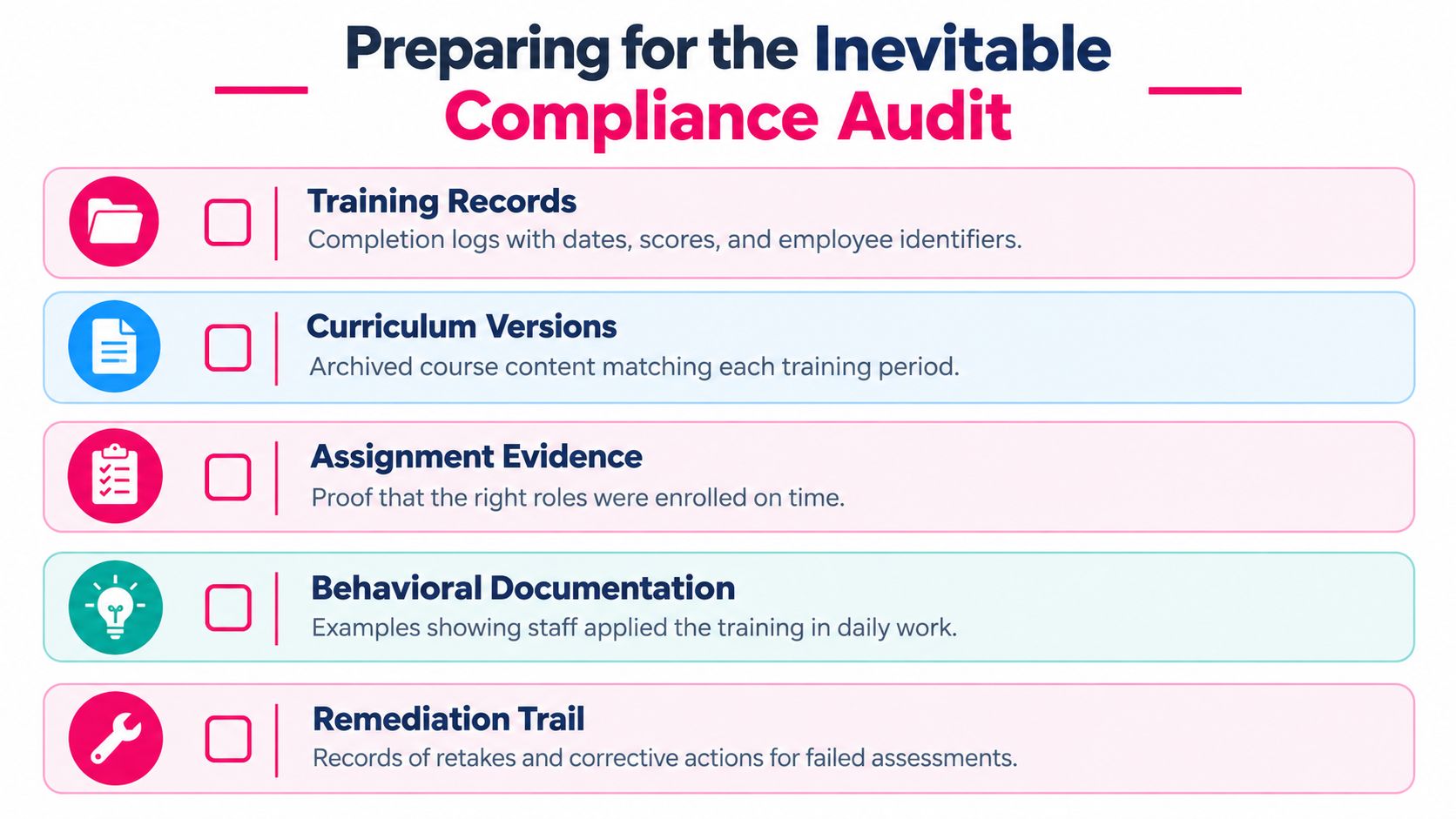
Preparing for the Inevitable Compliance Audit
A compliance audit does not start with a completion percentage. It starts with the control behind that number. Auditors want to know which employees were in scope, why they were assigned the training, what the course required, how competence was tested, and what happened after a failure or expiry.
Use a sample employee to test the full record. An auditor may trace a controlled activity from recruitment and role assignment through initial training, qualification evidence, assessment results, supervision, and renewal. A spreadsheet marked “complete” proves little if it omits the course version, due date, result, and reason for assignment. The record should connect learning to the work the employee was permitted to perform.
What the evidence file should contain
Build an evidence pack that answers those questions without manual reconstruction:
- Training records: Completion dates, scores, attempts, employee identifiers, and the relevant assignment.
- Curriculum versions: Archived content, objectives, assessments, and approval history for each training period.
- Assignment evidence: Proof that the correct roles were enrolled when the trigger occurred.
- Competence evidence: Qualification records, scenario results, demonstrations, observations, and remediation.
- Supervision records: Reviews or attestations showing how managers monitored the activity.
- Expiry controls: Renewal alerts, escalations, blocks, and resolution records.
- Change history: The policy or regulation update, the course revision, and the date the new version took effect.
Retention should follow the applicable obligation, not the default settings of the LMS. The FCA Training and Competence requirements illustrate why records must remain retrievable across recruitment, training, competence assessment, and qualification history. Store the requirement, the retention decision, and the owner responsible for reviewing it.
Microlearning can support this workflow when each short lesson carries clear objectives, assessment rules, version data, and role metadata. Automated LMS tracking then records completion, results, renewals, and exceptions. The design goal is not more course completions. It is evidence that training changed what an employee could do and that the organization acted when the control identified a gap.
Walk the audit before the auditor does
Select an employee and run the process from beginning to end. Can an administrator identify the triggering role change? Can the system show the exact course version? Can a manager explain what followed a failed assessment? Can compliance retrieve the evidence without asking several teams to search their inboxes?
If the answer is no, fix the workflow instead of polishing the dashboard. Build the audit trail requirements into assignment, assessment, renewal, remediation, and archival processes.
A strong audit response is calm because it is routine. The organization can show why training was assigned, what employees had to demonstrate, how competence was maintained, and how the business responded when a control detected a gap.
VideoLearningAI helps L&D teams turn approved compliance material into structured, bite-sized training videos and prepare them for LMS distribution and tracking workflows. Visit VideoLearningAI to support a repeatable production process connected to auditable compliance operations.