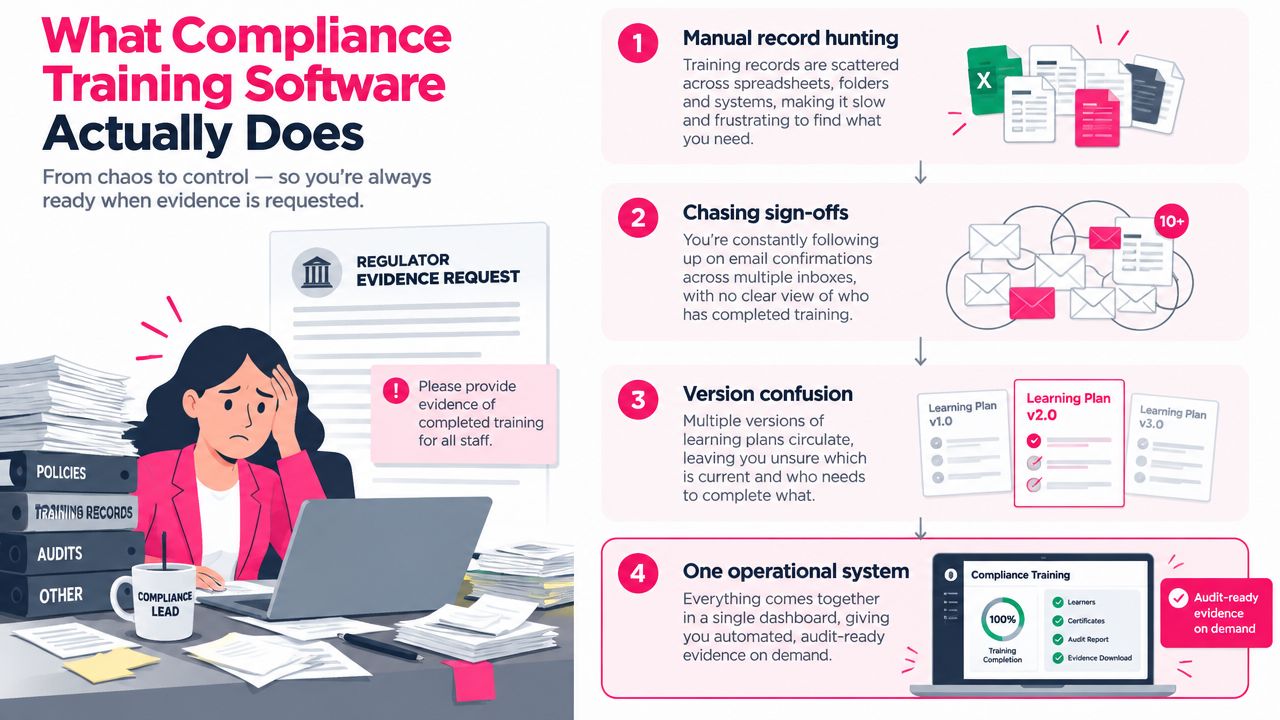
A regulator has asked for evidence that everyone completed the right training, and your compliance lead is searching through spreadsheets, email confirmations, shared folders, and an outdated learning plan. One employee changed roles during the training cycle. A contractor was missed. Several certificates have no clear version history. The question isn't whether training happened. It's whether your organization can prove exactly who received which content, when they completed it, and what they acknowledged.
That pressure explains why compliance training software has become an operational priority rather than a small feature inside an HR platform. The market is expanding alongside the broader enterprise training category. One projection places the global compliance training software market at USD 8.23 billion in 2025, USD 9.10 billion in 2026, and USD 15.75 billion by 2031, implying an 11.60% CAGR from 2026 to 2031 (Research and Markets market overview). The practical issue for buyers, however, isn't market size. It's whether a platform keeps content current before it produces clean completion records.
Table of Contents
- From training task to documented control - Configuration determines coverage - Delivery determines participation - Measurement determines whether completion means anything - Evidence determines audit readiness- Why Digital Compliance Training Has Become the Default
- Standards, Records, and Audit Defensibility Explained
What Compliance Training Software Actually Does
The compliance lead in the opening situation doesn't need another place to upload a PDF. They need one system to connect the obligation, the learner, the content version, the assessment, and the evidence. A capable platform turns a regulatory requirement into a managed workflow rather than leaving each department to interpret and document it independently.
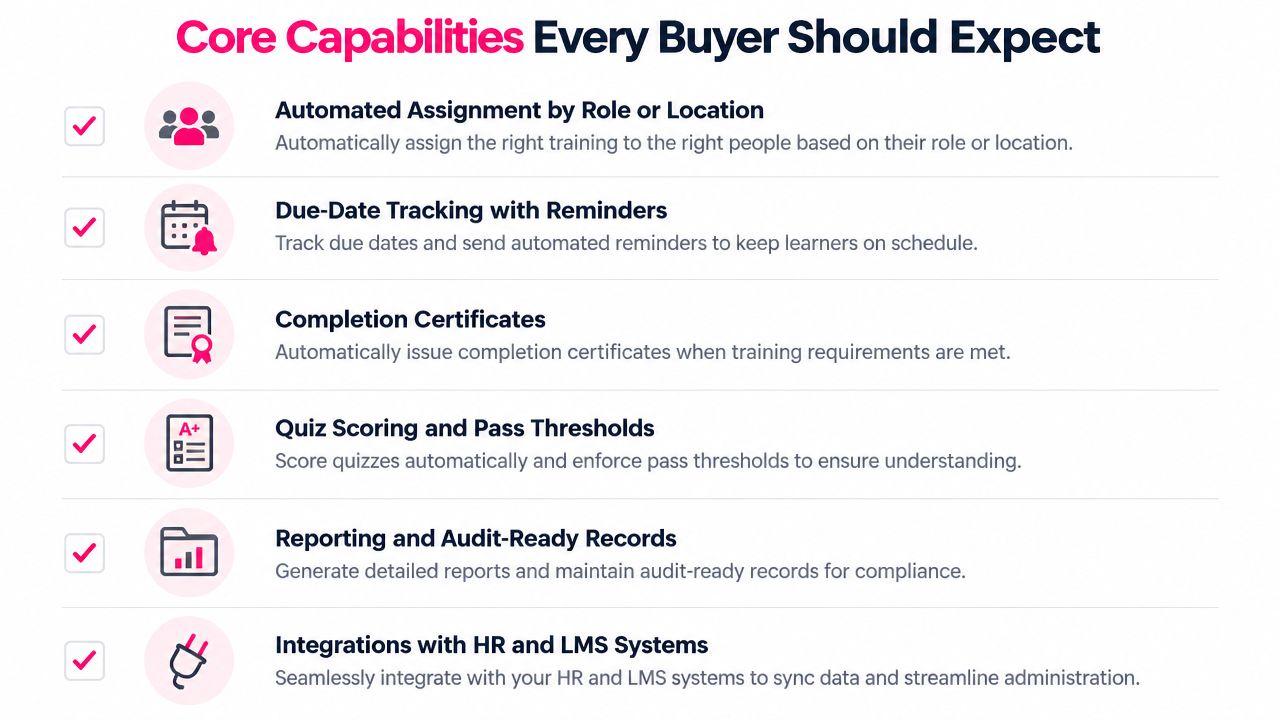
At its simplest, compliance training software assigns mandatory learning, delivers it, monitors progress, manages renewals, and preserves evidence. It can use role, location, department, employment status, or certification requirements to determine who needs a course. It can then set deadlines, send reminders, flag overdue learners, record assessment results, and create reports for managers or auditors.
From training task to documented control
A general LMS may host courses effectively. A compliance-focused system adds the accountability layer around them. It should preserve assignment logic, completion timestamps, certificates, policy acknowledgments, quiz evidence, and content-version history in a form that an authorized user can export without reconstructing the story manually.
That distinction matters during an audit. A spreadsheet may show a name and a completion date, but it often won't explain why that person received the course, which version they saw, whether they passed the assessment, or whether their obligation changed after a transfer. Software designed around compliance treats each of those details as part of the record.
> Practical rule: Buy the platform that can answer an auditor's question without asking three teams to search their inboxes first.
The system also supports the wider learning operation. Teams that need to manage courses and certifications can use a training management perspective to connect course administration, certification status, and workforce records. For a plain-language explanation of the learning itself, what compliance training means provides useful context.
The strongest platforms don't merely report that people clicked through a module. They help compliance leaders see gaps before an inspection, identify stale content, trigger recertification, and demonstrate that training functions as a documented control. That shift reduces frantic record hunting, but only when the underlying content and assignment rules are maintained with the same care as the reports.
Core Capabilities Every Buyer Should Expect
Start with four questions: who gets what, how does it reach them, how do you measure learning, and what evidence survives an audit? Those questions are more useful than a long vendor checklist because they expose whether a feature works in the situations your organization faces.
Configuration determines coverage
Assignment rules should work like a postal sorting system. The employee's role and location determine which destination the training goes to, while changes in the employee record redirect future assignments. Test a role transfer, a manager change, a new site, and a contractor who needs access without becoming a permanent employee in the HR system.
The platform should also support recurring requirements. A certificate that expires needs a renewal workflow, not a note in someone's calendar. Automatic re-enrollment, reminders, escalation paths, and manager visibility prevent routine obligations from depending on memory.
Delivery determines participation
Learners need a reliable path to the content. Check browser and mobile access, language handling, accessibility features, offline behavior where relevant, and the friction involved in signing in. A technically complete assignment still fails if a shift worker can't open the course or a multilingual workforce receives instructions they can't understand.
Measurement determines whether completion means anything
A completion flag is useful, but it isn't the whole record. Look for quiz scoring, pass thresholds, retake rules, time spent, acknowledgment capture, and manager or supervisor sign-off where the regulation or internal policy requires it. The platform should distinguish between assigned, started, completed, failed, overdue, exempted, and waived states.
Evidence determines audit readiness
Think of the audit trail as a flight recorder. It should preserve what happened, when it happened, and who performed each action. Reports should be exportable by learner, course, department, location, requirement, and date range, with access controls that prevent unauthorized editing or deletion.
A useful buyer test is to ask the vendor to demonstrate an edge case rather than a polished dashboard. Change an employee's role midway through a cycle, replace a course with a revised version, revoke an exemption, and export the resulting history. Superficial products often look complete until the workflow stops being linear.
For teams working in regulated professional settings, a practical CPD compliance guide can also help clarify how certification, continuing education, and evidence requirements fit together. The software should support that operational reality instead of forcing you to recreate it in spreadsheets.
Why Digital Compliance Training Has Become the Default
Digital delivery fits the way modern organizations operate. Employees work across sites, shifts, countries, and time zones, while compliance teams need to distribute updates without repeatedly booking classrooms or pulling entire departments away from their duties.
The adoption data reflects that change. Mandatory and compliance training represented 12% of training budgets in 2024, while 91% of organizations delivered at least some compliance training online and 48% delivered it entirely online, according to the Gallup compliance and ethics training report. Digital delivery isn't automatically effective, but it gives administrators a practical way to scale assignments, reminders, updates, and records.
The quality problem remains significant. Gallup found that 23% of employees who had taken compliance or ethics training during the prior twelve months rated it as excellent (Gallup's findings). Moving a weak classroom slide deck into an LMS won't solve that problem. Buyers need a platform that supports concise lessons, relevant scenarios, meaningful assessments, and rapid content revision.
| Operational Factor | Classroom Training | Digital Compliance Training Software | |---|---|---| | Scheduling | Requires shared dates, rooms, and facilitator availability | Assignments can reach learners across schedules and locations | | Record keeping | Attendance sheets and sign-off forms need manual consolidation | Completion, scores, acknowledgments, and timestamps sit in one record | | Updates | Revised materials require new sessions or replacement handouts | Approved content can be versioned and reassigned through workflows | | Manager follow-up | Supervisors often rely on attendance lists and email | Dashboards can surface overdue learners and expiring certifications | | Access | Participation depends on being present at a particular place and time | Learners can often use browser or mobile delivery in their workflow |
Classroom instruction still has a role for practical drills, demonstrations, discussions, and situations where an in-person assessment is required. Digital software becomes the baseline for the repeatable parts of the program, especially when the organization must prove coverage across a distributed workforce.
Standards, Records, and Audit Defensibility Explained
Compliance evidence works like a chain of custody. Each link should show who completed the requirement, which material they used, and what happened afterward. Technical standards support that chain, but they do not replace sound content governance. SCORM commonly imports packaged e-learning into an LMS and reports completion, scores, and time spent. xAPI records learning events beyond the LMS, including simulations, workplace assessments, classroom activity, and other blended experiences.
The practical distinction is clear. SCORM confirms that a learner completed a course inside the LMS. xAPI can document a wider sequence of events when the organization has the supporting systems and rules to manage them. The corporate LMS standards overview explains why buyers should check for SCORM 1.2 or 2004 and xAPI support when third-party content or cross-system reporting matters.
| Standard | What It Captures | Best Used For | |---|---|---| | SCORM 1.2 or 2004 | In-LMS completion, score, and time-spent data | Packaged online courses and standard LMS reporting | | xAPI | Learning events across systems, devices, and activities | Blended learning, simulations, field assessments, and richer event records | | cmi5 | A structured way to use xAPI for assigned learning | Modern architectures that need governed assignment and xAPI-based reporting | | Audit log | Administrative and learner actions with time and identity context | Evidence of assignments, changes, approvals, completions, and access |
The record must tell a complete story
A defensible record identifies the learner, requirement, content version, completion time, and assessment result where relevant. It should also capture an acknowledgment or supervisor attestation and show what followed a failure, retake, exemption, transfer, or course revision. A completion mark without this context resembles a receipt without the item description. It proves that an event occurred, but not what the event meant.
Look for tamper-evident and timestamped records, certificate management, automatic recertification, immutable logs, and exportable reports. These functions reduce manual administration and keep inspection evidence available when requested, as described in guidance on audit-ready compliance training records.
Permissions deserve the same scrutiny as reporting. The person who configures assignments should not automatically be able to rewrite historical evidence, while a report viewer should not be able to alter course records. Ask vendors how they separate administrative privileges, preserve version history, retain logs, and support data exports.
For a practical checklist, review the requirements for an audit trail in compliance systems. Standards support defensibility by making learning evidence consistent, attributable, and usable when someone outside the L&D team needs to examine it. Just as important, the system must connect each record to the correct content version, because accurate tracking cannot rescue training that is no longer current.
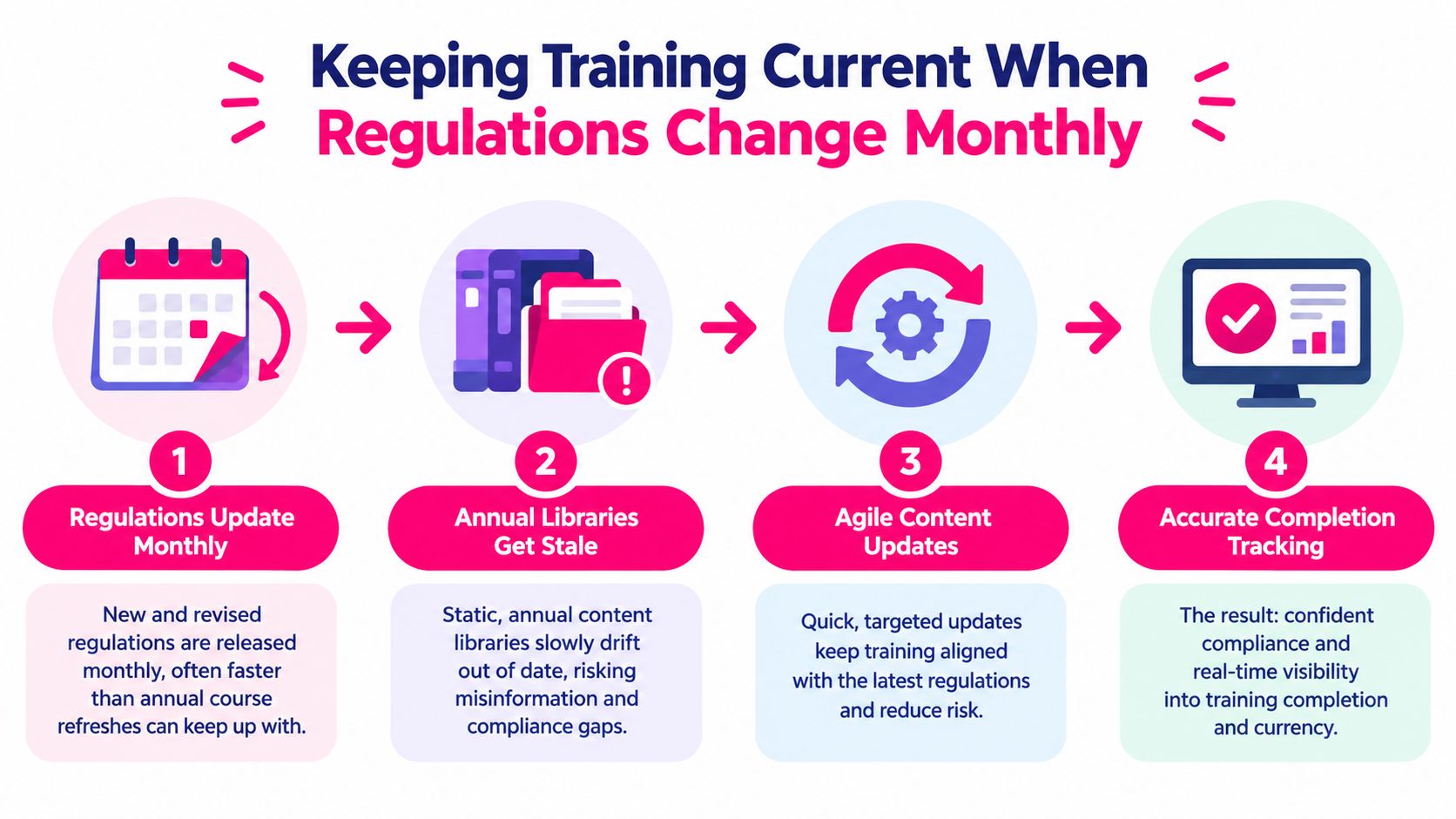
Keeping Training Current When Regulations Change Monthly
A perfect completion report for obsolete content is still a compliance problem. Organizations often build an annual library, assign it broadly, and then struggle when regulators issue new guidance, regional requirements, privacy amendments, cybersecurity expectations, or internal policy changes between scheduled refreshes.
The Mordor Intelligence market analysis reports that 20 U.S. states had broad privacy laws in effect as of January 2026, with 8 taking effect in 2025 alone. That environment makes a static annual course increasingly difficult to defend, particularly when obligations differ by jurisdiction and role.
Build a content engine, not a library
A workable freshness process connects four activities:
1. Monitor approved sources. Legal, privacy, security, and compliance owners identify relevant regulatory changes and decide whether they affect the organization. 2. Translate the change. The team turns dense legal text into a short explanation of what changed, who is affected, and what behavior is expected. 3. Target the lesson. Role, location, business unit, and exposure determine who receives the update. A privacy change shouldn't automatically force every employee through the same full course. 4. Record the response. The LMS assigns the lesson, captures acknowledgment or assessment evidence, and preserves the content version linked to the change.
VideoLearningAI can fit the production step by turning approved compliance material into structured training videos and short, scenario-based lessons for LMS delivery. The tool does not replace legal review. It can reduce the distance between an approved change and a clear lesson that affected employees can easily consume.
The downstream benefits are operational. Faster policy-to-training turnaround reduces the time employees spend working from outdated guidance. Role-based updates reduce unnecessary reassignment. Version control becomes easier to audit, and completion reporting becomes more meaningful because it refers to current content.
A buyer should therefore ask, “How quickly can we update and target a lesson?” before asking, “How many dashboard widgets are included?” Tracking becomes valuable only after the organization has assigned the right, current training to the right people.
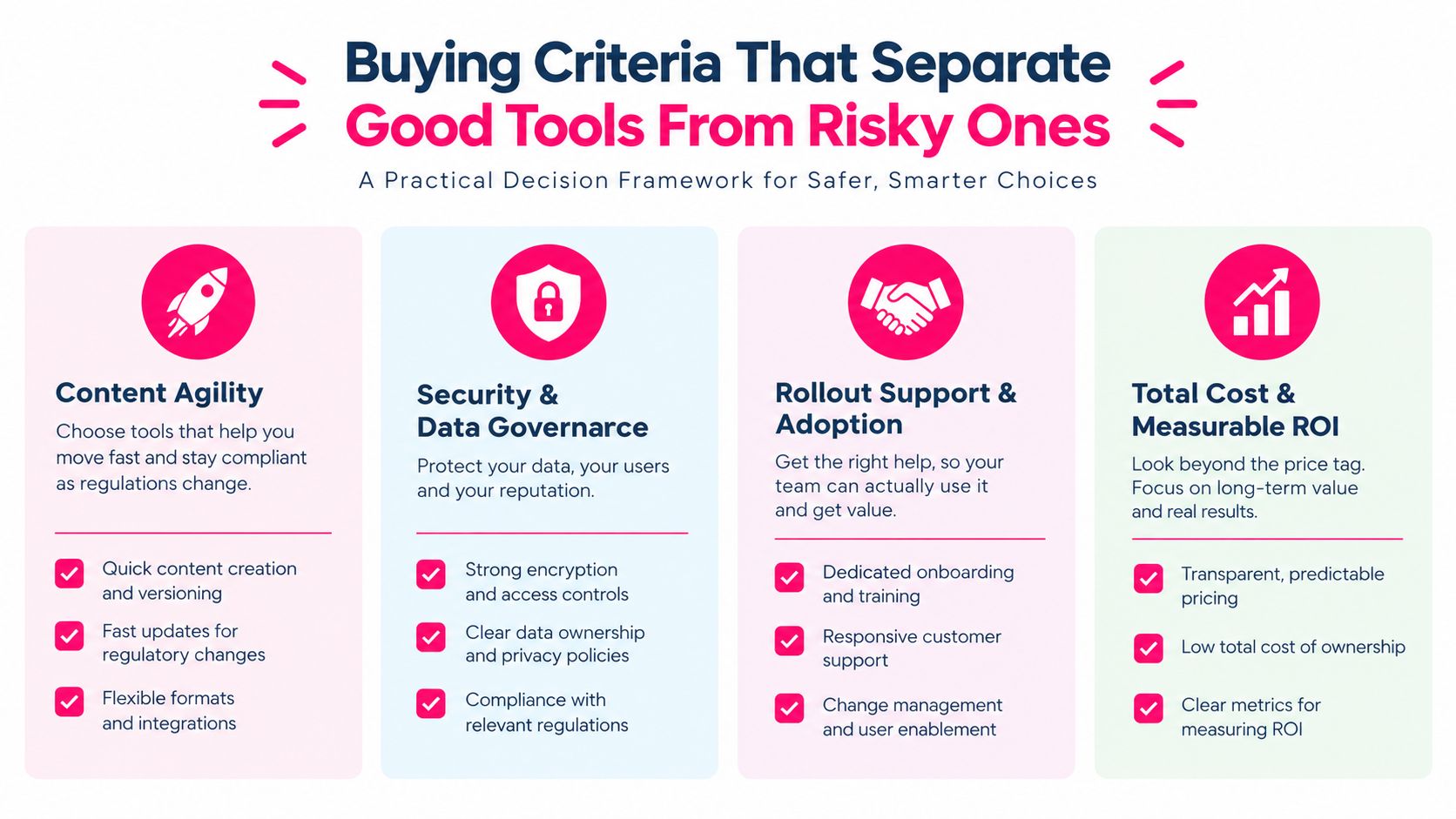
Buying Criteria That Separate Good Tools From Risky Ones
A vendor demo should test your operating model, not display a collection of attractive screens. Evaluate the platform through four lenses: content agility, evidence integrity, learner experience, and vendor viability.
Content agility
Give the vendor a sample policy update and ask them to show the complete workflow. How does an administrator create a revised lesson, mark the prior version, select affected roles, assign the update, and report on the response? Ask for a clear update service commitment if the vendor supplies regulatory content.
Red flags include vague update responsibilities, a content library that requires your team to monitor every change manually, and a roadmap built around infrequent releases. A polished authoring tool isn't enough if governance reviewers can't see what changed and who approved it.
Evidence integrity
Request an export containing learner identity, assignment reason, completion timestamp, assessment result, content version, certificate status, and relevant approvals. Then ask whether ordinary administrators can edit historical records or delete evidence.
Verify role-based access, immutable logs, retention controls, data portability, and integrations with your HR system. For a wider view of LMS decisions, compliance training LMS considerations can help frame the questions before vendor meetings.
Learner experience
Test the course on a mobile device, with assistive technology where applicable, and through the login method your workforce will use. Ask employees in different regions or shifts to complete the same lesson and report where they get stuck.
A system that makes completion unnecessarily difficult creates overdue work and encourages superficial behavior. Check language support, accessibility, offline access, assessment clarity, and whether learners can find their assigned requirements without navigating a crowded catalog.
Vendor viability
Ask references how the vendor handled a regulatory update, a role-mapping problem, an audit request, and an integration failure. Request current security and privacy documentation, including relevant independent attestations such as SOC 2 or ISO 27001 where your procurement policy requires them.
Put these terms in the contract:
- Data portability: You can retrieve learner, course, certificate, and audit data in usable formats.
- Content ownership: Your approved internal materials remain yours, including revised versions.
- Audit log retention: The agreement defines retention, access, and export responsibilities.
- Exit assistance: The vendor provides reasonable help during migration or termination.
If a provider won't demonstrate edge cases before signing, assume implementation will expose them later.
A Realistic 90-Day Implementation Roadmap
A rollout works better when the organization treats it as a control redesign, not a software installation. Use three stages, each with a defined owner and a deliverable that leadership can inspect.
Days 1 to 30 focus on discovery
The executive sponsor confirms policy priorities and decision rights. The compliance lead interviews legal, security, HR, operations, and regional managers, then creates an inventory of requirements, current courses, assignment populations, renewal rules, and evidence gaps.
L&D maps the learner experience and communications plan. IT documents identity, single sign-on, HR data, integrations, and migration constraints. The team should agree on success measures before configuration begins, including completion rate, time to completion, overdue count, audit-pass rate, and the interval between a regulatory change and a current lesson.
Don't migrate every historical spreadsheet without reviewing its quality. Clean duplicate names, unresolved exemptions, missing dates, and conflicting course titles first. A new system won't repair unreliable source data by itself.
Days 31 to 60 establish a controlled pilot
Configure a limited set of courses and assignment rules for one department or clearly defined population. Upload approved content, set reminders, test certificates, verify role mappings, and train administrators before inviting learners.
Capture a baseline of current completion and overdue status, then compare pilot results with the existing process. Ask learners where instructions, login, navigation, or assessments create friction. Ask managers whether the dashboard shows the exceptions they need to act on.
> Avoid the expensive shortcut: Don't customize every workflow in the first week. Prove the standard process, then add exceptions that have a documented regulatory or operational reason.
The compliance lead owns rule accuracy. L&D owns communications and learner support. IT owns identity and integrations, while the executive sponsor resolves policy disputes that the project team can't settle.
Days 61 to 90 expand and refine
After the pilot, fix assignment logic, improve messages, remove duplicate content, and confirm reports with the audit or legal stakeholder who will rely on them. Expand to the remaining population in groups that managers can support.
Use manager briefings rather than sending employees a single launch email. If the program also involves document-heavy approvals or legal workflows, resources covering automation tools for legal teams may help the wider project team identify adjacent manual tasks.
The steering committee should review the agreed measures, unresolved overdue cases, content-staleness interval, support volume, and audit evidence quality. Skipping the pilot, under-communicating with managers, and treating role data as an IT-only problem are common causes of avoidable rework.
Where Compliance Training Software Is Heading Next
The next phase won't be defined by more course catalogs alone. It will be shaped by the relationship between content velocity, role-specific obligations, and learner data governance.
AI-generated micro-content can shorten the path from an approved regulatory change to a usable lesson. That speed creates a new responsibility: legal or compliance specialists must review the source, approve the wording, control the version, and decide whether the lesson requires acknowledgment, assessment, or practical demonstration. Faster production without review only creates faster distribution of errors.
Regulation is also becoming more skills-oriented. AI governance, cybersecurity disclosure, operational resilience, privacy, and sector-specific controls can require different behaviors from engineers, managers, customer-facing teams, and executives. A single company-wide module may be easy to assign, but it can be too broad for some roles and too shallow for others.
Privacy-by-design will become increasingly important in procurement. Learning platforms hold identity data, assessment results, certification histories, acknowledgments, and sometimes behavioral event data. Buyers should ask where those records are stored, who can profile learners, how long logs remain available, and how the provider supports deletion, access, and export obligations.
Use one decision rule when comparing platforms: choose the system that keeps the right content current, assigns it to the right people, and produces trustworthy evidence without manual reconstruction. Current feature parity matters, but roadmap questions matter more. Ask vendors how they will support faster content updates, broader role taxonomies, stronger review controls, and stricter governance of learner data.
VideoLearningAI offers a way to turn approved compliance material into concise training videos and structured microlearning for LMS workflows, including SCORM or xAPI-compatible publishing needs. Visit VideoLearningAI to explore how your team can refresh regulatory lessons more quickly while keeping human approval and completion evidence in the process.