Onboarding is the systematic integration of a new hire into company culture, processes, and role, designed to turn a stranger into a productive employee. Only 12% of U.S. employees strongly agree that their organization does a great job onboarding new hires, so the difference between orientation and effective onboarding matters.
But what happens after the welcome presentation ends? If the new hire still doesn't know which decisions they own, where to find reliable information, or how to complete real work, the onboarding process hasn't finished. It has barely started.
A useful way to understand onboarding is as a continuous time-to-productivity cycle. The cycle begins before the first day, develops role confidence through guided practice, and ends when the employee can perform core responsibilities with appropriate independence. That model gives managers a clearer operating question: not “Did we deliver orientation?” but “What does this person need to become fully autonomous?”
Table of Contents
- The five supports of the bridge - The employee's early decision path - Pre-boarding - Orientation - Training - Retention - Failure patterns managers can spot quickly- Best Practices for an Efficient Onboarding Workflow
- Measuring Success with Onboarding Metrics
- Streamlining Onboarding with Video Microlearning
- Building Your Action Plan for Onboarding Success
Onboarding Defined: Integration, Not Orientation
What happens after the welcome presentation ends? A new employee may have a laptop, policy documents, and a schedule of meetings, yet still lack a usable picture of how to contribute. Orientation introduces the organization. Onboarding builds the employee's path to productive, independent work.
Onboarding is the structured integration of a new hire into an organization's culture, relationships, responsibilities, workflows, and expectations. It combines administrative preparation with social connection, role-specific learning, practice, feedback, and follow-up. The employee is building a working map of how decisions get made, how work moves, and where their responsibilities begin and end.
Onboarding works like bridge construction. One side is the employee's existing experience, skills, and professional identity. The other is the organization's systems, standards, customers, and goals. A welcome sign marks the entrance, but visible supports, clear markers, guided practice, and regular feedback make the route usable.
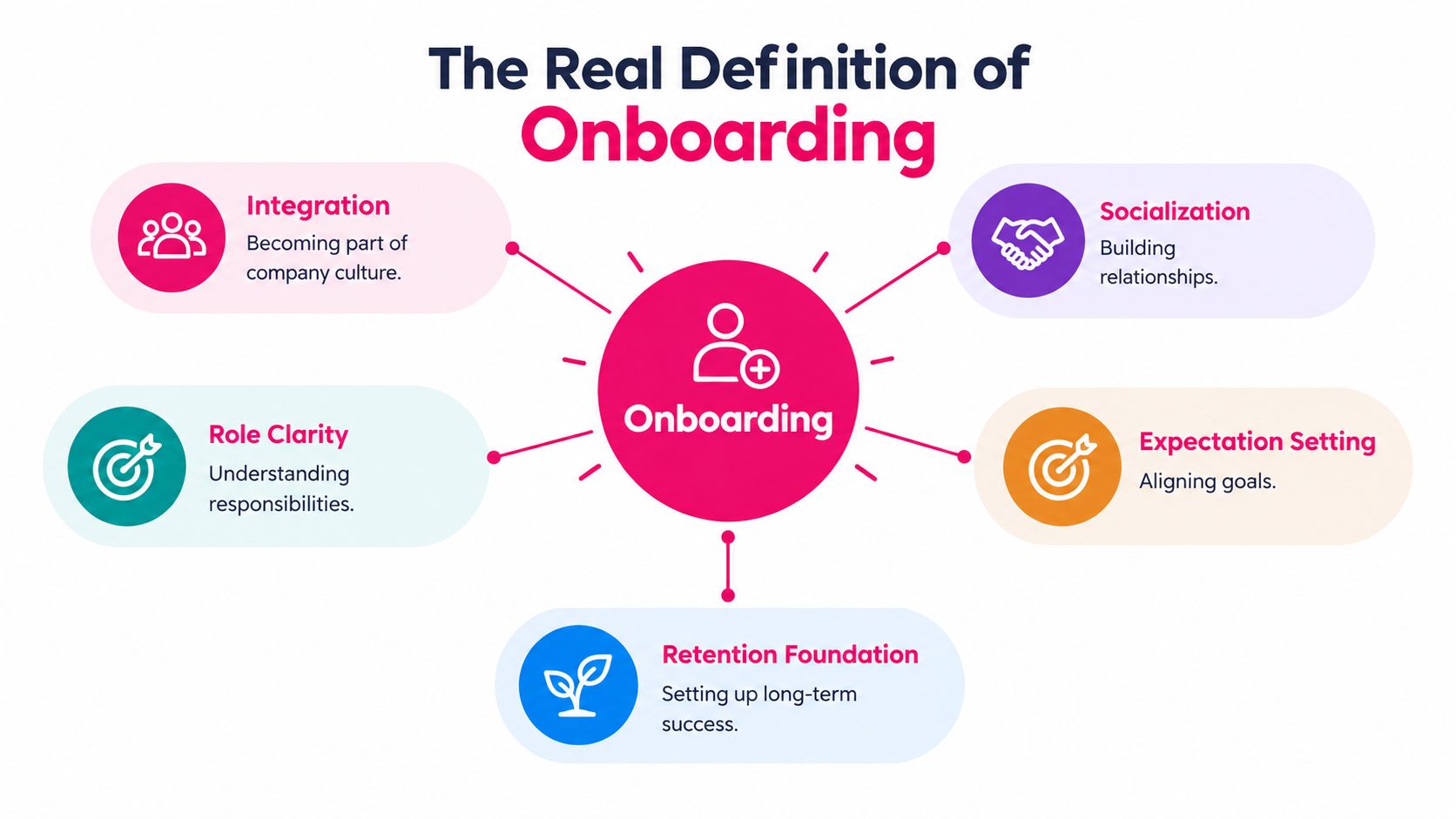
The five supports of the bridge
- Integration: The employee learns how the organization makes decisions, uses tools, and delivers work.
- Socialization: They build relationships with managers, peers, mentors, and key collaborators.
- Role clarity: They understand responsibilities, decision rights, priorities, and measures of success.
- Expectation setting: Both sides align on communication, performance, learning, and support.
- Retention foundation: The organization creates conditions that support confidence, belonging, and continued contribution.
The practical test is straightforward. Can the employee explain good performance, demonstrate the core workflow, find trustworthy resources, and identify the right person for help? If not, the time-to-productivity cycle needs more guided experience, practice, and feedback rather than another general presentation.
> Practical rule: Design onboarding around the employee's path to independent contribution, not around the documents HR needs to distribute.
Why Onboarding Determines Employee Retention
What makes an employee decide that a job is worth staying in? The answer often begins before they have enough experience to evaluate every part of the role. During the early period, people read small signals. A missing account can indicate poor preparation, while an unclear assignment can raise doubts about role fit. A supportive manager, a useful peer connection, and a realistic first task can build confidence quickly.
Gallup reporting associates strong onboarding with an 82% improvement in retention, and reports that new hires often decide whether a job feels like the right fit within the first 30 days. Companies have an average of 44 days to influence long-term retention, according to the same body of reporting on employee onboarding statistics and research. Early onboarding therefore functions as a retention intervention, not a ceremonial welcome.
The employee's early decision path
Onboarding addresses two questions at once. The administrative question is, “Can I access the systems and complete required tasks?” The psychological question is, “Do I belong here, can I succeed, and does this role match what I was promised?” Ignoring either question leaves part of the employee experience unsupported.
Managers can make the employee's path visible through five anchors:
1. Purpose: Why the role exists and whom it serves. 2. Priorities: Which outcomes matter first. 3. People: Who provides context, approval, coaching, and collaboration. 4. Progress: How the employee will recognize improvement. 5. Support: What to do when work becomes unclear or difficult.
The first 90 days are a high-risk period, but they are not just a countdown tracked by calendar reminders. The employee needs a sequence that moves from observation to supported practice, then from practice to ownership. Each check-in should examine evidence of progress, such as completed work, decisions made, and help requested, rather than only asking whether everything feels fine.
Onboarding becomes a time-to-productivity cycle. It ends when the employee can contribute independently, not when orientation finishes.
Personal identity also shapes retention. A Harvard Business School case study at Wipro found that onboarding centered on newcomers' personal identity made employees more than 32% less likely to quit during the first six months, according to the Harvard Business School study. The approach also improved customer satisfaction, engagement, and productivity while reducing errors, as described in the Wipro onboarding case study. Onboarding should help people connect their strengths and identity with the organization's work.
The Four Phases of a Structured Onboarding Process
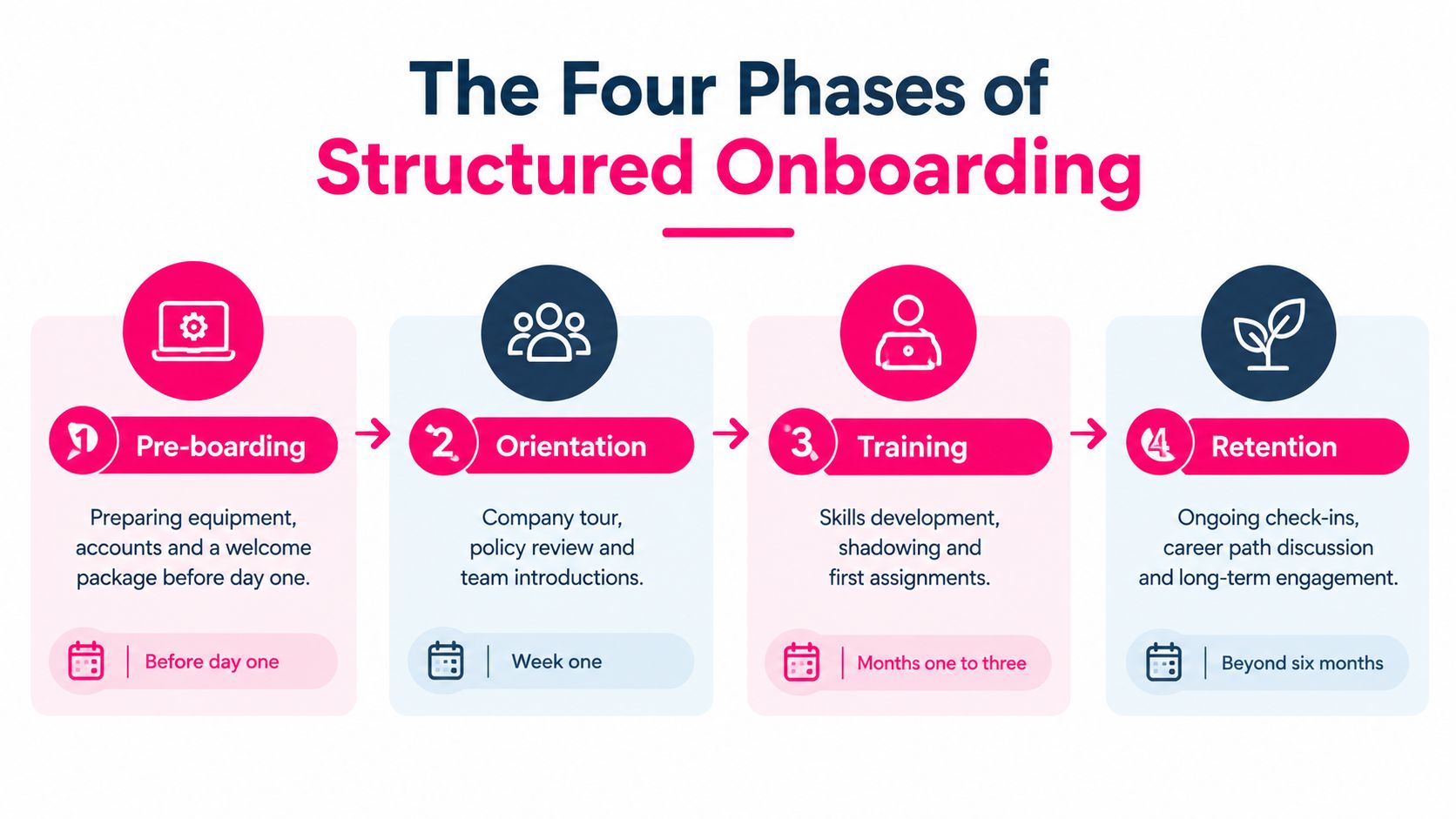
A structured onboarding process has four connected phases. The names are useful only if each phase produces a clear outcome and hands the employee smoothly into the next one.
Pre-boarding
Before day one, the organization prepares the conditions for a productive start. That includes equipment, accounts, access permissions, a welcome message, a first-day schedule, and information about who will be available. The manager should also define an initial work context, such as a team overview, current priorities, and a low-risk first activity.
Orientation
Orientation introduces the organization and the team. It covers essential policies, communication norms, culture, key people, and the employee's place in the wider system. Keep the content selective. New hires need a usable map, not a complete archive of everything the company has ever written.
!An infographic illustrating the four phases of a structured onboarding process for new employees.
Training
Training converts information into capability. The employee observes the work, practices with guidance, completes first assignments, receives feedback, and gradually handles more complex decisions. A systematic review of formal onboarding found statistically significant effects on newcomer adjustment in 3 of 5 included studies, with effect sizes ranging from Cohen's d 0.13 to 1.35. The review found the strongest support for structured, supported on-the-job training and highlighted standardized plans, explicit time frames, role models, and clear socialization into responsibilities. See the systematic review of formal onboarding for the evidence base.
Retention
Retention is the continuation of learning after the initial ramp-up. Managers review performance, discuss development, refresh knowledge, and remove obstacles that prevent independence. For organizations hiring across borders, resources such as Hire Latin American Developers can help managers think more carefully about distributed hiring, role expectations, and the support required across locations.
The phases shouldn't operate as isolated departments. HR may prepare access, L&D may build learning, and the manager may assign work, but the employee experiences one journey. A handoff without context creates the same confusion as missing training.
Common Mistakes in Modern Onboarding Workflows
The biggest onboarding failure is treating the process as an event. A one-day orientation can satisfy a compliance requirement while leaving the employee unable to perform the job. The organization then mistakes attendance for readiness.
Training quality is a major part of the problem. 52% of employees say onboarding focuses too much on administration rather than role training, while 25% feel pressure to perform before training is complete, 24% report weak follow-up after initial training, and 23% want more personalized learning options, according to BambooHR's onboarding benchmarking.
Failure patterns managers can spot quickly
- Information overload: New hires receive policies, systems, acronyms, and procedures before they understand the work those materials support.
- Generic learning: Every role receives the same sequence, even when a sales representative, engineer, and finance analyst need different practice.
- No owner: HR sends the welcome materials, but nobody owns the employee's path to role readiness.
- Delayed feedback: The first meaningful review arrives after habits have already formed.
- Weak follow-up: The manager asks whether the employee has questions instead of checking whether they can complete defined tasks.
Replace the event model with a continuity rule. Every learning item should connect to a job responsibility, every responsibility should have a practice opportunity, and every practice opportunity should produce feedback.
> A new hire shouldn't have to guess whether they're progressing. The workflow should make progress visible through tasks, demonstrations, conversations, and increasingly independent decisions.
Start by removing unnecessary content from day one. Then create role-specific learning paths, assign a person who can answer practical questions, and schedule follow-up before the employee begins. Onboarding becomes manageable when the organization separates what must be known immediately from what can be learned at the moment of need.
Best Practices for an Efficient Onboarding Workflow
How can a manager tell whether onboarding is creating role readiness rather than merely completing orientation? The answer is to design the workflow around capability. Orientation shares common information, while role-ready onboarding connects learning to the work a new hire must perform independently.
| Traditional one-way orientation | Modern role-ready onboarding | |---|---| | Slides and policy explanations | Short lessons connected to real tasks | | One sequence for everyone | Role-based paths with relevant examples | | Attendance as evidence of completion | Demonstrated capability as evidence of readiness | | Manager answers questions reactively | Mentor and scheduled check-ins provide support | | Learning ends after the session | Reinforcement continues through the ramp-up period | | HR owns the event | HR, L&D, managers, and peers share defined responsibilities |
The workflow should function like a marked route, with clear checkpoints from first access to independent decisions. Six design choices help keep that route practical:
1. Assign a mentor. Pair the new hire with an experienced colleague who can explain informal norms, answer practical questions, and identify confusion early. 2. Map the first 90 days. Use a visible timeline with early learning goals, practice tasks, manager check-ins, and ownership milestones. 3. Create one resource hub. Keep current policies, role guides, recordings, templates, contacts, and job aids in a clearly organized location. 4. Schedule meaningful reviews. Examine completed work, observed behavior, open questions, and the next capability to develop. 5. Build a feedback loop. Ask what remains unclear, then compare the answer with manager observations and task evidence. 6. Teach culture through decisions. Use examples of prioritization, customer communication, escalation, and collaboration to show how values guide daily work.
For teams with limited HR capacity, this onboarding best practices for small businesses offers a useful reference for assigning ownership and keeping the workflow practical. Remote managers can use this remote employee onboarding guide to adapt introductions, collaboration practice, and asynchronous learning to distributed work.
These choices keep onboarding focused on the time-to-productivity cycle. The process is complete when the employee can handle defined responsibilities, make appropriate decisions, and seek help selectively rather than rely on step-by-step direction.
Measuring Success with Onboarding Metrics
A manager says a new analyst is “doing well.” The employee feels welcomed, but still needs help with the core reporting workflow. Both statements may be true. Measurement turns that ambiguity into a clearer picture by combining task evidence, employee feedback, manager observation, and retention outcomes.
Start with one definition of time to productivity. It might mean completing a core workflow without step-by-step assistance, handling a standard customer request, or producing work that meets the team's quality criteria. The definition should match the role, because productivity for a developer looks different from productivity for a recruiter.
Track the employee journey with a small set of measures rather than a crowded dashboard.
| Metric | What It Measures | Why It Matters | |---|---|---| | Time to productivity | How long it takes to perform core work with appropriate independence | Shows whether learning connects to real contribution | | Readiness checks | Whether the employee can demonstrate required knowledge or skills | Identifies gaps before they affect customers or colleagues | | New-hire experience feedback | How clear, supported, and relevant the process feels | Reveals friction that task data may miss | | Manager confidence | Whether the manager sees progress toward role expectations | Tests whether training and work assignments align | | Early retention | Whether new hires remain through the early employment period | Connects onboarding quality with workforce stability |
Review the measures at planned points, then investigate exceptions. If many people finish required learning but struggle with the same task, the issue may be instructional design, access, workflow complexity, or unclear expectations. If employees report strong support but managers see inconsistent performance, the organization may need better demonstrations and assessment.
The purpose isn't to rank new hires. It's to improve the system that shapes their first experience of work.
Streamlining Onboarding with Video Microlearning
What should a new hire be able to do after each lesson? Video microlearning works best when the answer is one practical question, such as “How do I submit an expense?” A focused lesson can show the workflow, explain decision points, and direct the learner to practice. “Understand company operations” is too broad to guide performance.
Build each lesson through a clear sequence:
1. Map the role. Identify the behaviors, decisions, systems, and conversations that shape early success. 2. Sequence the lessons. Provide context, introduce the workflow, demonstrate it, offer practice, and finish with a knowledge check. 3. Keep each lesson focused. Use plain language, visible examples, and one clear action after viewing. 4. Connect learning to support. Add job aids, templates, contact points, and links to the resource hub. 5. Update from real questions. Repeated questions and common errors identify lessons that need clarification.
A video lesson should support human guidance, not replace it. It can handle repeatable explanations consistently, leaving managers and mentors more time for judgment, context, feedback, and relationship building. That division matters for hybrid and global teams, where inconsistent delivery can create different versions of the same process.
VideoLearningAI turns existing course materials into bite-sized training videos and provides templates for onboarding and publishing workflows suited to learning management systems. Teams can standardize core explanations with video while keeping role practice and manager conversations local.
For practical guidance on arranging a coherent sequence, review these employee onboarding video ideas. Each video should move the learner closer to independent performance, making microlearning part of the wider time-to-productivity cycle rather than a standalone orientation event.
Building Your Action Plan for Onboarding Success
An onboarding audit should begin with the employee's first useful contribution, then work backward. Ask what the person must understand, demonstrate, and decide before they can operate independently. This exposes gaps that a document inventory won't reveal.
Use the following checklist with HR, L&D, managers, and recent hires:
- Define readiness: Write observable criteria for autonomy in each role.
- Prepare access: Confirm equipment, accounts, permissions, schedules, and essential contacts before the start date.
- Separate learning layers: Distinguish immediate essentials from later reference material.
- Create role paths: Adapt examples, practice tasks, and assessments to the employee's responsibilities.
- Assign support: Name the manager, mentor, subject-matter contacts, and escalation route.
- Schedule reinforcement: Plan check-ins, practice, feedback, and knowledge refreshers beyond the first day.
- Centralize resources: Give employees one trusted place to find current materials.
- Measure capability: Track time to productivity, readiness evidence, feedback, manager confidence, and early retention.
- Improve the workflow: Review repeated questions, errors, delays, and employee feedback, then update the relevant lesson or process.
A useful implementation sequence is to pilot the workflow with one role, observe where employees hesitate, revise the materials, and then expand to other roles. Standardization shouldn't mean giving every person identical content. It means giving managers a dependable operating model that can still adapt to role, location, experience, and learning needs.
Use this employee onboarding checklist to turn the audit into assigned actions and owners. The finish line is clear: the new hire knows what to do, can demonstrate how to do it, knows where to get help, and can make appropriate decisions without constant supervision.
---
VideoLearningAI helps L&D and HR teams turn existing onboarding materials into structured, bite-sized training videos without requiring editing expertise. Visit VideoLearningAI to explore a practical way to standardize onboarding lessons, support role readiness, and keep learning available throughout the employee's path to autonomy.