A sales leader asks for a new onboarding program. The revenue operations lead responds with a CRM workflow. Marketing sends over another playbook. A manager schedules role-plays, while nobody decides who owns the process that sellers are supposed to follow.
This is a common failure mode in sales enablement vs sales operations discussions. The functions share a revenue goal, use many of the same systems, and increasingly operate inside the same seller workflow. When leaders treat them as interchangeable, teams duplicate content, split accountability for CRM adoption, and struggle to connect training investment with forecast quality.
The distinction still matters. Sales enablement changes seller behavior and readiness. Sales operations makes the revenue system reliable, measurable, and scalable. The strongest operating model doesn't create a rigid wall between them. It assigns clear ownership for behavior change, data quality, process design, and in-workflow execution, then gives both teams a shared feedback loop.
That framework is useful whether you're documenting internal processes, creating training material, or evaluating support resources such as the SupportGPT blog. By the end, you'll know which team should lead a problem, where collaboration is mandatory, and how to measure the result without confusing course completion with operational performance.
Table of Contents
- Introduction Why Teams Confuse These Two Functions
- What Sales Enablement and Sales Operations Actually Do
- Detailed Comparison of Roles Goals Activities and KPIs
- How Training Content and Playbooks Differ for Each Function
- Tooling and Video Learning Workflows That Support Both Teams
- Which Model Fits Your Team and What to Do Next
Introduction Why Teams Confuse These Two Functions
The confusion usually starts with a reasonable request: “We need sales productivity to improve.” That request can send three teams into motion at once.
Sales enablement may build onboarding lessons, objection-handling practice, and a refreshed discovery playbook. Sales operations may redesign opportunity stages, add required CRM fields, and change forecast categories. Sales managers may coach reps on the new motion, while marketing updates messaging and product teams revise collateral. Each activity can be useful, but the organization may still lack a single owner for whether sellers adopt the new behavior.
The problem isn't that the functions overlap. Some overlap is healthy. The problem is unresolved accountability. If a rep skips a qualification field, operations may blame training. If a rep completes training but continues using an old pitch, enablement may blame management. If a forecast remains unreliable, leadership may ask both teams for a dashboard without defining which team owns the underlying process or the seller's adherence to it.
The cost appears in three places:
- Productivity: Sellers spend time searching for answers, correcting data, or navigating workflows that haven't been taught clearly.
- Forecasting: Operations can't produce dependable reporting when sellers interpret stages, fields, or exit criteria inconsistently.
- Training ROI: Enablement can't demonstrate business impact if it only reports attendance while the operating process remains difficult to follow.
A practical definition resolves much of this:
> Sales enablement owns whether people are ready and changing how they work. Sales operations owns whether the system makes the intended work consistent, visible, and scalable.
That definition won't eliminate every boundary dispute. It gives leaders a useful starting point for assigning a directly responsible owner, a consulted partner, and a shared outcome.
What Sales Enablement and Sales Operations Actually Do
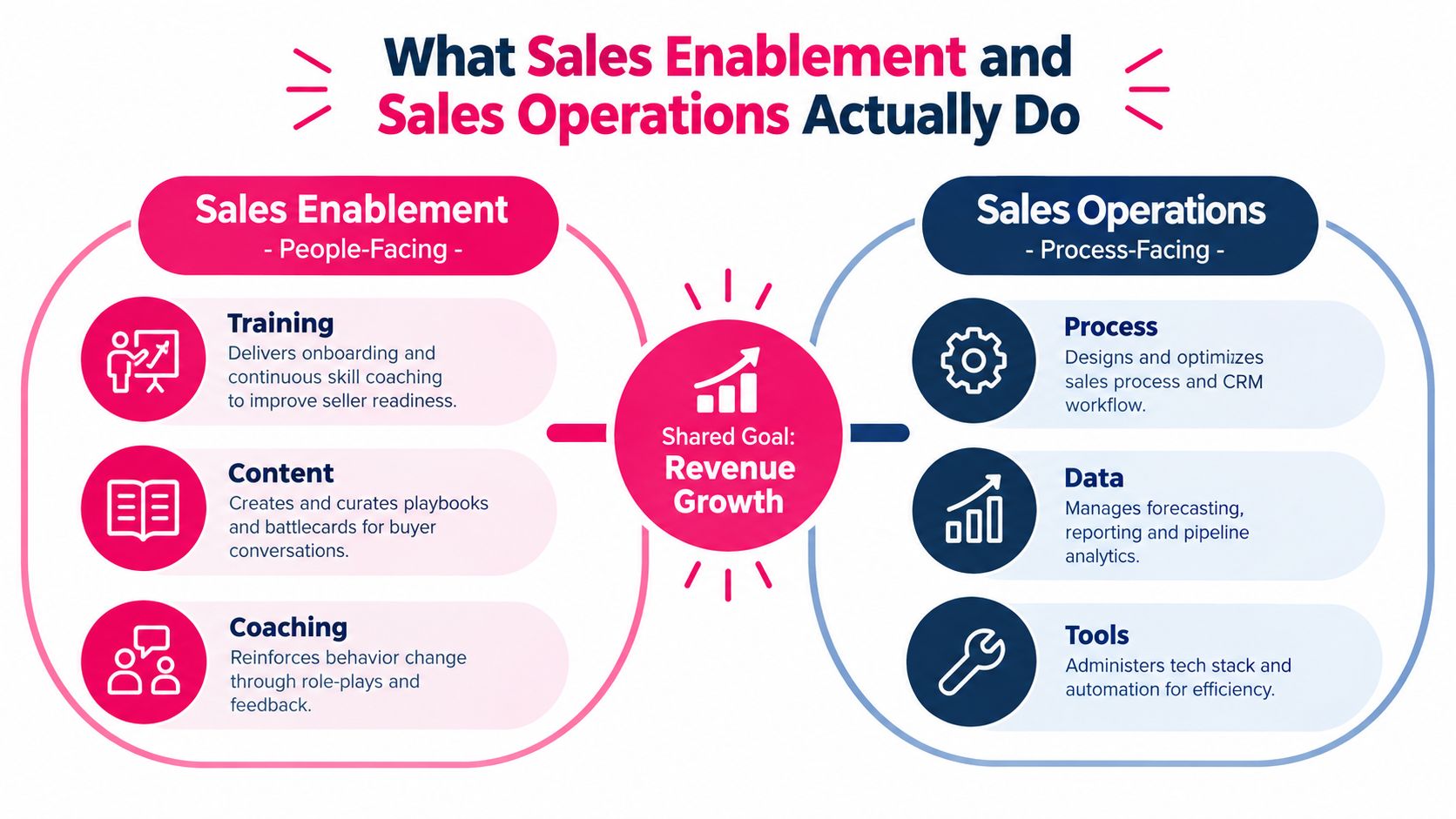
Sales enablement is the people-facing discipline. It equips sellers with the knowledge, content, coaching, and tools required to execute the company's sales motion. Onboarding, continuous learning, role-play, playbooks, battlecards, certification, and manager coaching usually sit within this function.
Sales operations is the system-facing discipline. It manages the processes, data, infrastructure, and governance that allow the sales organization to operate consistently. Territory design, quotas, compensation administration, forecasting, CRM governance, reporting, and sales technology commonly fall within its remit.
The distinction has a useful historical foundation. Gartner's long-running definition described sales enablement as providing sales teams with the information, content, and tools they need to sell more effectively. CSO Insights broadened the concept into a strategic discipline focused on increasing predictable sales results, as summarized in this overview of sales enablement and sales operations.
The people side
Enablement translates strategy into actions a seller can perform. If the company changes its qualification methodology, enablement turns that change into instruction, examples, practice, feedback, and reinforcement. Its work is successful when sellers can apply the intended behavior in buyer conversations and deal execution.
That doesn't mean enablement owns every tool a seller touches. It may configure or curate a learning platform, but its core question is human: Can the seller perform the required behavior with confidence and consistency? Organizations that need flexible capability models may also explore enablement as a service when internal ownership is limited.
The system side
Operations turns the sales motion into an operating environment. It defines how territories are assigned, how quotas are represented, how opportunities move through stages, how data enters the CRM, and how leaders inspect pipeline and forecast health. Its core question is operational: Does the system support the intended motion and produce trustworthy information?
A sales enablement strategy should therefore be designed alongside, not separately from, the process and data model. Teams can use this sales enablement strategy guide to connect readiness work with the execution environment.
Detailed Comparison of Roles Goals Activities and KPIs
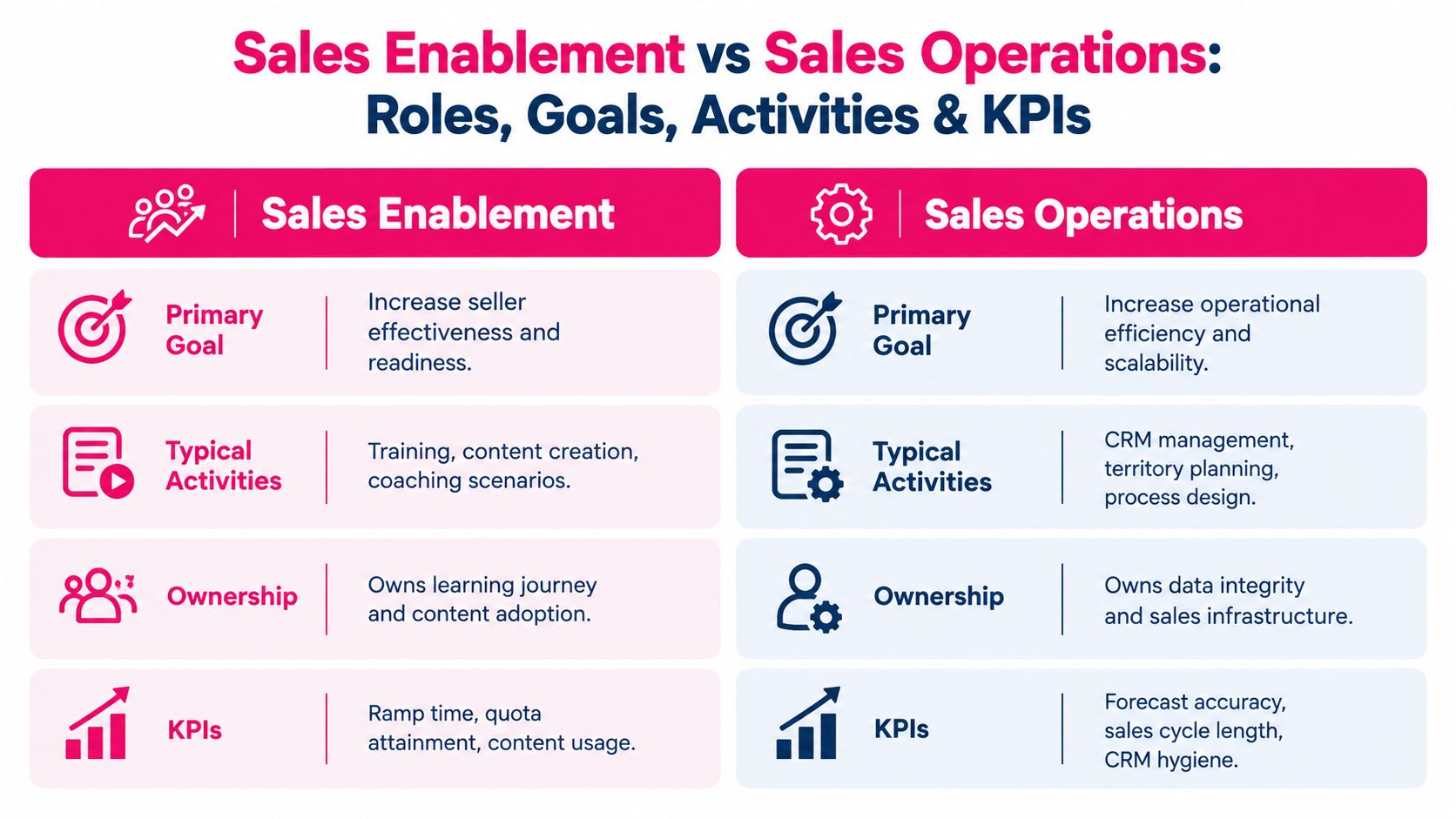
The clearest comparison separates what each function changes from what each function maintains. Enablement changes seller capability and behavior. Operations maintains the structure in which that behavior occurs.
| Dimension | Sales Enablement | Sales Operations | |---|---|---| | Primary goal | Improve seller readiness, effectiveness, and execution quality | Improve process reliability, efficiency, scalability, and visibility | | Typical activities | Onboarding, training, coaching, playbooks, content delivery, certification | CRM governance, territory planning, quotas, compensation, forecasting, reporting, process design | | Primary ownership | Learning journey, behavior change, content adoption, coaching programs | Data integrity, sales infrastructure, workflow rules, operating standards | | Core questions | Can sellers perform the motion? Are they using the right content and behaviors? | Is the motion defined correctly? Can leaders trust the data and forecast? | | Common KPIs | Time to productivity, available selling time, content usage, sales confidence, win/loss rate, sales velocity | Close rate, customer acquisition cost, average sales cycle length, task time, sales-qualified leads, sales velocity |
The KPI boundary matters because the same metric can mean different things to each team. Sales velocity, for example, can reflect improved seller execution for enablement and improved funnel mechanics for operations. The metric is shared, but the diagnostic question differs.
Enablement typically examines whether reps become productive, use approved content, build confidence, and apply the sales motion. Operations examines whether opportunities progress through a defined process, whether data is complete enough for reporting, and whether the commercial system supports efficient execution. The Sales Enablement Collective comparison describes these different performance lenses, including time to productivity and content usage for enablement, and close rate, acquisition cost, cycle length, and task time for operations.
> The differentiator: Enablement is accountable for the human adoption of the process. Operations is accountable for the process and data environment that makes adoption possible.
Use the table as an audit tool. If nobody owns the learning journey, readiness will be inconsistent. If nobody owns field definitions, CRM governance, or forecast logic, leadership will receive reports that look precise but rest on unreliable inputs.
The functions should meet at three points. Operations defines the process and system requirements. Enablement teaches and reinforces the required behavior. Sales managers observe execution and provide feedback to both teams. That arrangement prevents a CRM change from being treated as a software release or a training program from being treated as a substitute for sound process design.
How Training Content and Playbooks Differ for Each Function
The same format can serve both teams, but the job of the content changes. A short video for enablement should help a seller make a better decision in a buyer conversation. A short video for operations should help a seller complete a process correctly and leave behind usable data.
Enablement content changes behavior
Enablement content is built around performance in the field. A lesson might demonstrate a discovery conversation, model an objection response, explain product positioning, or prepare a rep for a new buyer segment. A playbook gives the seller language, decision guidance, examples, and next actions.
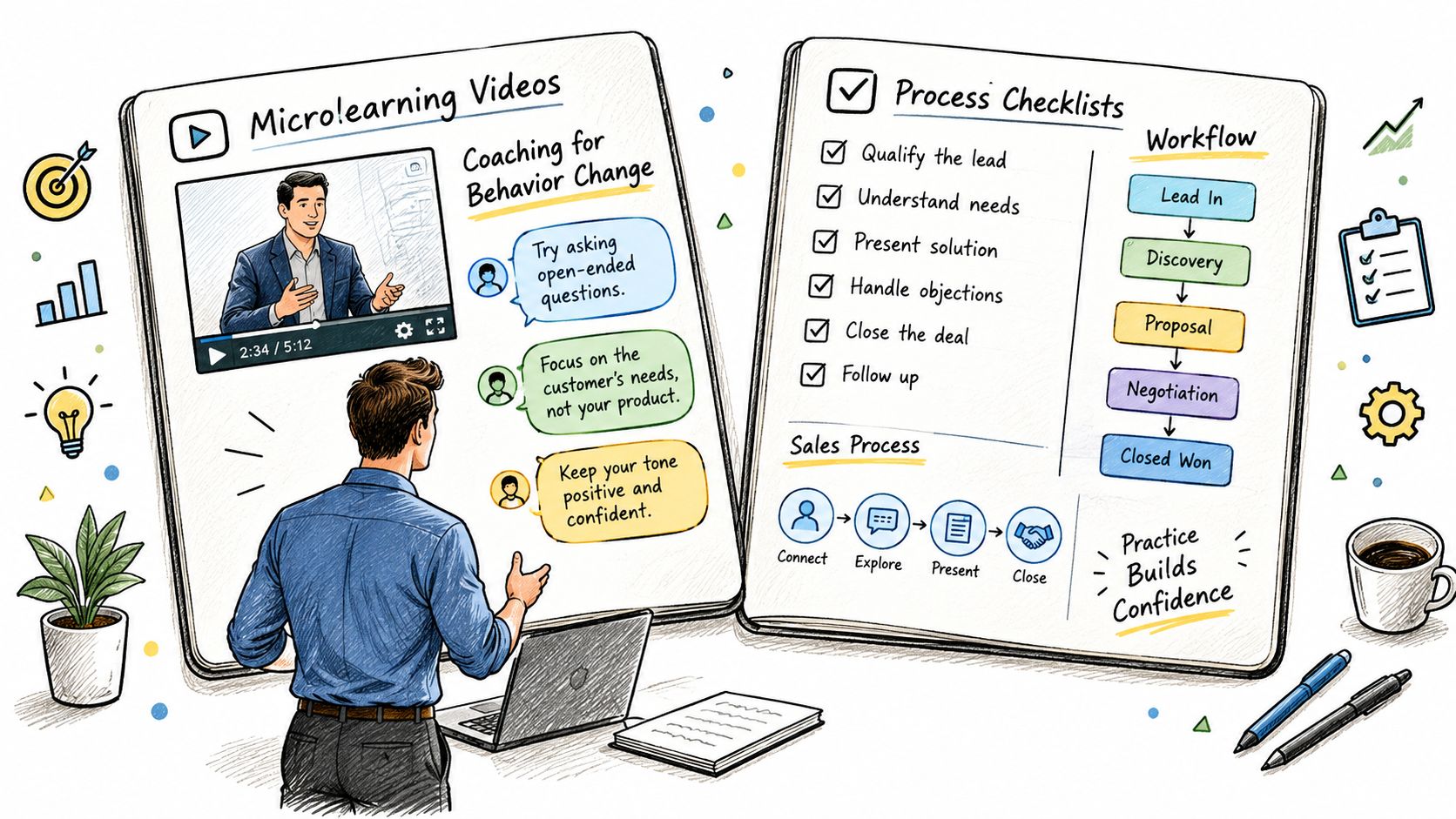
The asset should be easy to find and easy to apply. Bite-sized video can work well for onboarding and reinforcement because it can isolate one behavior instead of burying it inside a broad course. A sales training video workflow should therefore define the behavior first, then select the format, scenario, practice activity, and adoption signal.
Useful enablement measures include:
- Readiness: Time to productivity, time to first sale, certification pass rate, and sales confidence.
- Adoption: Content utilization, training completion, and evidence that sellers use the approved material.
- Commercial connection: Quota attainment, win rate, lead conversion, revenue growth, and sales velocity.
Operations content reinforces process adherence
Operations content has a different purpose. It might show how to update an opportunity stage, explain forecast categories, document a territory rule, or demonstrate the required CRM workflow. The content isn't trying to improve a seller's persuasive technique. It is reducing variation in how the organization records and advances work.
That means the production brief should specify the exact trigger, action, required field, exception path, and quality check. The success signal may be task completion, clean data, shorter task time, or more dependable reporting. A polished video that leaves the workflow ambiguous has failed, even if viewers finish it.
Independent benchmarking reinforces the value of a focused measurement set. A 2025 benchmark reported that roughly 75% of companies used a repeatable group of measures including quota attainment, sales KPIs, training completion, win rate, revenue growth, pipeline-to-quota coverage, certification pass rate, lead conversion, content utilization, employee satisfaction, time to first sale, and time to productivity. The benchmark is documented in Highspot's State of Sales Enablement 2025.
The useful conclusion isn't to place every measure on one dashboard. It's to separate leading readiness signals from operational reliability signals, then connect each content asset to the outcome it can plausibly influence. VideoLearningAI can be considered when a team needs to turn existing sales materials into structured, bite-sized learning videos and publish them through an LMS workflow. Use one content owner, one process owner, and one agreed adoption signal for every major change.
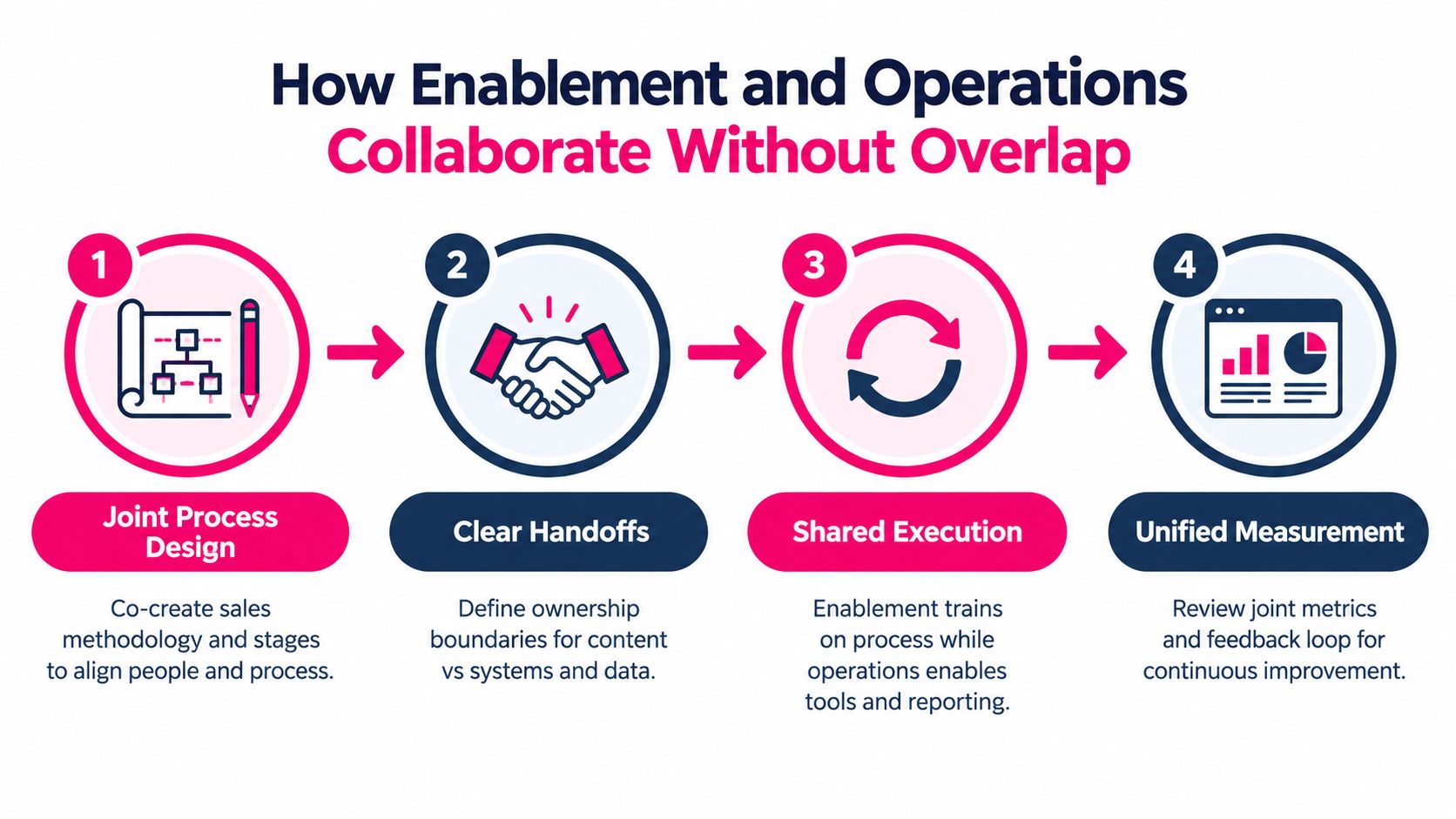
How Enablement and Operations Collaborate Without Overlap
The functions shouldn't operate as separate ticket queues. They should share a change-management loop in which operations defines the mechanics, enablement builds capability, managers reinforce execution, and both teams inspect evidence.
Start with joint process design
Operations should lead the technical and data design, but enablement must be involved before the workflow is finalized. A process that looks logical in a diagram may be difficult to execute in a live customer conversation. Enablement can identify where sellers need decision support, examples, practice, or in-workflow guidance.
The handoff should produce four artifacts: the defined process, the system configuration, the learning and coaching plan, and the measurement plan. Marketing, product, and sales management may contribute, but ownership stays explicit.
Assign the gray-zone work
Recent 2026 trend coverage describes enablement moving into the workflow through AI assistants, in-CRM guidance, and real-time coaching, while platform consolidation brings separate tools into unified revenue environments. This convergence makes old labels less useful. The right question is not who owns the content library. It is who owns the intended behavior, the system record, and the control that connects them. The trend is discussed in coverage of sales enablement trends.
A practical RACI-style split looks like this:
- Behavior change: Enablement is responsible. Sales managers are accountable for reinforcement. Operations is consulted when the behavior depends on workflow design.
- Data quality: Operations is responsible and accountable for definitions, validation, governance, and reporting. Enablement teaches the field how and why to enter the data.
- CRM configuration: Operations is responsible. Enablement validates usability and creates adoption support.
- Coaching: Enablement owns the program and methodology. Managers own day-to-day coaching conversations.
- In-workflow execution: Shared accountability. Operations owns the system controls, while enablement owns guidance, practice, and behavior reinforcement.
Teams that sell complex products also need reliable product information. A governed approach to centralize product info for sales can reduce the risk that enablement publishes one message while operations or product teams maintain another source of truth.
> Governance rule: Give one team final authority over each decision, but require the other team to approve changes that affect its evidence, workload, or seller experience.
Tooling and Video Learning Workflows That Support Both Teams
Tool selection should follow ownership, not the other way around. Sales operations needs systems that preserve trustworthy records and make performance visible. Sales enablement needs systems that deliver learning, content, practice, and coaching where sellers can use them.
A practical stack usually has distinct layers:
- CRM and revenue analytics: Operations manages data definitions, field governance, permissions, pipeline reporting, forecast logic, and workflow configuration.
- Learning management system: Enablement manages curricula, assignments, assessments, certifications, and learning records.
- Content and knowledge layer: Enablement curates playbooks and buyer-facing assets. Operations helps define metadata, access rules, and links to the sales process.
- Workflow integration: Both teams decide where guidance appears, how users reach it, and which adoption signals return to the operating dashboard.
The main selection criterion is not the number of features. It's whether the tool can connect an action to an owner and an observable result. A CRM guide should point to the correct process and make the required behavior clear. A coaching lesson should identify the skill it develops and the evidence that the seller applied it.
The sales enablement tools guide can help teams map platforms to these needs. For video workflows, VideoLearningAI is one option for turning existing training or sales materials into bite-sized lessons using templates for onboarding and sales enablement, then publishing content for LMS-based distribution and tracking.
Avoid buying overlapping platforms that each claim to own content, coaching, analytics, and workflow guidance. Before approving a tool, document the system of record, the content owner, the integration boundary, the adoption event, and the person responsible for reviewing the data. If those answers aren't clear, another platform will add complexity rather than resolve it.
Which Model Fits Your Team and What to Do Next
There isn't one correct org chart for sales enablement and sales operations. The right sequence depends on whether your primary constraint is unreliable infrastructure, inconsistent seller behavior, or a workflow that demands both at the same time.
Early-stage teams
An early-stage company often needs operational clarity before it needs a standalone enablement department. Assign an owner for CRM definitions, pipeline stages, forecasting, and process documentation. At the same time, create a lightweight enablement layer with onboarding notes, core messaging, manager-led coaching, and a small set of repeatable lessons.
The first hire or formal investment should usually address the most expensive source of variation. If leaders can't trust pipeline data, prioritize operations. If the process is documented but sellers execute it inconsistently, prioritize enablement.
Scaling teams
A growing team needs both disciplines to stop relying on informal knowledge. Operations should formalize territory, quota, compensation, CRM governance, and forecast routines. Enablement should turn the sales motion into onboarding, coaching, content delivery, and reinforcement.
Don't measure the program only by whether people completed training. Recent 2026 coverage emphasizes a move from completion toward adherence, from static libraries toward in-the-flow guidance, and from one-time training toward continuous enablement. It also notes that the tradeoff between faster training and actual performance lift remains difficult to quantify, as described in sales enablement trend guidance for 2026.
Enterprise revenue organizations
Larger organizations may benefit from a revenue enablement model that coordinates sales, marketing, product, customer success, and operations. That model works only when governance remains precise. A unified platform shouldn't mean unified, vague ownership.
Use this decision checklist:
1. Process maturity: Are stages, fields, definitions, and forecast rules consistent? 2. Behavior maturity: Can sellers demonstrate the required motion, or do they depend on individual coaching? 3. Data reliability: Can leadership distinguish a real pipeline problem from a data-entry problem? 4. Workflow friction: Does the process require guidance inside the CRM or other selling tools? 5. Measurement discipline: Does each initiative have a readiness signal, an adherence signal, and a business outcome?
Review the answers with sales leadership, operations, enablement, and frontline managers. Then assign one accountable owner for each gap before purchasing technology or producing another course.
---
VideoLearningAI helps teams turn existing materials into structured, bite-sized training videos for onboarding, sales enablement, and reinforcement workflows. Use it to give enablement a faster content-production path while keeping operations involved in the process definitions and measurement signals, then visit VideoLearningAI to evaluate whether its workflow fits your team's ownership model.