Your reps finished the modules. The LMS says they're certified. Managers see green checkmarks across onboarding, product, pricing, and messaging. Then a buyer asks an unexpected question on a live call, and the rep sounds nothing like they did in training.
That's the problem in sales enablement training. Many teams don't lack content. They lack transfer. The rep understood the lesson well enough to complete it, but not well enough to use it in a live conversation where timing, pressure, and buyer pushback change everything.
The fix isn't another content library. It's a system that helps reps learn a skill, rehearse it in context, then use it in the field while managers reinforce the behavior. That's where training starts to affect ramp time, win rate, and forecast quality.
Table of Contents
- Anchor training to the revenue motion - Use a skill-and-scenario structure - Build from the call, not the content pile - Keep modules short and reinforcement close - Match the method to the job - Use AI and managers where behavior matters most - Days 1 through 3 - Days 4 through 7 - Days 8 through 30 - Separate vanity from signal - Build a lag-aware measurement model - Pay special attention to the AI ROI problem - Days 1 through 14 - Days 15 through 45 - Days 46 through 90The Moment a Trained Rep Freezes on a Live Call
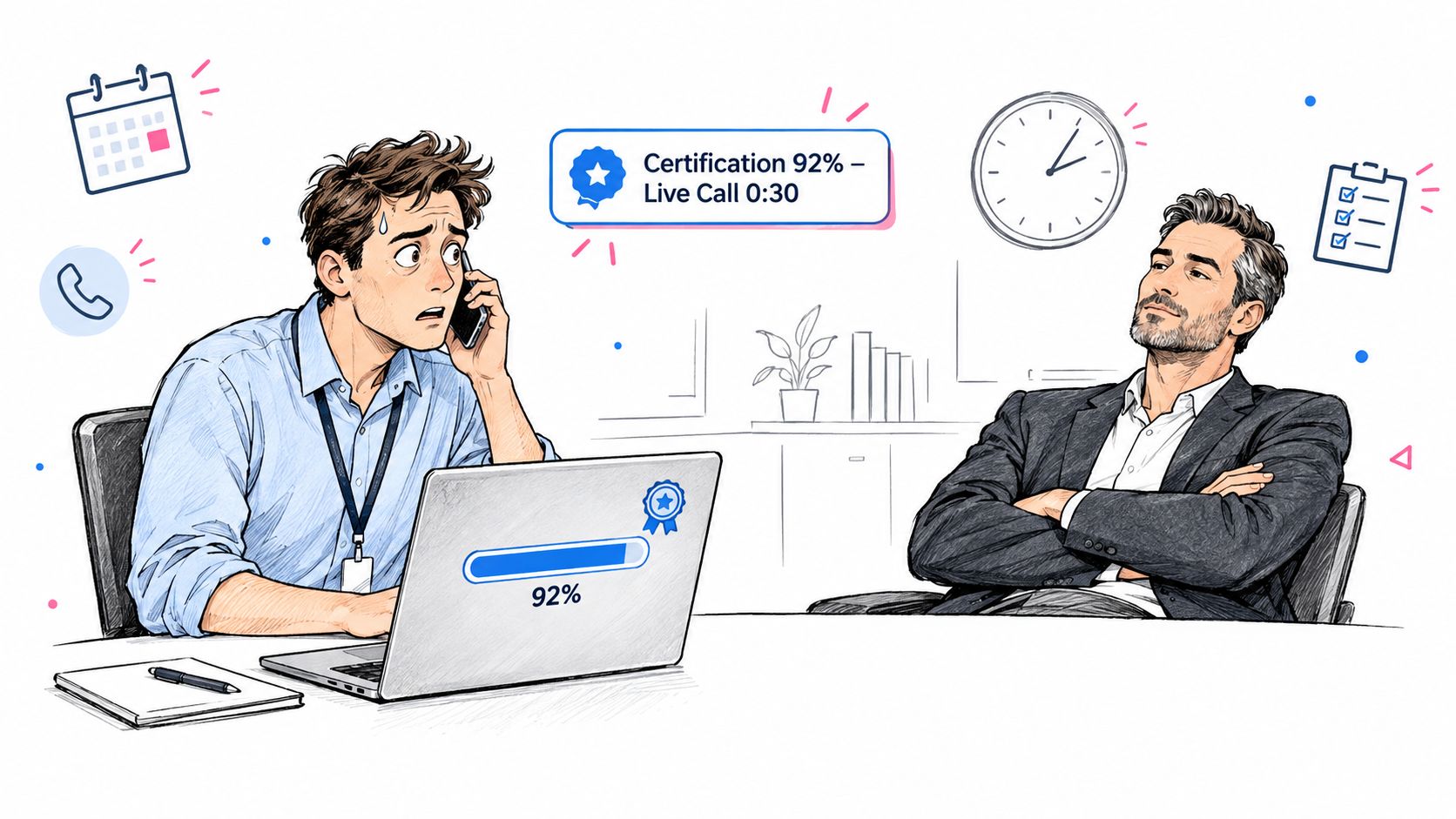
A new rep finishes onboarding, passes the certification quiz, and enters her first meaningful discovery call feeling ready. She's polished in internal practice. She knows the deck. She can explain the product clearly.
Then the prospect, a mid-market CTO, asks a layered security question tied to implementation risk, internal approvals, and data handling. The rep reaches for the nearest familiar script. She starts listing features. The answer gets longer, not clearer. The buyer interrupts, the thread breaks, and the call starts slipping.
!A stressed employee on a phone call while a calm manager observes during sales enablement training.
Nothing about that moment shows up in completion data.
The quiz said she was ready. The course completion report said onboarding worked. But live selling exposed the gap. She had information, not usable behavior. She knew what the product team wanted said, but she hadn't practiced how to recover when a buyer combined technical concern, commercial risk, and urgency into one question.
A peer on the same team handled a similar moment very differently. That rep had done short scenario drills based on actual calls. He'd rehearsed with a manager who stopped him mid-answer, forced him to clarify the buyer's concern, and made him restate the risk before responding. On his live call, he didn't know everything either. He just stayed composed long enough to diagnose the question, confirm what mattered most, and answer in sequence.
> Completion tells you who saw the material. Live calls tell you who can use it.
That distinction matters because formal sales enablement isn't cheap. A 2023 Association for Talent Development report found that organizations dedicated 63% of their sales budget to internal costs such as talent development, sales enablement staff salaries, and training delivery, while the median organization spent between $1,000 and $1,499 per salesperson on sales training in 2022, with kickoff meetings adding another $1,000 to $1,499 per salesperson. The same research found first-year salespeople averaged 10.2 training days, versus 3.9 for third-year reps and 3.8 for fifth-year reps, which shows how heavily early performance depends on structured training (ATD figures summarized here).
If that investment doesn't show up when a rep is under pressure, the design is wrong.
What Sales Enablement Training Actually Is
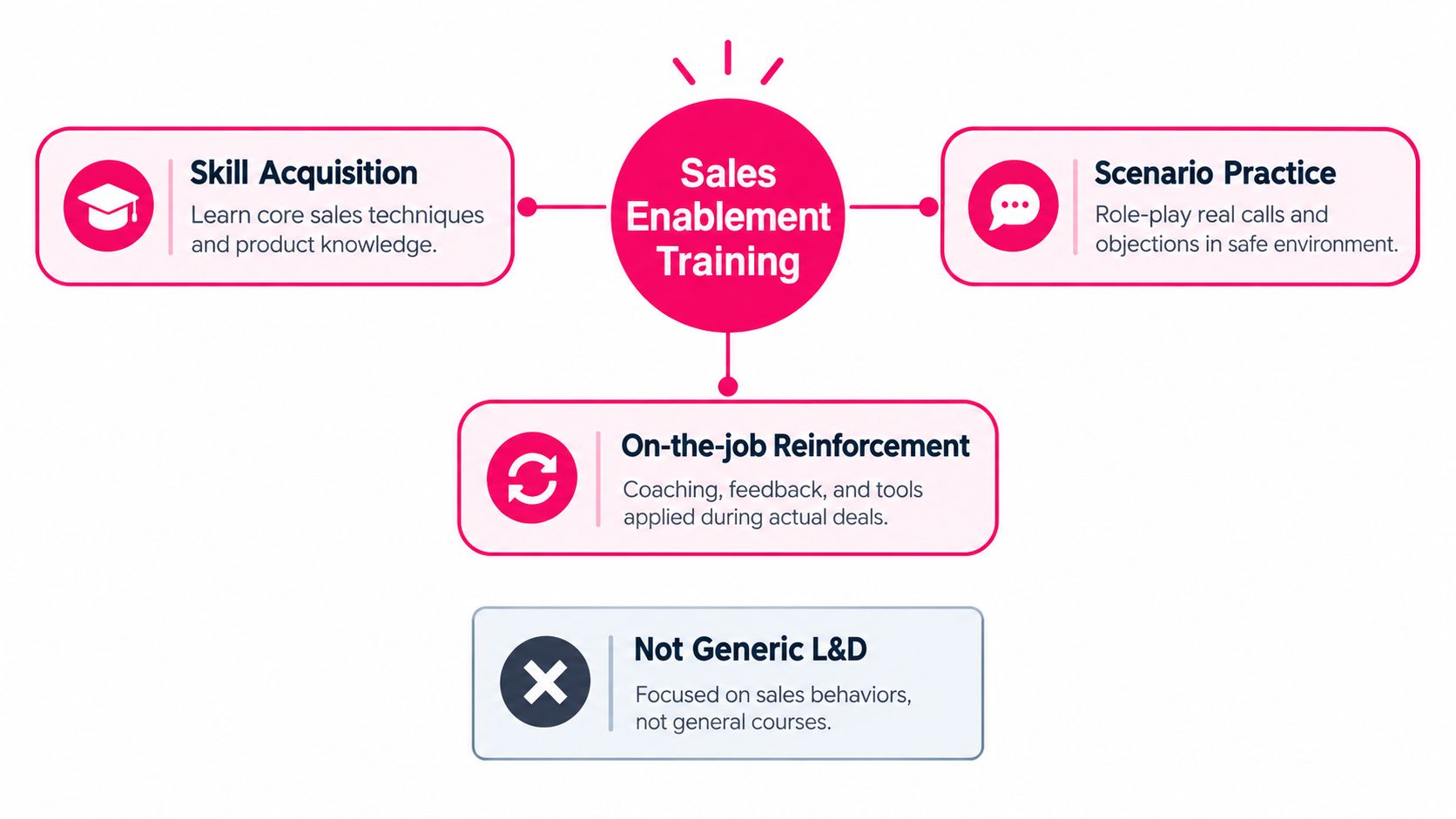
Sales enablement training works when you treat it as a behavior-change system. Not a course catalog. Not a content drop. Not a set of certifications that look tidy in a dashboard.
It has three moving parts:
- Skill acquisition: Reps learn a discrete behavior, such as quantifying cost of inaction, running a tighter discovery opening, or handling procurement pushback without discounting too early.
- Scenario practice: Reps use that skill in a realistic call moment, not in a generic knowledge check.
- On-the-job reinforcement: Managers, peers, and tools push that behavior into real deals until it becomes normal.
Anchor training to the revenue motion
Generic L&D often starts with broad competencies. Sales enablement training should start with a revenue moment. First meeting. Discovery. Demo. Mutual action plan. Renewal save. Expansion conversation.
That changes how you write objectives.
A weak objective says, “understand pricing” or “know the product.” Those are easy to assign and hard to coach. A useful objective says, “defend pricing in a late-stage call when procurement introduces a lower-cost competitor” or “surface business impact in the first five minutes of discovery.”
Use a skill-and-scenario structure
Every objective should name two things:
1. The skill 2. The call scenario where it must appear
That framing sharpens everything downstream. Content gets shorter because it only teaches what the rep must do. Practice becomes easier to design because the context is clear. Manager coaching improves because the observation target is visible on a real call.
> Practical rule: If a manager can't listen to a call and tell whether the rep used the trained behavior, the objective is still too vague.
This is also how enablement leaders defend spend to finance. The conversation changes from “we need more training” to “we're improving behavior in specific parts of the sales motion.” That's a stronger operating case, especially because organizations with a named enablement function report 29% higher overall sales training effectiveness, with topic-level gains ranging from 15% to 31%, including 31% improvement in changing sales messaging and 15% improvement in helping low performers improve (Sales Management Association summary).
For teams refining their operating model, I also like browsing practical sales enablement tips at Flexwork Podcast Studios because they often spark useful discussion around content, coaching, and field execution.
Designing a Curriculum That Changes Behavior
The cleanest curriculum I've seen fits on one page before anyone builds a module. If it takes a slide deck to explain the design, it's usually too broad.
For a mid-market SaaS motion, start with four columns: call stage, skill objective, scenario practice prompt, and reinforcement loop. That keeps the curriculum tied to selling behavior instead of topic sprawl.
Build from the call, not the content pile
Teams usually begin with assets they already have. Product decks, competitor slides, pricing docs, messaging one-pagers. That's backward. Start with the conversation the rep must survive, then pull in only the knowledge required for that moment.
Here's a simple working template.
| Call Stage | Skill Objective | Scenario Practice Prompt | Reinforcement Loop | |---|---|---|---| | Discovery | Surface three quantified pain points in under five minutes | CIO at a 600-person logistics firm dealing with fragmented visibility across systems | Weekly manager call review scored against a five-point rubric | | Demo | Tie each workflow shown to a buyer-stated pain point | Operations leader says the current process is “annoying but manageable” | Peer review of recorded demo segments | | Mutual Action Plan | Gain next-step commitment from multiple stakeholders | Buyer agrees verbally but avoids naming internal owners | Manager deal review with commitment checklist | | Negotiation | Protect value while answering procurement pressure | Procurement introduces timing pressure and asks for price movement before security review finishes | AI role-play drill followed by manager debrief |
The scenario prompt matters more than many teams think. “Handle objections from a tough buyer” is too vague to practice. “Security-conscious CTO asks whether your platform can replace existing controls, while procurement wants a faster answer than legal can support” is usable. A rep can role-play that in minutes.
Keep modules short and reinforcement close
The content unit should be small. In most sales motions, a module only needs enough material to explain the behavior, model it, and give reps language to try. Pair that with one drill and one manager touchpoint.
A practical sequence looks like this:
- Short lesson: A focused module on one behavior, usually brief enough to fit between live selling blocks
- Immediate drill: A role-play or simulation built around one realistic prompt
- Manager touchpoint: A call review, ride-along, or debrief that checks for use in the field
- Certification: A scored simulated call, not a multiple-choice quiz
That last point is where many programs drift. Multiple-choice recall is fine for product facts. It's weak for selling behavior. Certification should ask the rep to perform.
If you're building the learning design from scratch, this guide to instructional design best practices is useful because it helps tighten objectives and remove filler before production starts.
Choosing Delivery Methods for Real Transfer
Delivery format changes what kind of learning sticks. Teams get into trouble when they treat every format as interchangeable. It isn't.
Some methods are good at broadcasting knowledge. Some are good at exposing weakness. A smaller set changes behavior in live deals.
Match the method to the job
| Method | Best For | Transfer Strength | Cost to Run | |---|---|---|---| | Live workshops | Complex frameworks, mindset shifts, peer modeling | Medium without follow-up. Stronger when paired with drills and manager coaching | Higher calendar and facilitation cost | | On-demand microlearning | Product refreshers, pricing changes, competitor facts, process reminders | Low on its own for live-call behavior | Lower production and scheduling burden | | AI role-play | Objection handling, discovery fluency, talk-track rehearsal, executive conversations | Strong for repetition and skill decay detection | Moderate setup cost, scalable once running | | Manager coaching | In-deal application, diagnosis of real call gaps, reinforcement | Highest because it connects training to active opportunities | High manager attention cost |
Live workshops still matter. They force reps to think in real time, hear how peers respond, and test judgment in the room. The problem is erosion. A workshop without reinforcement fades fast, especially when the field goes back to old habits by the next week.
Microlearning solves a different problem. It's efficient for discrete knowledge. Pricing updates, packaging changes, and competitor counters belong there. But teams overestimate what a short video can do alone. Reps may remember the answer and still fail to use it when a buyer interrupts or reframes the objection.
Use AI and managers where behavior matters most
AI role-play tools are valuable because they create repetition without burning manager hours on every rep, every time. They also make weak spots visible. If a rep repeatedly misses discovery depth or defaults to feature pitching, the pattern shows up early.
Manager coaching is where transfer becomes real. That's the moment the rep takes a trained behavior into an active deal and gets feedback tied to consequences. No other format does that as directly.
> Don't stack every delivery method onto the same lesson. More surfaces can create more noise.
If you need fresh practice ideas for workshop segments or team sessions, some of the sales training game exercises from United We Transform can help loosen up rigid role-play blocks and make repetition less sterile.
For teams deciding how to blend formats, this overview of training delivery methods is a practical reference point. VideoLearningAI is one option in that mix for turning existing sales materials into short training videos that fit microlearning workflows, especially when enablement teams need LMS-ready content without a long production cycle.
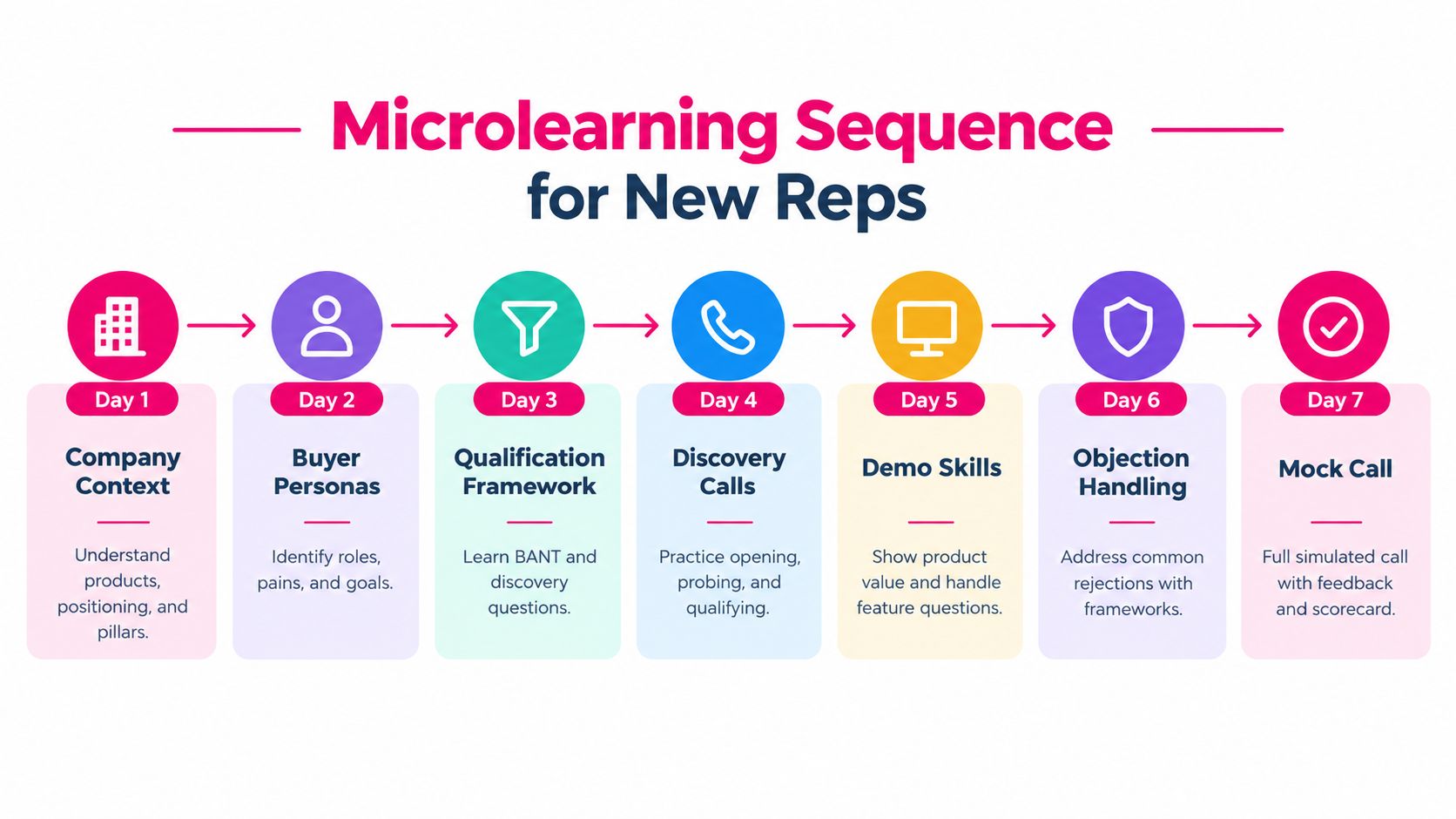
A Sample Microlearning Sequence for New Reps
A new rep's first month shouldn't feel like a content marathon. It should feel like a controlled build toward the conversations they're about to have.
Days 1 through 3
Start with company context, buyer personas, and the qualification framework. Keep each lesson short. A rep doesn't need a full history lesson on the company. They need enough context to explain why customers buy, who usually cares, and what problems show up early in a sales conversation.
Cap this block with an AI discovery drill. The rep should open a first conversation, ask qualification questions, and summarize what they heard. That first simulation usually exposes whether they can move from memorized language into a real exchange.
Days 4 through 7
Shift to competitor context and objection patterns. Then put the rep next to reality. Manager shadowing matters here because new reps need to hear how experienced sellers transition between questions, value framing, and next-step control on actual calls.
For organizations building outbound capacity, this is also where role-specific training for BDRs becomes useful, especially if the top-of-funnel motion requires a different talk track and qualification threshold than full-cycle account executives use.
A short visual helps teams map the early sequence before expanding it to a full month:
Days 8 through 30
This phase moves into demo mechanics, mutual action plans, pricing conversations, multi-threading, negotiation, and executive summaries. Each lesson should end with one action applied to an active opportunity that day.
That last piece is the hinge. If the rep learns mutual action plans in the morning, they should draft one for a real deal by afternoon. If they learn executive recap structure, they should send one after their next customer meeting.
A workable month looks like this:
- Early ramp: Context, buyer roles, qualification, discovery structure
- Middle ramp: Objections, demo control, value articulation, call shadowing
- Later ramp: Stakeholder mapping, pricing, negotiation, executive communication
- Weekly reinforcement: Call reviews tied to actual opportunities
The thread through all of it is simple. Every lesson connects to a real conversation, not a hypothetical one.
Metrics That Prove Training Moves Revenue
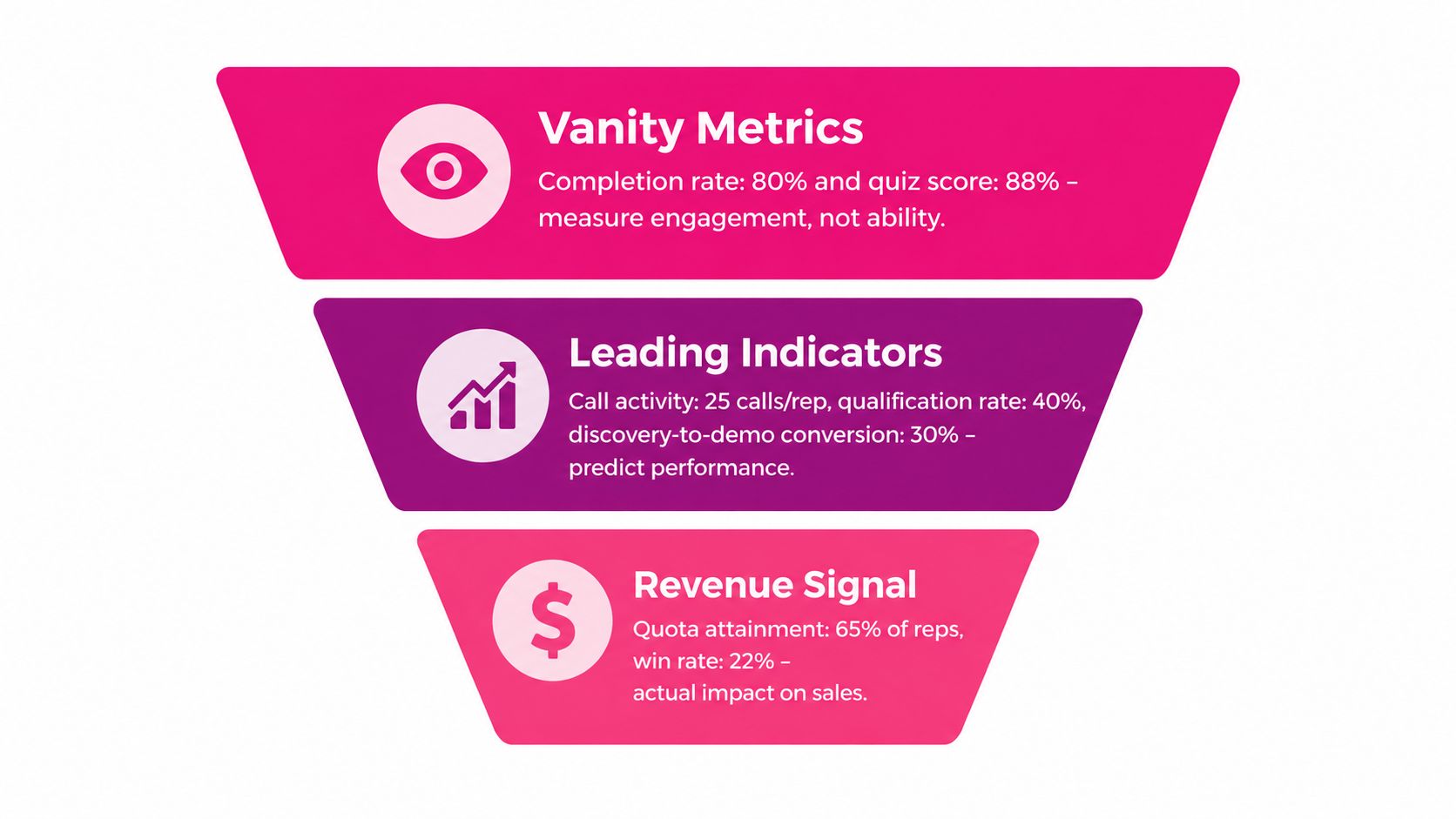
If your training dashboard stops at completion and quiz scores, leadership won't trust it. They shouldn't. Those metrics show participation, not selling improvement.
The harder job is connecting practice behavior to pipeline outcomes with enough discipline that a CRO sees signal instead of activity noise.
Separate vanity from signal
A lot of training reports still center on the wrong measures:
- Hours consumed: Useful for workload tracking, weak for capability
- Completion rate: Tells you who finished, not who can execute
- Training NPS: Interesting sentiment, poor proxy for revenue impact
- Knowledge-only certification: Fine for recall, weak for live-call readiness
What matters more are leading indicators that sit closer to behavior. Practice repetitions per rep. Pass rates on scenario-based certifications. Observable call-pattern shifts, such as whether reps ask deeper discovery questions, cover multiple stakeholders, or change how they control next steps.
> A dashboard earns trust when it shows that rep behavior changed first, then pipeline metrics moved later.
Build a lag-aware measurement model
Independent enablement research cited in industry summaries reports that organizations with formal enablement see a 49% average win rate, compared with 42.5% without enablement, and that dedicated enablement can reduce new-rep ramp time by up to 40% (industry summary here). Those are useful benchmarks, but they only help if your internal measurement model can explain how your program is influencing those outcomes.
Use a simple chain:
1. Input metrics: Did reps complete the lesson, run the drill, and attend the coaching session? 2. Behavior metrics: Did their simulated and live-call performance change? 3. Business metrics: Did cohort win rate, ramp quality, deal progression, or quota spread improve after behavior changed?
Track the relationship over a lag window. Behavior on calls usually shifts before revenue does. Segment results by tenure, segment, and manager, or you'll miss what's happening.
Pay special attention to the AI ROI problem
This gets more important as AI enters the training stack. Industry coverage notes rapid growth in AI use for sales training, with one 2025 report citing 164% more companies using AI in their sales training programs year over year. The same body of content notes that 55% of organizations are unable to effectively drive go-to-market initiatives and 29% still rely on multiple disconnected GTM tools, which is a reminder that tool adoption alone doesn't prove impact (Highspot 2025 coverage).
That's why your dashboard should compare approaches, not just usage. If one team uses AI role-play plus weekly manager call review and another only completes modules, you want to know which group sounds different on calls and moves deals more cleanly.
For teams building that reporting layer, this guide on how to measure training effectiveness is a solid starting point for structuring leading and lagging indicators.
Rolling Out the Program Without Losing the Room
Most sales enablement training fails in rollout, not design. Good content gets buried under bad timing, weak manager follow-through, and too many competing priorities.
Treat the launch like a change sprint. Not a content release.
Days 1 through 14
Start with a pilot. Use a small group with one committed manager and a handful of real opportunities in motion. You're not validating whether the idea of reinforcement matters. You're finding friction points in the actual workflow.
Ship something visible early:
- One sharp module: Pick a single call behavior that matters now
- One simple rubric: Give managers a fast scoring tool for live or recorded calls
- One practice ritual: Add a recurring drill reps can complete without calendar drama
Days 15 through 45
Expand only after managers show they'll reinforce. Many rollouts drift into passive assignment. Reps get courses. Managers assume enablement handled it. No one listens for behavior on calls.
Build the reinforcement mechanics into manager cadence:
- Weekly call reviews tied to a specific skill
- Peer shadow sessions where reps observe what “good” sounds like
- Coaching scorecards that force concrete feedback instead of vague advice
Also remove noise. If reps are juggling multiple messaging changes, product launches, and forecast pressure, training won't land cleanly.
Days 46 through 90
By this stage, the new rhythm should feel normal. Practice is scheduled. Dashboards exist. Content refreshes follow current messaging instead of lagging behind it.
A 2026 research summary argues that 89% of revenue teams have a defined sales process, yet only 36% say reps follow it consistently, which is a useful warning sign (GetBackdrop coverage of 2026 research). Documentation isn't adoption.
Watch for the usual failure modes:
- Training over peak selling weeks: Reps will rush through it and forget it
- Managers assigning instead of coaching: The behavior never reaches the field
- Outdated messaging in the modules: Reps lose trust fast
- Completion treated as success: Leadership gets a false positive
The rollout owner has to protect cadence and escalate resource needs in revenue language, not activity language.
Bringing It All Together
The enablement leader's job isn't to publish more content. It's to orchestrate behavior.
That means each program needs a target skill tied to a live call scenario. Each module should end in practice, not passive recall. Manager coaching can't be a nice-to-have added later. It has to be built into the operating rhythm from the start. Measurement has to follow the same logic by tracking behavior change before asking revenue to move.
A quick diagnostic helps:
- Target behavior: Does every lesson name a specific skill and scenario?
- Practice path: Does each module end with a drill or field application?
- Manager cadence: Is coaching scheduled, not implied?
- Trusted metrics: Are you tracking certification quality, call-pattern shifts, and revenue outcomes together?
Start smaller than you want. Pick one motion. Run a four-week pilot. Instrument a few leading metrics that sales leaders will respect. Then brief leadership on what changed in rep behavior before you ask them to fund the broader rollout.
Sales enablement training earns its budget when reps sound different on calls and forecasts move with more confidence.
---
VideoLearningAI helps teams turn existing sales materials into short, structured training videos that fit microlearning, onboarding, and reinforcement workflows without heavy production work. If you're building sales enablement training around real call moments instead of long courses, it's worth seeing how VideoLearningAI can support faster content production and cleaner rollout.