B2B sales enablement is a cross-functional discipline connecting training, content, technology, and buyer progression, not a repository of sales assets. Its success depends on changing seller behavior and helping buyers evaluate, verify, and champion a solution, especially when 75% of B2B buyers prefer a rep-free sales experience.
That creates a counterintuitive problem. Buyers may want less seller contact, yet Gartner reports that buyers who complete purchases through digital self-service are 1.65 times more likely to regret the purchase than buyers using representative-led processes (Gartner's B2B buying research). The answer isn't to force more calls. It's to make every digital asset, training module, and human interaction work together.
A modern sales enablement b2b program equips sellers to guide complex decisions while making the vendor's knowledge easy for buyers and AI systems to understand. It measures whether people apply that knowledge in real conversations and opportunities, not whether they merely opened a video or downloaded a presentation.
Table of Contents
- From document management to dynamic capability - Map the committee, not just the funnel - Design modular assets around buying jobs - Build the program in short learning loops - Separate productivity, proficiency, and performance - Refresh content when the evidence changes - Build an evidence-ready enablement stackDefining Modern B2B Sales Enablement
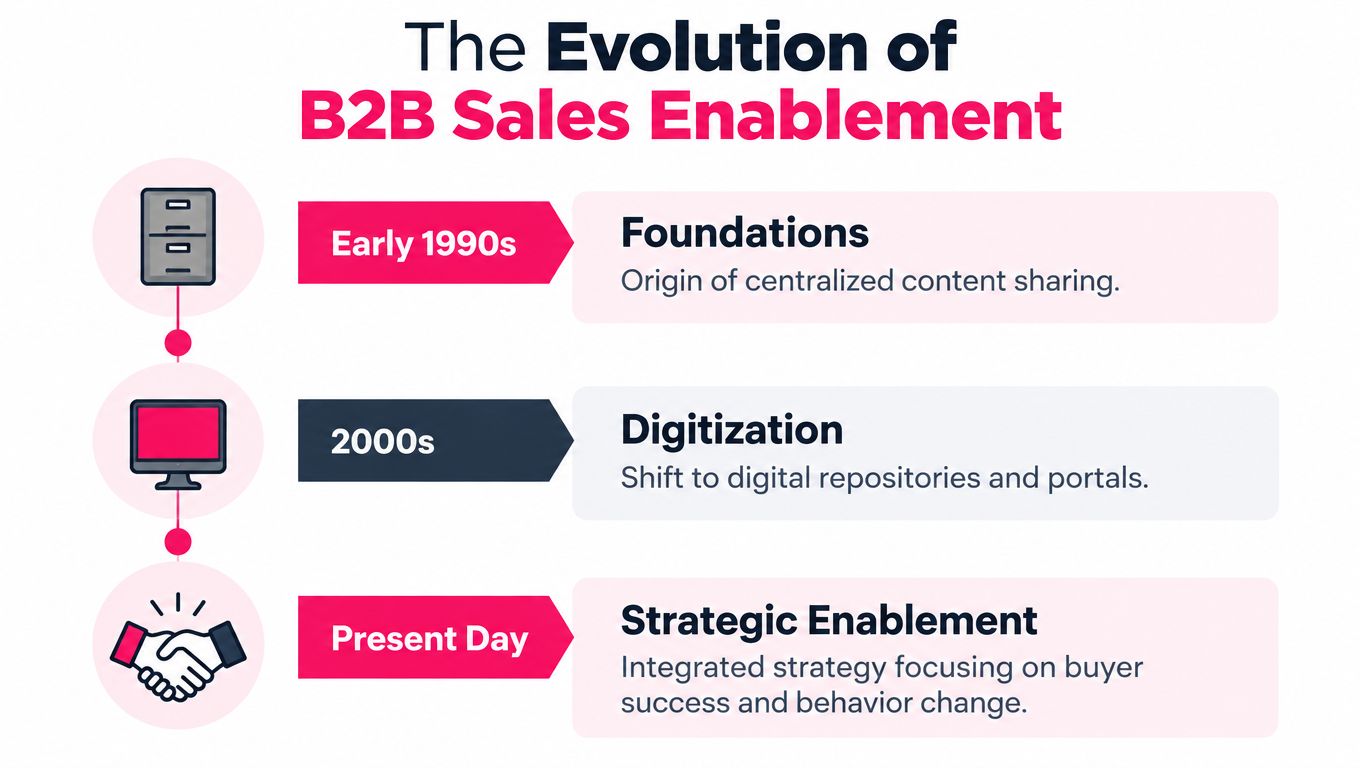
The old definition of sales enablement was simple: put approved brochures, pitch decks, battle cards, and case studies in one searchable location. That approach solved a distribution problem, but it didn't solve the harder commercial problems. Sellers still lacked context, managers couldn't reinforce the right behaviors, and buyers received disconnected explanations from marketing, sales, product, and customer success.
Modern sales enablement is an operating discipline. It connects people, process, performance, content, training, and technology around the way customers buy. A useful definition must include three outcomes:
- Seller readiness: Customer-facing employees can perform the behaviors required for their role, from discovery to objection handling and CRM execution.
- Buyer clarity: Each stakeholder receives accurate, relevant explanations that help them evaluate value, risk, implementation, and internal fit.
- Commercial evidence: Enablement leaders can connect learning and behavior indicators to opportunity progression and revenue outcomes.
Industry history supports this broader view. A structured approach emerged in 1999, when John Aiello and Drew Larsen worked on inconsistent messaging and sales execution. During the 2000s, companies commonly used the term for shared repositories of sales collateral. Around 2010, Forrester analyst Scott Santucci helped frame enablement as an ongoing process for equipping client-facing employees to conduct valuable customer conversations (an overview of sales enablement history).
From document management to dynamic capability
The discipline gained clearer institutional recognition in 2016, when the Sales Enablement Society was formed. Academic research later characterized sales enablement as a dynamic organizational capability that continually reconfigures content, processes, and technology around customer buying behavior. Another research stream organized the field around the 3 Ps, people, process, and performance.
That history matters because it changes the executive question. Don't ask, “Which assets should we upload?” Ask, “Which buyer or seller behavior must improve, and what system will make that behavior easier to perform repeatedly?”
For a practical definition and terminology, Grou's explanation of sales enablement is useful. For implementation guidance, see this sales enablement strategy framework, then adapt it to your sales motion rather than copying a generic playbook.
> Practical rule: If your enablement team owns files but not behaviors, it owns content operations, not sales enablement.
Understanding the Complex B2B Buyer Journey
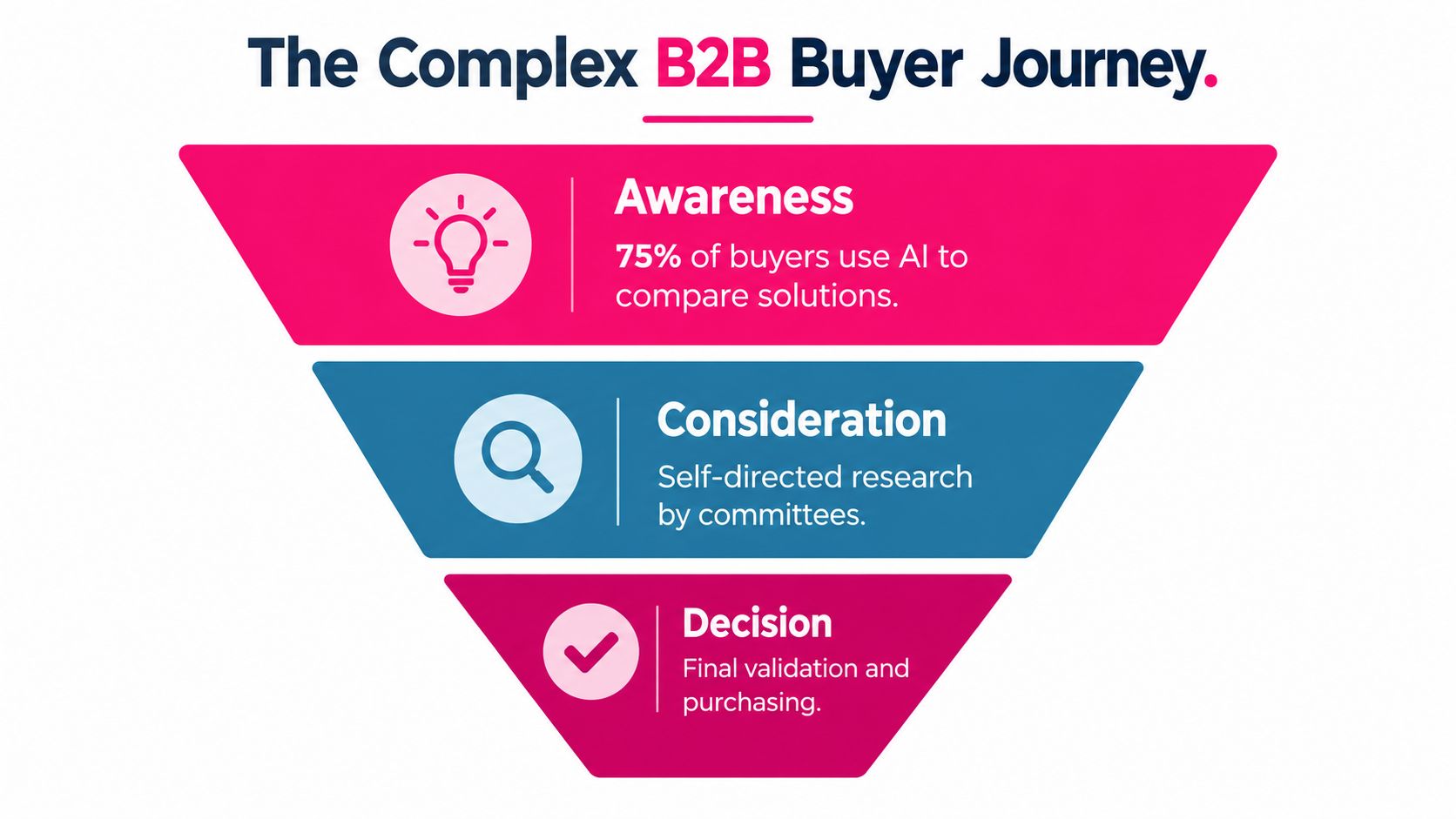
The individual-rep model is obsolete for complex B2B purchases. Gartner reports that 75% of B2B buyers prefer a rep-free sales experience, while an average enterprise buying group includes five to 11 stakeholders across approximately five distinct business functions (Gartner's B2B buying report).
That doesn't mean buyers want an entirely human-free journey. It means they want control over how they learn. The finance leader may need a business case, the technical evaluator may need integration details, legal may require compliance evidence, and the end user may care about workflow changes. One generic deck cannot serve all of them.
Map the committee, not just the funnel
At the awareness stage, buyers need concise explanations of the problem and the category. During consideration, they need proof, comparisons, implementation detail, and answers to objections. At decision, they need material they can circulate internally without losing the original meaning.
Gartner also reports that 99% of B2B purchases are driven by organizational change, while 66% of buyers find the amount of change in their organization overwhelming. That explains why feature-heavy enablement fails. Buyers aren't only choosing software or services. They're trying to coordinate a change that affects multiple teams.
Build a stakeholder map for every major sales motion:
- Economic buyers need financial logic, risk framing, and a clear view of organizational impact.
- Technical evaluators need architecture, integrations, security information, and operational requirements.
- Legal and compliance reviewers need precise claims, documented controls, and approved language.
- End users and internal champions need practical workflows and a simple explanation they can reuse with colleagues.
The seller's job is to guide movement between self-service and assisted interactions. Buyers are reported to be 2.3 times more likely to experience value affirmation from supplier representatives than from supplier digital channels, so removing sellers from the process entirely is a mistake. The better approach gives buyers independent access to reliable information and gives sellers the context to add value when the decision becomes ambiguous or politically difficult.
Strategies for Content and Training Alignment
A content library answers the question, “Where is the file?” An intelligent enablement system answers, “Which person needs which explanation at this stage, and what should happen next?”
The difference is operational. A library stores a long product presentation. A buyer-centered system breaks the same knowledge into a product overview for an executive, an integration walkthrough for a technical evaluator, a compliance explanation for legal, and a short internal champion summary. Each asset carries the same approved claims, but the format and emphasis match the audience.
One industry benchmark reports an average buying group of 11 people, an average purchase cycle of 11.3 months, and buyers spending only 17% of the journey in direct seller interactions (Cirrus Insight's sales enablement benchmark summary). Treat those figures as directional planning assumptions, then validate them against your own CRM and content data.
Design modular assets around buying jobs
Tag each asset by persona, industry, buying stage, sales motion, product area, and approval status. This turns content selection into a controlled assembly process instead of a memory test for the seller.
A practical asset sequence might look like this:
1. Problem explainer: Establishes why the issue matters without leading with product features. 2. Role-specific value module: Connects the problem to the stakeholder's priorities. 3. Proof and validation asset: Addresses evidence, risk, implementation, or compliance. 4. Internal champion kit: Gives the buyer language, visuals, and answers for an internal meeting. 5. Decision support: Clarifies next steps, ownership, dependencies, and commercial assumptions.
Training must mirror that structure. A seller shouldn't only learn where the asset lives. They should learn when to use it, how to introduce it, what question it answers, and how to test whether the buyer understood it.
VideoLearningAI can fit this workflow as one production option because it converts existing sales materials into bite-sized training videos for onboarding, objection handling, product positioning, and reinforcement. Whether a team uses that platform, an LMS, a sales content system, or a combination of tools, the governing principle stays the same: every asset must support a defined buyer or seller job.
> Decision test: If removing an asset would change neither a seller behavior nor a buyer decision, archive it.
Building Effective Sales Training Programs
Most sales training fails before the first lesson is published. Leaders start with topics, not behaviors. “Product training” is too broad to manage. “Explain the integration trade-off in a discovery conversation” is specific enough to teach, observe, and assess.
Start by identifying the behavior that should change. For discovery, that might be asking questions that uncover business impact rather than collecting surface-level requirements. For objection handling, it might be acknowledging the concern, diagnosing its source, and responding with evidence instead of rushing to a discount.
Build the program in short learning loops
Use this sequence:
- Define the competency: Write the observable action in plain language.
- Create the lesson: Explain one concept through a short video, example, or demonstration.
- Require application: Ask the seller to use the behavior in a call, role-play, account plan, or opportunity review.
- Assess performance: Score the behavior with a manager rubric or structured skill check.
- Reinforce in workflow: Place prompts, templates, and guidance where sellers prepare for customer interactions.
- Review the signal: Compare assessment and application data with relevant opportunity outcomes.
Microlearning works best when it reduces the distance between instruction and use. A lesson on objection handling should end with a response framework that the seller can use in the next meeting. A lesson on CRM execution should include the exact opportunity hygiene behavior expected by the organization.
The production workflow also matters. Teams can turn a dense product document, regulatory requirement, or recorded sales conversation into a sequence of focused lessons, then publish those lessons through an LMS or another learning workflow. The format supports accessibility and faster updates, but short video alone won't create proficiency. Managers must observe application and provide feedback.
The following video illustrates the kind of concise, structured learning experience teams can use when designing sales enablement training:
Use the sales enablement training guide to structure onboarding, reinforcement, and role-based practice. Keep lessons version-controlled. When product claims or processes change, update the source material, the lesson, the assessment, and the manager guidance together.
> Manager standard: Never celebrate completion until a manager has seen the behavior in a real selling context.
Measuring Impact Beyond Content Adoption
Content adoption is an activity metric, not a business result. It tells you that someone opened, watched, downloaded, or shared something. It doesn't tell you whether a seller asked better questions, handled a concern more effectively, or helped a buying group reach a decision.
The gap is visible in current practice. 50% of enablement professionals use sales-content adoption as their most common performance metric, while Forrester finds that 65% of B2B marketing assets go unused (the sales enablement measurement data). Those figures should make leaders suspicious of dashboards dominated by views and downloads.
Separate productivity, proficiency, and performance
A credible measurement architecture uses three layers:
| Measurement layer | What it shows | Examples | |---|---|---| | Productivity | Whether the program is being used | Training completion, content access, time-to-productivity | | Proficiency | Whether people can perform the skill | Assessment scores, call-review rubrics, manager coaching observations | | Performance | Whether commercial outcomes are changing | Win rate, quota attainment, deal size, sales-cycle length, stage conversion |
The leading indicators still matter. Benchmark guidance for complex B2B sales places best-in-class onboarding at roughly 60 to 90 days, with mature programs commonly targeting at least two coaching sessions per representative each month and 80% or higher training completion (sales enablement strategy benchmarks). But those measures are signals of program operation, not proof of impact.
Test the connection. Compare lesson completion and assessment scores with opportunity-stage conversion, ramp duration, and time to first deal. Control for territory, segment, and rep tenure so high engagement doesn't get mistaken for causation. Use pre- and post-training skill checks, cohort comparisons, and controlled content refreshes when the organization has enough data to support them.
A useful dashboard might show that a lesson was completed, the related behavior was observed, and opportunities using that behavior progressed differently from comparable opportunities. That still isn't automatic proof of causality, but it creates a disciplined path toward learning what works.
Refresh content when the evidence changes
A stale asset creates risk even when adoption is high. Track claims, owners, approval dates, product dependencies, and buyer questions that repeatedly trigger confusion. Remove or rewrite content that increases search burden without improving a conversation.
> Measurement principle: A viewed lesson is an input. A changed behavior is an enablement result. A better buyer outcome is the commercial test.
Navigating Technology and AI in Enablement
The AI-mediated buyer changes the purpose of enablement. Your team isn't only equipping sellers with persuasive material. It's making the company's knowledge discoverable, concise, accurate, and trustworthy when buyers use AI to compare vendors.
Recent research reports that 68% of buyers always or often use AI to compare products and features, while only 33% actively rely on vendor salespeople during evaluation (IDC's research on AI and the buyer journey). If your most important product claims exist only in a long presentation or a seller's memory, they won't travel well through this environment.
Build an evidence-ready enablement stack
Convert high-value knowledge into small, reusable learning objects:
- Product facts: State capabilities, limits, integrations, and dependencies precisely.
- Proof points: Connect each claim to approved evidence and an accountable owner.
- Objection modules: Explain the concern, the diagnostic question, and the supported response.
- Implementation guidance: Clarify prerequisites, responsibilities, sequencing, and common risks.
- Champion language: Give buyers concise explanations they can reuse internally.
AI can help draft, classify, summarize, and recommend content. It shouldn't become an uncontrolled source of product truth. Establish review ownership for pricing, security, compliance, integrations, and performance claims. Version control matters because an inaccurate AI-generated summary can spread an outdated message faster than a misplaced PDF.
When evaluating software, compare sales enablement platforms against the workflow you need. Check whether a tool connects content, learning, CRM context, assessments, analytics, and governance instead of adding another isolated destination.
The sales enablement tools guide can help teams frame that evaluation around use cases rather than feature checklists. The right stack should reduce seller search time, strengthen buyer self-service, expose behavior signals, and make content maintenance visible.
> Technology rule: Use AI to improve access and adaptation, but keep humans accountable for the truth of every commercial claim.
Executing Your Sales Enablement Roadmap
Launch with a narrow commercial problem, not a company-wide content migration. Choose one sales motion, one buyer journey, and a small set of behaviors that affect progression. Align sales, marketing, product, revenue operations, and L&D on the same definitions before producing new material.
A workable roadmap has four moves:
1. Diagnose the gap: Identify where buyers stall and which seller behaviors contribute to that friction. 2. Build the minimum system: Create role-specific assets, short lessons, assessments, manager prompts, and clear ownership. 3. Embed the workflow: Place guidance in the LMS, CRM, meeting preparation process, and buyer-facing channels where it will be used. 4. Prove and refine: Connect completion to proficiency, proficiency to opportunity movement, and results to the original commercial problem.
Don't reward the team for producing more collateral. Reward accurate guidance, faster readiness, better conversations, stronger stakeholder alignment, and evidence that the program changes execution. Keep a visible content register with owners and review dates, then retire material that no longer supports a buyer or seller decision.
Your first operating review should answer five questions:
- Which behavior are sellers expected to perform?
- Where can managers observe it?
- Which buyer stakeholder should benefit?
- Which leading and lagging indicators are connected?
- What will the team remove or change when the evidence contradicts the plan?
Sales enablement becomes a revenue function when it manages this loop continuously. It stops being a support queue and starts governing how the organization teaches, communicates, learns, and improves around customer buying behavior.
---
VideoLearningAI helps teams turn sales materials into bite-sized training videos for onboarding, objection handling, product positioning, and ongoing reinforcement. Visit VideoLearningAI to create structured lessons that support behavior-focused B2B sales enablement and modern LMS workflows.