The usual advice for process safety training is to add refresher courses, shorten the videos and improve completion rates. None of that answers the question a site manager needs answered: Can this person perform a safety-critical task correctly when the process stops behaving normally? Better delivery helps, but it can't substitute for a defined performance standard.
For teams responsible for training process safety management personnel, the starting point should be the task, not the course catalog. Identify the critical control, describe what correct performance looks like and decide what evidence will demonstrate it. Then build the lesson and assessment around that requirement.
Table of Contents
- Cover the people who touch the process - Check evidence, not presentation quality - From identified need to verified performance - Keep the procedure and lesson connected - Build modules around barriers - Keep short lessons within their limits - Define the standard before teaching - Observe safely and score consistently - Teach the decisions between procedure steps - Capture reasoning without endorsing workarounds - Interpret the signal before acting - Assign a review rhythm and close actions - Start with a bounded test - Rebuild the highest-risk module firstWhat OSHA Requires for Process Safety Training
The legal floor is process-specific training, not a generic safety orientation. OSHA's Process Safety Management standard, 29 CFR 1910.119, took effect on May 26, 1992, following catastrophic chemical incidents including Bhopal and the Phillips Petroleum explosion in Pasadena, as described in OSHA's process safety management guidance.
For employees operating covered processes, the training obligation connects process knowledge to operating procedures, specific hazards, emergency operations and safe work practices. Employers must also verify understanding. That distinction matters: a signed attendance sheet identifies who was present, but doesn't establish what they understood.
OSHA PSM training requirements at a glance
| Requirement | What the employer must do | Trigger or interval | |---|---|---| | Initial training | Train every employee who operates a covered process | Before assignment to the process | | Process overview | Cover the process, its operating procedures, specific hazards and job-relevant safe work practices | Before assignment to the process | | Emergency operations | Train on shutdown and other emergency actions | Before assignment to the process | | Refresher training | Repeat training so knowledge stays current | At least every three years, or sooner when needed | | Contractor instruction | Explain known fire, explosion and toxic-release hazards | Before they work on the covered process | | Documentation | Record completion and confirm the employee understood the training | Keep records available for audit |
The refresher interval in the table is a regulatory minimum, not a reason to postpone instruction after a meaningful change. Documentation should connect the employee, training date and method used to verify understanding. Keep the applicable procedure revision alongside the assessment so a reviewer can determine what the employee was trained to do.
Cover the people who touch the process
Build the coverage register around work performed, not employment status. Include operators, maintenance personnel, contractors and temporary workers according to their duties and exposure. Maintenance, line breaking and startup demand particular attention because workers may encounter conditions outside steady-state operation.
Contractor responsibilities also need clear ownership. The host communicates known process hazards to the contract employer, while the contract employer ensures its employees receive appropriate instruction. Include site emergency response and evacuation arrangements, not just a general contractor induction.
Check evidence, not presentation quality
A polished course can still omit a site-specific shutdown decision. Use OSHA compliance training videos as a delivery resource, then verify that the actual lesson reflects the equipment, procedures and hazards workers encounter.
Pull the training file for a covered process. Against every requirement row, check for a dated record, a named person and role, and an assessment result where understanding must be demonstrated. Treat missing evidence as an action to resolve, not an administrative detail to explain away.
How the Training System Fits Together
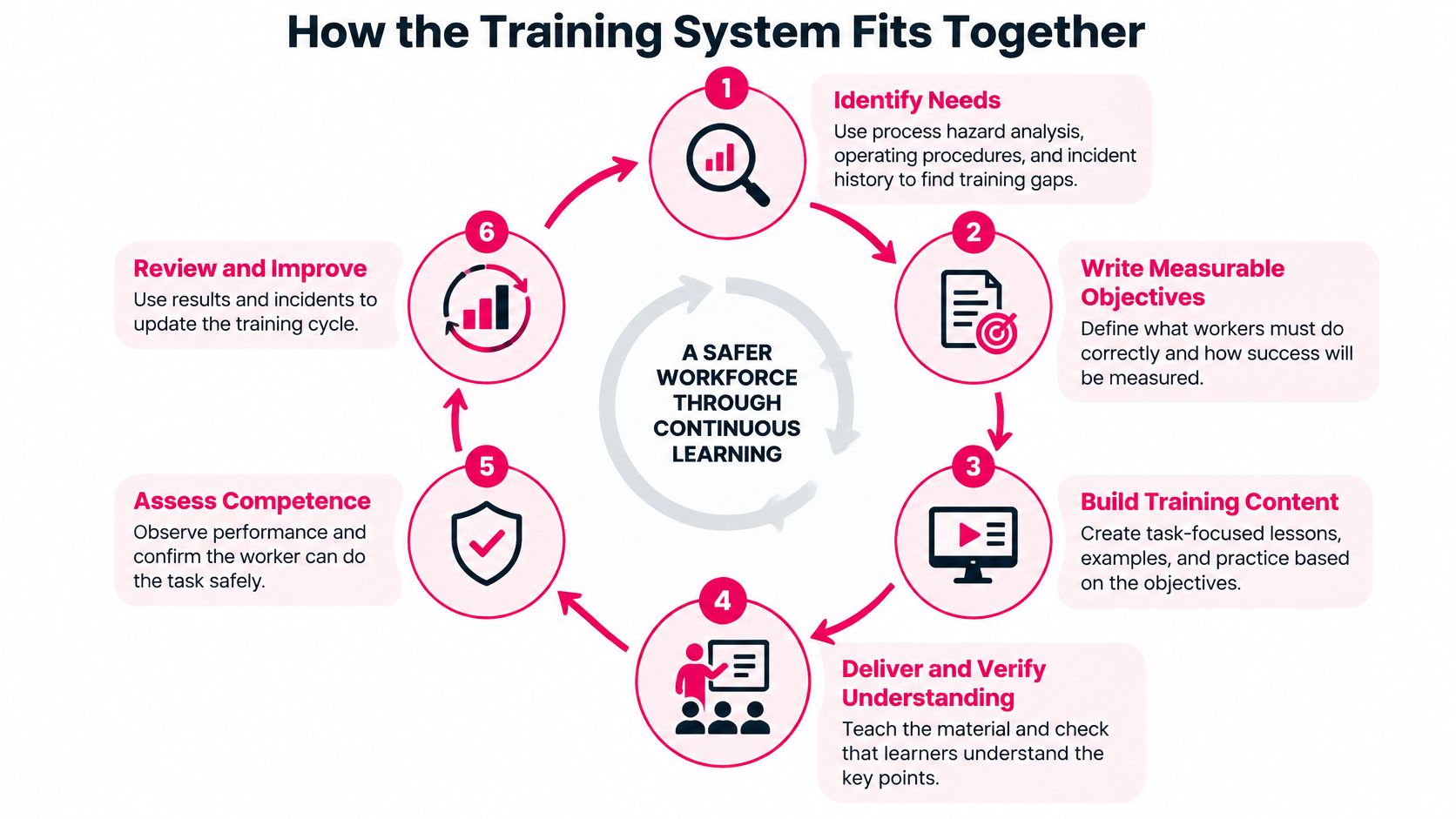
Treat training like a closed-loop control system: define the required output, measure actual performance and correct the difference. Without feedback, a training program can drift away from the operating process even while administrators keep every course assignment current.
Use the cycle below to connect lesson development with workplace evidence.
From identified need to verified performance
1. Identify needs from operating evidence. Review process hazard analysis findings, operating procedures, incident investigations and unresolved field questions. Select gaps that affect a worker's ability to maintain or restore a critical control.
2. Write measurable objectives. Specify the task, conditions and acceptable performance. Replace “understand isolation” with an objective requiring the worker to identify isolation points, verify the required state and explain what would prevent authorization.
3. Build and deliver task-focused content. Use classroom discussion for competing decisions, e-learning for foundational knowledge, simulation for abnormal conditions and coaching for equipment-specific execution. Choose the method after defining the objective.
4. Assess competence against the standard. Check understanding during delivery, then evaluate performance using the method appropriate to the task. Someone who can explain a procedure may still need supervised practice before independent authorization.
5. Record evidence and the resulting decision. Capture the individual, role, process area, required modules, completion date, assessment result and retraining trigger. Record whether the person is authorized, requires supervision or needs further instruction.
6. Review and improve. Feed procedure changes, near misses and assessment failures into the needs analysis. Assign an owner to update affected objectives and withdraw obsolete materials.
Keep the procedure and lesson connected
Procedure quality constrains training quality. If the written instruction leaves equipment identification or acceptance criteria ambiguous, don't ask a trainer to improvise the missing detail. Resolve the procedure first.
For help turning operational knowledge into usable instructions, WaterJobsIntel.com's standard operating procedure examples for operators provide a useful starting point. Adapt the structure to local authorization, equipment and emergency requirements rather than copying another operation's steps.
> Practical rule: Every training record should lead to a decision, not just a filing location.
Test the system by tracing an identified gap through its objective, lesson, assessment and authorization decision. If a stage has no document or accountable owner, the cycle isn't closed.
Role-Based Curriculum for Safety-Critical Work
A control room operator and a maintenance technician may face the same release hazard, but they need different skills to prevent it. Assign curriculum by task and barrier responsibility, then add shared content where roles must coordinate.
Use the role matrix as a starting point, not a substitute for reviewing actual job assignments.
Core modules and hazards by role
| Role | Core modules | Hazards to recognize | |---|---|---| | Control room operator | Process overview, alarm response, emergency shutdown | Abnormal conditions, interlock bypass, loss of containment | | Field operator | Operating procedures, energy isolation, permit-to-work | Stored energy, toxic exposure, hot work | | Maintenance technician | Energy isolation and verification, management of change awareness, nonroutine work authorization | Stored energy, confined-space entry, simultaneous operations | | Contractor | Site rules, hazard communication, emergency evacuation | Fire, explosion and toxic release linked to their task | | Supervisor or shift lead | Shift handover, stop-work authority, escalation criteria | Production pressure, procedure deviations, unplanned work |
For control room operators, teach the connection between indications and field conditions. An alarm-response lesson should require the operator to distinguish an instrument problem from a developing process upset and identify the applicable response.
Field operators need equipment identification and verification practice. Maintenance technicians need a clear boundary between approved restoration and a modification requiring review. Those are different learning problems, even when both groups use the same isolation procedure.
Build modules around barriers
OSHA's PSM compliance guidance emphasizes measurable training objectives, contractor hazard instruction and safe work practices. Translate those principles into task-level modules:
- Energy isolation and verification: Establish what must be isolated, how workers verify the condition and when they must stop.
- Permit-to-work controls: Teach the issuer and receiver to reconcile the permit with actual field conditions.
- Alarm and shutdown response: Connect the indication to the decision, action and escalation boundary.
- Change awareness: Help workers recognize when equipment, materials or work methods no longer match approved instructions.
- Hazard communication: Require workers to interpret relevant safety data sheet information for the planned exposure.
Contractors need task-specific fire, explosion and toxic-release instruction alongside emergency and evacuation arrangements. Supervisors need practice resolving conflicting priorities, including when to delay work rather than accept an unclear handover.
Keep short lessons within their limits
For a focused reminder about a single inspection point or barrier, one-point lessons from Forge Reliability offer a useful model. Keep the lesson narrow enough that a worker can apply it to a defined action.
Microlearning suits recognition and reinforcement. It doesn't replace supervised practice for line breaking, confined-space work or emergency execution. Where roles meet during startup, shutdown or simultaneous operations, add a joint exercise so each worker knows who owns the next decision.
Proving Competence Instead of Counting Completions
In Sphera's 2025 survey of 300 process-safety professionals, 50% identified training and competency as a leading challenge. The practical response isn't automatically more content. It's better evidence that workers can apply what the site already expects them to know.
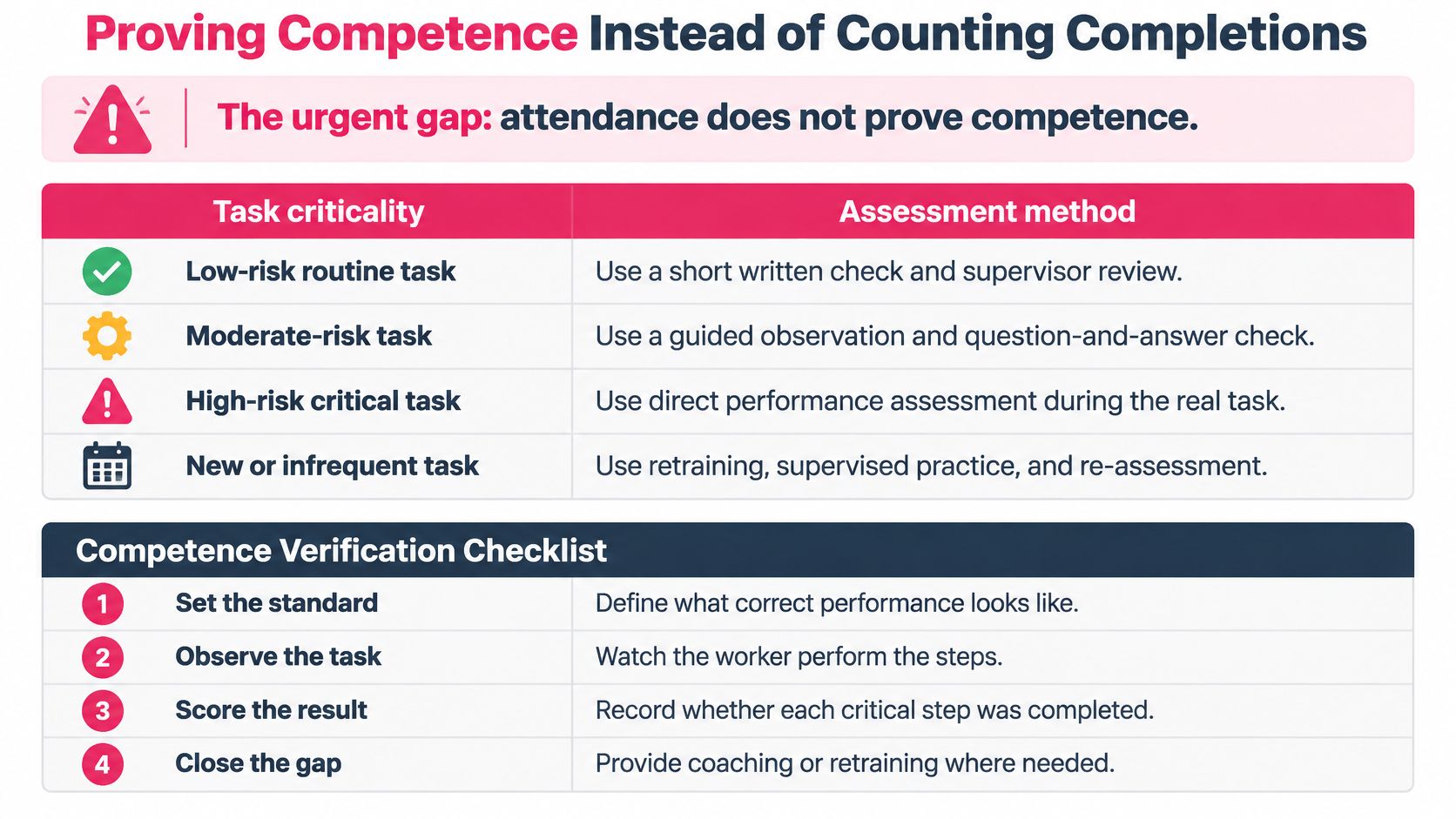
Competence means meeting a defined performance standard under specified conditions. Attendance, quiz scores and confidence can inform the assessment, but none should be mistaken for direct evidence of a high-risk skill.
Use task criticality to choose how closely the assessment must reproduce the work.
Define the standard before teaching
Start by listing critical tasks for each role. Then write the observable behaviors that demonstrate correct performance, including the decisions workers must make when instructions don't match conditions.
For an alarm response, those behaviors might include recognizing the abnormal indication, checking corroborating information, selecting the approved response and escalating when recovery criteria aren't met. For a permit review, competence includes challenging an unclear boundary rather than merely signing the document.
Set the passing standard before delivery. Identify critical failures that cannot be offset by correct answers elsewhere, such as proceeding without required verification. Use a qualified assessor who understands both the procedure and the process consequences.
Assessment method and retraining trigger by task criticality
| Task criticality | Evidence of competence | Retraining trigger | |---|---|---| | Low, knowledge-based | Scored check with a passing mark set in advance | Procedure revision or missed refresher date | | Medium, routine task | Observed walkthrough against a written standard | Near miss or repeated deviation from the standard | | High, safety-critical | Simulation or live job-task sign-off by a qualified assessor | Alarm failure, process change or transfer into the role |
Observe safely and score consistently
A written quiz tests recognition and recall. It can't demonstrate that a worker can locate the correct device, notice an unexpected condition or coordinate with another role under pressure. Use checks for understanding to identify misconceptions during instruction, then assess execution separately.
During normal work, supervisors can observe authorized tasks against a prepared checklist. Record what the worker did, what prompting was needed and whether each critical step met the standard. Don't manufacture a hazardous upset to make the assessment realistic. Use simulation when live testing would expose people or equipment to unnecessary risk.
For planning supervised workplace practice, TP Training's discussion of practical on-site safety training is a useful companion to a site-specific assessment plan. Local assessors still need to define acceptable performance and stop conditions.
> A correct outcome reached through an unsafe shortcut is not a passing performance.
After a failure, diagnose the cause before assigning another course. The worker may need practice, but the site may instead need a clearer procedure, repaired indication or corrected work authorization. Reassess the affected task after the corrective action, and limit authorization until the required evidence exists.
Report demonstrated performance, unresolved critical gaps and authorization restrictions to management separately from attendance, and don't claim risk reduction from course completion alone.
Human Factors and Knowledge Loss Training Misses
Procedure compliance doesn't guarantee process safety. A worker can follow an instruction accurately while using an obsolete assumption, accepting an incomplete handover or overlooking a field condition the document doesn't describe.
In Sphera's reporting on people and process safety management, 36% of respondents cited frontline engagement as a concern in 2025, alongside concerns about retirement-driven knowledge loss. Training should give workers a way to challenge unsafe assumptions, rather than repeat approved wording.
Teach the decisions between procedure steps
- Changes that don't reach operators: Say a replacement component changes how equipment responds. Ask the shift to identify which operating assumptions and instructions need confirmation before use.
- Handovers that lose open issues: Give the incoming crew an unresolved instrument fault and a pending maintenance job. Require them to name the restrictions, owner and next decision.
- Production pressure: Use a scenario where a delayed startup creates pressure to proceed with an incomplete check. Have the supervisor explain the stop-work decision and escalation route.
- Alarm overload: Present competing indications and require prioritization using approved response logic. Don't teach workers to dismiss familiar warnings without checking their significance.
- Contractor interfaces: Use a task where the contractor assumes the host verified isolation and the host assumes the reverse. Make ownership explicit before anyone authorizes work.
Capture reasoning without endorsing workarounds
Before an experienced operator retires or changes roles, ask them to explain the cues they use, the assumptions they challenge and the conditions that make them stop. Record those explanations against the relevant task, then have operations and process safety personnel review them.
Some tacit knowledge is valuable diagnostic reasoning. Some is an unauthorized workaround. Preserve the former and investigate the latter rather than converting every familiar practice into training.
Facilitated discussions should put control room and field perspectives side by side. A console indication may appear stable while a field operator notices vibration, leakage or an unexpected equipment state. Workers need practice reconciling those observations and escalating uncertainty.
> Content review test: Can a worker recognize their equipment, their shift constraints and their authority to challenge the job?
Highly standardized or AI-generated material needs that local review. Remove irrelevant detail, but don't remove dissent, uncertainty or the operating context that helps workers detect weak controls.
Measuring Training Effectiveness Over Time
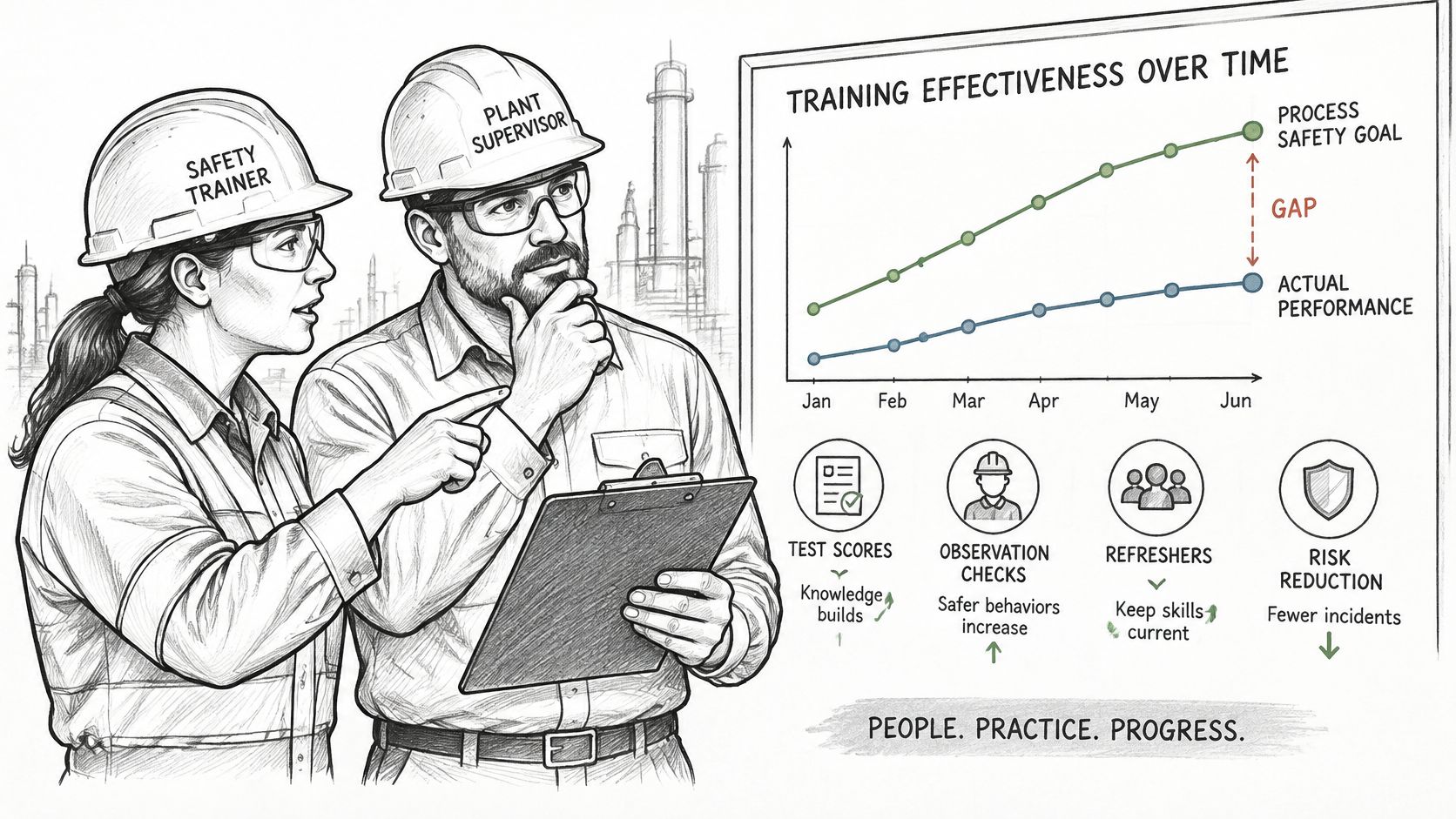
In Sphera's 2024 Process Safety Survey, 66% of respondents reported a gap between their organization's process safety goals and employees' on-the-job experience. Evaluate training where that gap becomes observable: task execution, decisions and control verification.
Use the performance discussion to connect the training record with the operating reality.
Training effectiveness metrics and what they show
| Metric | What it shows | Signal type | |---|---|---| | Completion rate | Who attended, not whether they can perform | Activity measure | | Observed competence pass rate | Whether workers meet the written performance standard | Competence measure | | Near-miss reports after training | Whether hazards are recognized and reported | Leading signal | | Procedure deviations per shift | Whether operators follow critical steps under pressure | Leading signal | | Drill response time | Whether shutdown decisions happen within the required window | Performance measure | | Incidents with a training root cause | Whether training gaps reached the process | Lagging signal |
Interpret the signal before acting
Activity measures help administrators identify missed assignments and overdue learning. They don't establish whether workers can perform independently. Keep them visible, but separate from operational assurance.
Competence results need context. Compare assessments using the same standard, and distinguish independent passes from performances requiring coaching. An apparent improvement means little if assessors have relaxed the criteria.
Leading signals require investigation rather than automatic celebration. More near-miss reports may reflect better recognition and reporting, not worsening conditions. Fewer reported deviations may indicate improvement, or reluctance to speak up. Compare the reports with observations and worker discussions.
Drill performance should include the quality of the decision, not just elapsed time. Fast execution of the wrong response isn't improvement. Lagging incidents require a broader investigation before assigning a training cause, especially where equipment condition, procedures or supervision contributed.
Use the video as a discussion prompt, then test the discussion against local task evidence.
Assign a review rhythm and close actions
A practical review schedule is to examine leading signals monthly by shift, review competence results quarterly against the written standards and audit training records annually. Treat this as a recommended management rhythm, not a replacement for regulatory audit requirements or event-driven reviews.
For each gap, record the affected behavior, corrective action, owner and verification method. If workers misidentify an isolation boundary, for example, correct the instruction or labeling as necessary, provide targeted practice and observe subsequent execution.
A broader framework for measuring training effectiveness can help organize reporting. Keep the conclusion narrow: describe the behavior that changed and the evidence supporting it, rather than presenting completion percentages as proof of safety.
Confirm the Objectives Before You Change the Training
Confirm the objectives before commissioning new content. Otherwise, a team can spend its production budget improving the appearance of a lesson that still doesn't address the critical task.
Start with a bounded test
1. Select a process and role. Write a clear learning objective for each module before building content. Our implementation checklist recommends one clear learning objective per lesson before production. Make the objective observable so the reviewer can judge whether the lesson prepares the worker for the assessment.
2. Inspect the existing file. Use the requirements table to flag missing dated records, named roles and evidence of understanding. Assign an owner to each gap and distinguish missing documentation from an actual skill gap.
3. Observe a high-criticality task. Select an authorized isolation verification or simulated alarm response. Score performance against the written standard, record any prompting and decide whether independent authorization remains appropriate.
4. Publish findings and check closure. Our implementation checklist recommends publishing, measuring completion and iterating every two weeks. Use that first check to confirm whether assigned gaps closed, then continue the monthly leading-signal and quarterly competence reviews.
Rebuild the highest-risk module first
Choose the module associated with the most consequential unresolved performance gap. Correct the objective, procedure or assessment before changing the presentation, then verify the revised lesson through observed performance.
Keep each lesson auditable by connecting its objective to a task, assessment and authorization decision. Once that connection works, expand the approach across the role matrix rather than rebuilding the entire catalog at once.
---
VideoLearningAI helps teams turn existing course materials into bite-sized training videos and publish them for learning management systems. Visit VideoLearningAI to build a task-focused lesson around your highest-priority learning objective, then pair it with the site-specific performance assessment needed to verify competence.