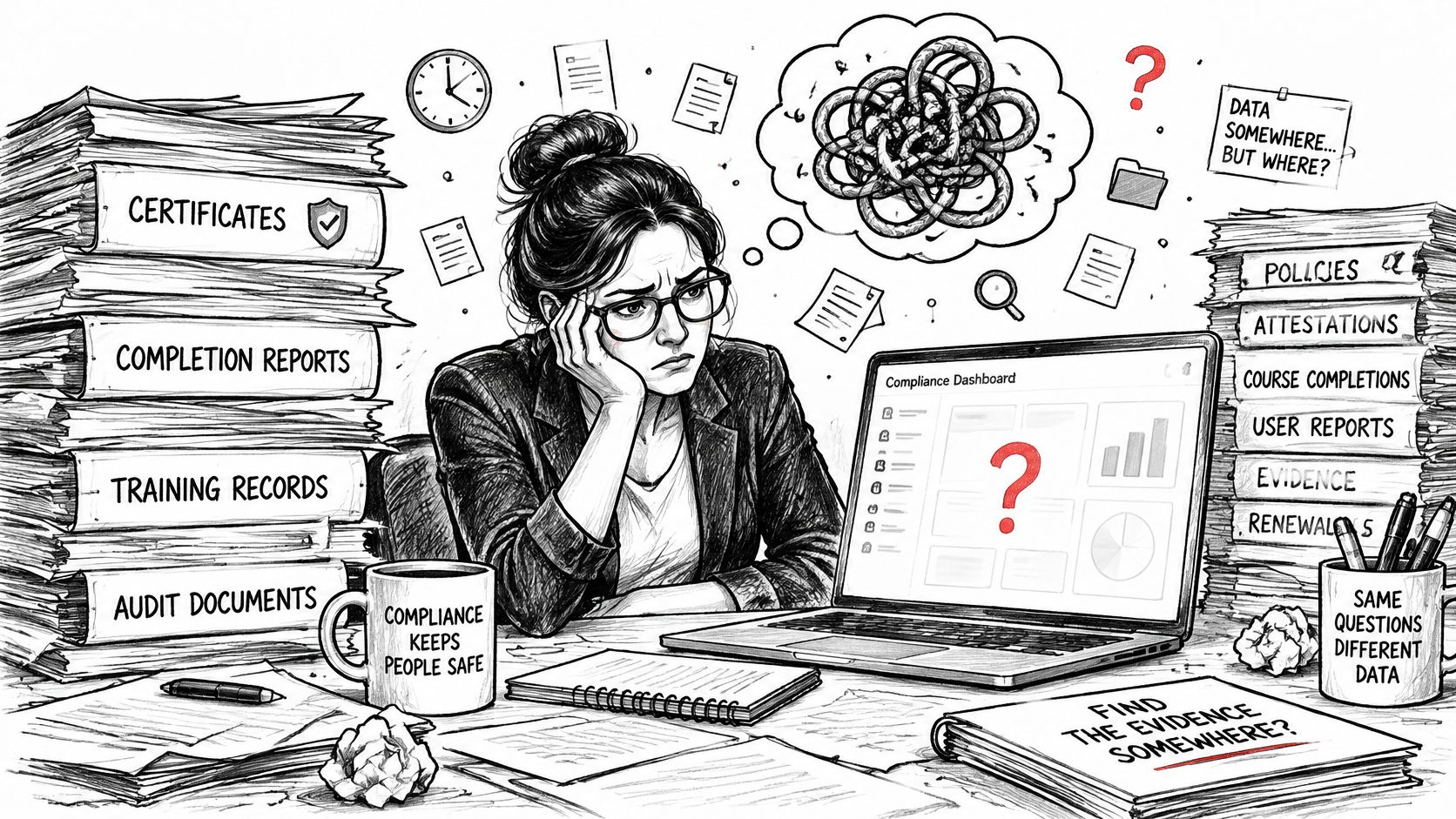
An L&D manager has assigned every relevant KPA course, and the dashboard is green. Completion certificates are filed, but when a supervisor asks whether employees follow the required procedure on the job, the manager can't give a confident answer. The courses were delivered. Whether they changed what people do is still unclear.
That gap matters because a training record and proof of competence aren't the same thing. A useful program connects course activity with what employees need to do, how supervisors can verify it, and what the organization learns from operational risk data.
Table of Contents
- Why Completion Is Not Enough
- Understanding KPA Compliance Training
- How KPA Compliance Fits Into Workplace Risk
- Write Learning Objectives That Match Real Work
- Compare Completion Competency and Behavior
- Design Video-Based Compliance Modules
- Build a Repeatable Microlearning Workflow
- Build a Compliance Learning Checklist
Why Completion Is Not Enough
A completion dashboard answers a specific question: did the learner finish the assigned course? It doesn't automatically show whether the learner understood the material, can apply it in a realistic situation, or follows the relevant procedure at work.
For example, an employee might complete a chemical-safety lesson but still be unsure where to find the Safety Data Sheet for a product they handle. A manager might see the course marked complete without knowing whether the employee can select the right protective measure or explain when to stop work and ask for help.
The next step is to treat the LMS record as the start of an evidence chain. Add a knowledge check that tests a decision, a supervisor observation that verifies the expected action, and a follow-up process when the employee misses a step. If an incident or near miss points to a recurring knowledge gap, use that information to review the assignment and decide whether focused retraining is appropriate.
> Practical rule: A certificate can show that learning was delivered. It can't, by itself, show that an employee can perform a task safely.
KPA's safety guidance frames training as part of a broader, evidence-based EHS control system, not a standalone course. It also describes incomplete training as a risk indicator and recommends considering completion information alongside accident and near-accident data when deciding whether retraining is needed (KPA's data-driven workplace-safety guide).
This way of thinking applies beyond safety. If you're reviewing a program after an event, a practical breakdown of event report sections can help organize what happened, what response followed, and what evidence the organization should retain. The central question remains concrete: what did the course ask the employee to do, and what evidence shows they can do it?
Understanding KPA Compliance Training
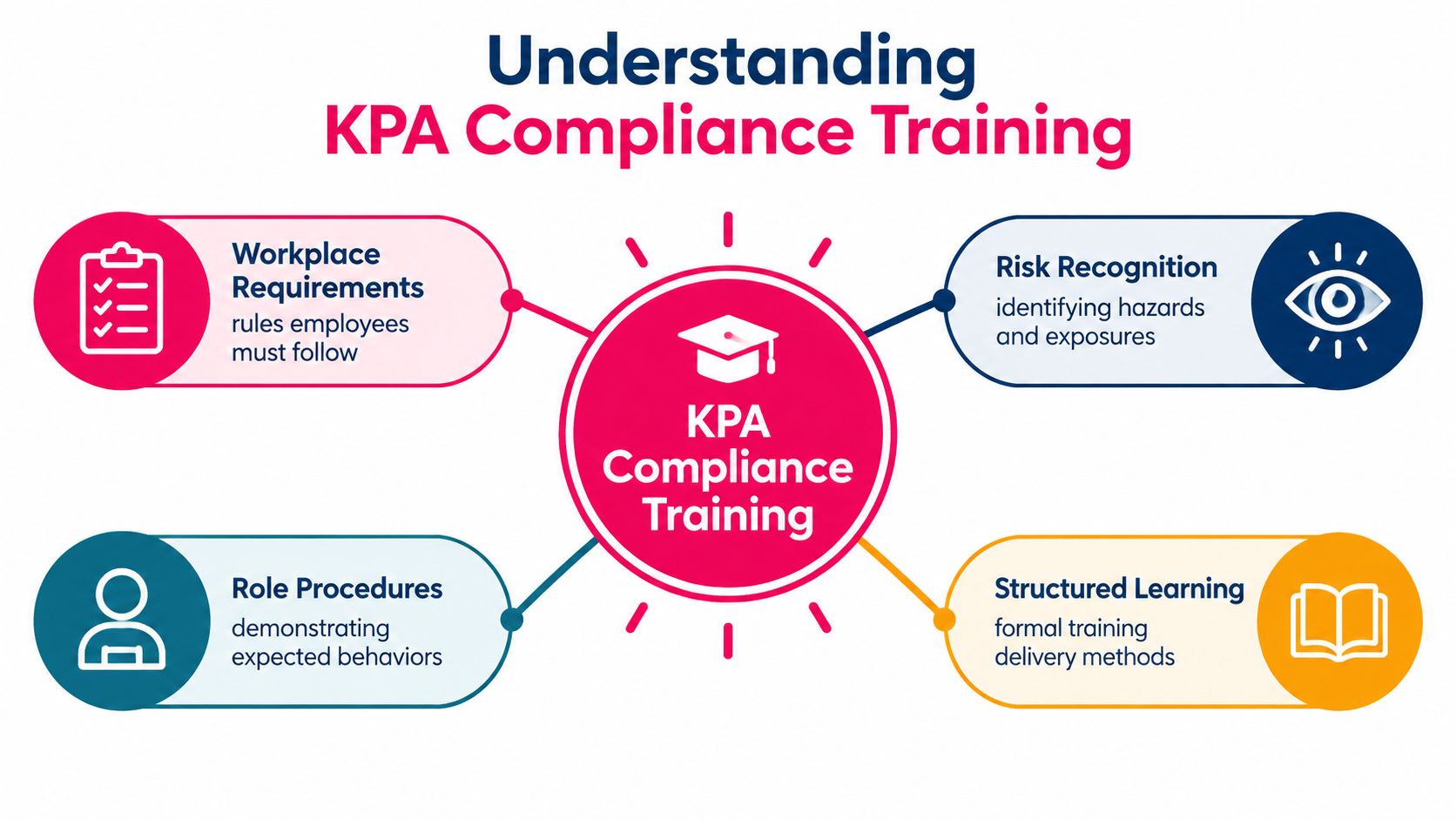
KPA compliance training brings workplace learning into a wider set of organizational responsibilities. Its course coverage includes environment, health and safety, human resources, financial and insurance compliance, cybersecurity, harassment prevention, and other workplace topics, as described in the National Safety Council's KPA company profile.
That range helps explain why the phrase “compliance course” can mean very different things across teams. A safety module may focus on recognizing a hazard and following a protective procedure. A harassment-prevention lesson may focus on identifying conduct that needs attention and understanding how to report it. The subject changes, but the instructional task is similar: help the learner recognize what matters and choose the expected action in context.
A useful analogy is a route map. The course provides one route through the topic, but the organization still needs to check that the route fits the employee's destination. Assignment rules determine who needs the lesson. Written policies and operating procedures explain what the organization expects. Protective controls shape what workers can do on the job. Records help show what training was assigned and completed, while refresher decisions respond to changes or identified gaps.
This distinction prevents a common misunderstanding: having access to a course library doesn't mean every course applies to every worker, or that completing a course establishes universal regulatory compliance. The course is one part of a program. The employer still needs to connect the lesson to the applicable requirements, actual work, procedures, and evidence.
When teams make those connections, kpa compliance training becomes more than content delivery. It becomes a structured way to communicate expectations and check whether employees can make relevant decisions. The key is to define the learner's job context before deciding what the course should teach.
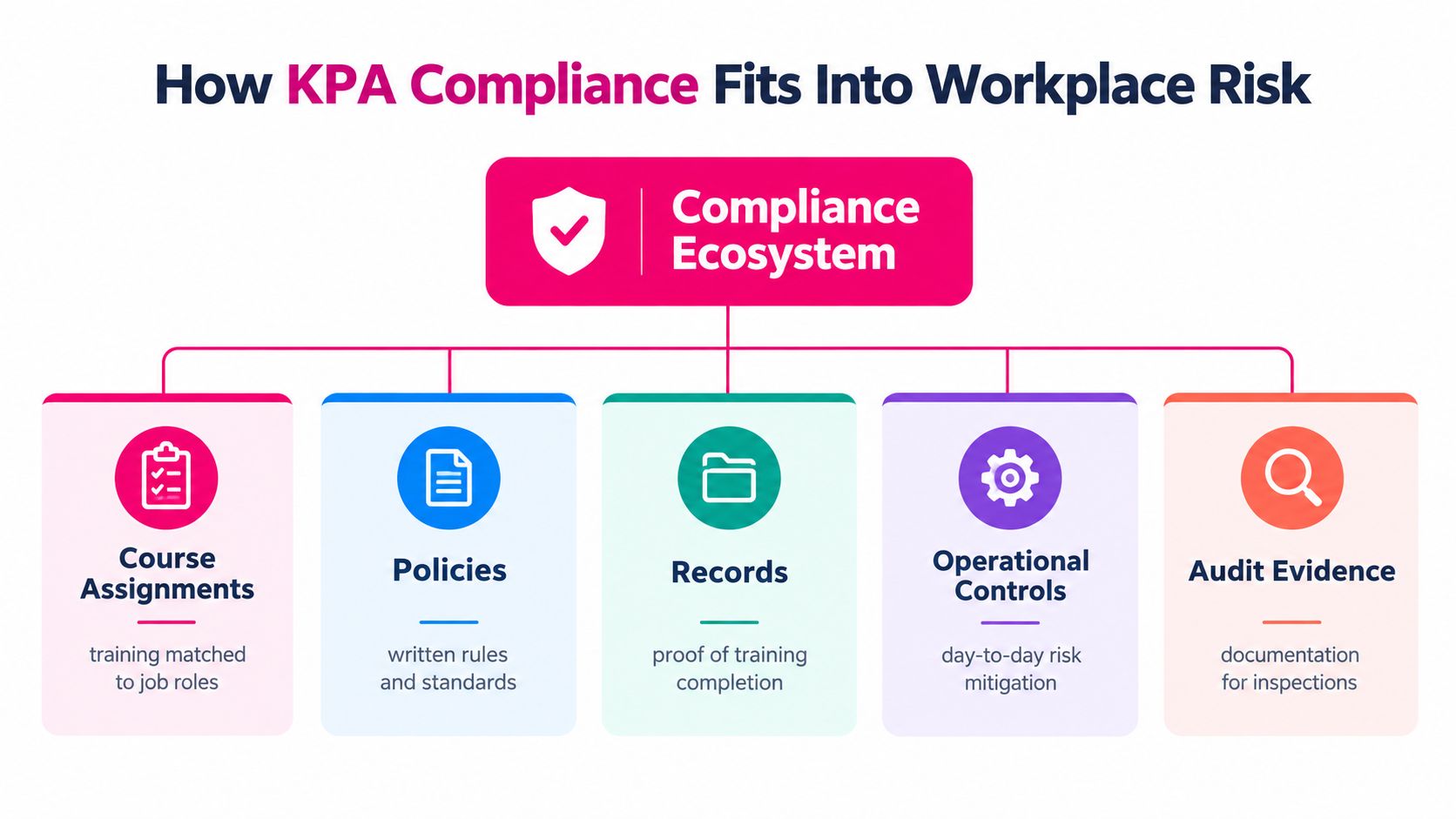
How KPA Compliance Fits Into Workplace Risk
A compliance system works through connected parts. Course assignments tell employees what learning applies to them. Policies set out organizational expectations. Records document the learning activity. Operational controls help workers carry out the required procedures, and audit evidence gives reviewers a way to understand what the organization has put in place.
KPA's development reflects that broader model. The National Safety Council's profile identifies KPA as founded in 1984, while KPA describes its modern EHS and compliance-services market presence as dating from 1986. Its offering has grown beyond a safety-management focus to combine software, consulting, and online training. In a 2025 announcement, KPA reported serving more than 15,000 companies and facilitating more than 12 million online workplace-safety trainings during 2024, with an online compliance-training library of over 1,000 courses (KPA's training-volume announcement). Those figures describe delivery scale, not unique learners or independently verified learning outcomes.
Scale can make a connected approach useful, but a platform or course catalog doesn't determine whether a module applies to a particular employee. The compliance owner still needs to consider the learner's jurisdiction, industry, site, role, and actual work performed. A generic lesson may explain a topic clearly while missing a local procedure, a specific hazard, or a task that changes what the employee should do.
Hazard communication is a good example. OSHA's requirements involve more than training alone: organizations need a written hazard-communication program, accessible and current Safety Data Sheets for hazardous chemicals, and training that enables employees to understand workplace hazards and protective measures. The course should connect to the employer's actual chemical information and procedures, not stand in for them.
The iframe below is included as a media resource. Teams should still review any training content against their own approved procedures and applicable requirements.
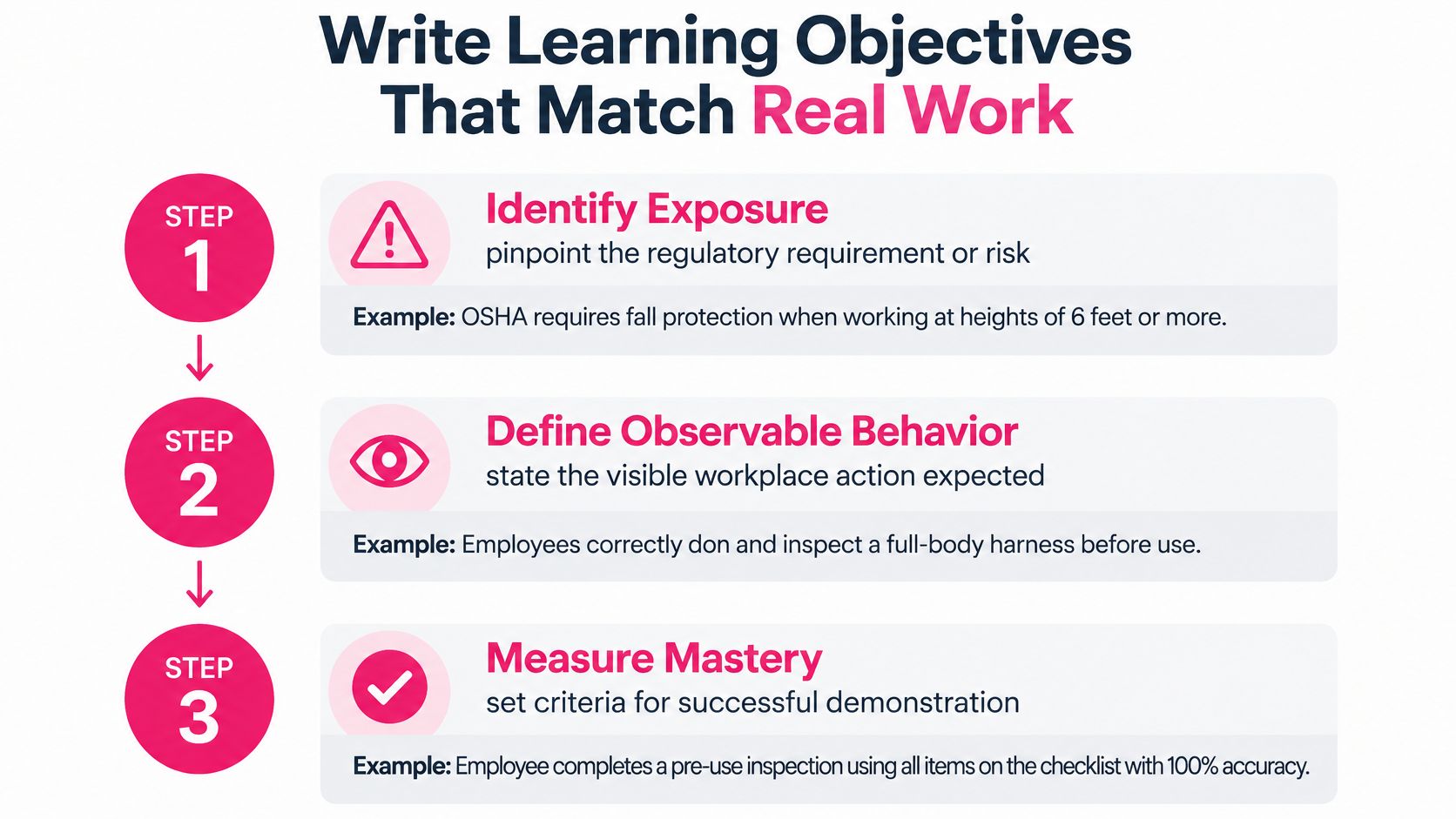
Write Learning Objectives That Match Real Work
A useful learning objective describes what the employee should be able to do, not merely what information they should encounter. “Understand the policy” is hard to verify. “Identify the applicable reporting path in a workplace scenario” gives the learner a decision to make and the reviewer something specific to assess.
Build an objective by working through the job context in order:
1. Identify the exposure or requirement. Name the hazard, rule, or workplace situation the learner needs to recognize. For a new employee handling cleaning products, that might mean identifying which product they're using and where to find its Safety Data Sheet. 2. Define the visible action. Describe what the employee should do. For example, the learner locates the relevant sheet, checks the organization's procedure, and selects the protective measure required for the task. 3. Choose evidence of learning. Decide how to test the action. A scenario question can test whether the employee chooses the right next step. A hands-on demonstration or supervisor observation may be better when the task involves equipment or a physical procedure. 4. Set a follow-up condition. Decide what should trigger a refresher or escalation, such as a failed assessment, a changed procedure, or a supervisor observing the wrong action.
The assignment should also match the employee's work. A new hire may need an introductory lesson tied to their initial duties. Someone moving into a different role may need a targeted refresher. An employee who works across sites may need to learn which requirements stay consistent and which site-specific procedures they must verify before starting.
KPA notes that course applicability can vary by state, industry, and work performed. Teams should validate assignments with their compliance owner or a competent regulatory adviser rather than assuming a general module covers every obligation (KPA's EHS compliance overview). For a practical example of job-specific content, teams developing cleaning operations training can review janitorial PPE and chemical safety modules and use them to prompt questions about tasks, products, and protective procedures in their own workplace.
For more help turning a topic into an observable outcome, see this guide to writing learning objectives. The objective should make it possible to answer a plain question: what could a supervisor see or hear if the learner has mastered this?
Compare Completion Competency and Behavior
Different evidence answers different questions. Completion shows that a learner finished an assignment. Competence shows whether the learner can respond to a relevant prompt or demonstrate a procedure. Workplace behavior concerns whether the expected action appears in real work.
| Evidence Level | What It Shows | Useful Checks | Main Limitation | |---|---|---|---| | Completion record | The course was assigned and marked complete | Assignment, start, completion, content version, date, and assessment result | Doesn't prove the learner can apply the material | | Demonstrated competence | The learner can answer a scenario or perform a task | Scenario-based questions, knowledge checks, or hands-on demonstration | A test or demonstration may not reflect routine work | | Workplace behavior | The expected procedure is followed on the job | Supervisor observation, corrective-action closure, or review of relevant operational records | Observation can be limited to the situation reviewed |
Choose the level of evidence that fits the risk and task. A short orientation topic may need a completion record and a relevant knowledge check. A procedure involving a workplace hazard may also need a practical demonstration or supervisor observation. The goal isn't to create an elaborate audit for every lesson. It's to match the verification effort to what employees must do and the consequences of getting it wrong.
For a concrete chemical-handling example, a learner might pass a scenario question about finding a Safety Data Sheet. A supervisor could then check whether the employee consults the right workplace procedure before handling the product. If a corrective action follows an incident, the organization can retain evidence that the issue was addressed and decide whether the learning assignment needs revision.
> Strong evidence doesn't come from collecting every possible record. It comes from choosing checks that answer the question the organization actually has.
Teams refining their measures can use a guide to measuring training effectiveness to distinguish learning activity from evidence of change. For a related perspective on connecting learning with organizational outcomes, this discussion of strategy execution training effectiveness may help teams clarify what they expect training to support.
Design Video-Based Compliance Modules
A short video module works best when it helps an employee make a decision, rather than presenting a condensed policy. Give the learner a recognizable setting, show the information they need, and ask them to choose what to do. Then explain why the selected action fits the organization's approved procedure.
Consider a hazard-communication lesson for an employee preparing to use a workplace chemical. The opening scene can identify the product and the task. The learner then chooses where to find the relevant Safety Data Sheet, reviews the applicable workplace procedure, and selects the required protective measure. A focused knowledge check can ask what the employee should do if the available information doesn't match the product or task. The lesson should reflect the employer's actual inventory and controls, not substitute for them.
An anti-harassment module can follow a different scenario. A learner sees a workplace interaction that raises a concern, identifies what makes the situation inappropriate under the organization's policy, and chooses the next step using the approved reporting path. A scenario question can test whether the learner knows when to report, who can receive the report, and what to do if the usual contact is involved.
Keep the presentation clear. Captions help learners follow narration, especially when they're reviewing a lesson in a noisy setting or need to revisit a key phrase. Visible choices let the learner see what information informs a decision. Short narrative beats keep one lesson focused on one topic, while a knowledge check gives the learner a chance to apply the idea.
A course owner should also decide what happens after the learner answers. If the learner chooses incorrectly, provide a brief explanation and a chance to review the relevant step. If a missed answer signals a serious misunderstanding, the organization can set an appropriate follow-up, such as supervisor review or a targeted refresher.
These examples describe instructional structure, not a substitute for legal or EHS review. The compliance owner should confirm that the scenario, reporting path, protective measures, and assessment match current approved materials before the module goes live.
Build a Repeatable Microlearning Workflow
A reliable production workflow separates instructional design from compliance approval. That distinction helps teams work efficiently without asking a video tool or course author to decide what a regulation requires.
1. Select and verify the subject. Start with a defined workplace need, then confirm the controlling requirement, policy, or procedure with the responsible subject-matter owner. 2. Set the audience and objective. Specify who needs the lesson, where they work, and what observable action they should demonstrate. 3. Choose a scenario that reflects the task. Use approved examples that resemble real decisions employees face. Avoid details that could confuse the organization's procedure with a general illustration. 4. Draft the script and assessment together. Write the explanation, learner decision, feedback, and knowledge check as one instructional unit. This keeps the test aligned with the behavior the course teaches. 5. Create and review the video. Add clear narration, captions, and visual cues. Ask the compliance or EHS owner to check technical accuracy, terminology, and alignment with current procedures. 6. Publish with usable tracking. Make the module available through the organization's LMS and record assignment, start, completion, assessment result, content version, expiration, and retraining status. 7. Set review and update conditions. Identify who will review the content when a procedure changes, an assessment reveals a recurring misunderstanding, or workplace data points to a gap.
VideoLearningAI can turn approved course materials into structured, bite-sized training videos and support a workflow from drafting through LMS-oriented publishing. It can help with production tasks, but the responsible compliance, legal, or EHS reviewer still needs to approve the content and confirm that it reflects the organization's requirements.
Teams exploring shorter, focused lessons can also review practical microlearning benefits. Whatever production method they use, they should keep version control visible: a completion record is harder to interpret when the organization can't tell which content the employee saw.
Build a Compliance Learning Checklist
Use this checklist to review an existing program or plan a new one:
- Applicability: Is the course assigned to the right role, site, jurisdiction, and work activity?
- Approved content: Does the module reflect current, organization-approved requirements and procedures?
- Observable objective: Can a learner demonstrate a specific action, rather than just recall a policy title?
- Accessible delivery: Are narration, captions, and visuals clear for the intended audience?
- Scenario-based assessment: Does the knowledge check test a decision the employee may face at work?
- LMS evidence: Does the record capture the learner, assignment, completion, result, and content version?
- Supervisor verification: Is there a practical way to confirm the required behavior when the task calls for it?
- Follow-up: Are there defined refresher or escalation triggers for failed checks, changed procedures, or identified risk?
- Content review: Does an accountable owner revisit the module when approved materials or work practices change?
The durable principle is simple: the LMS record proves delivery; stronger evidence connects delivery to competence and workplace behavior.
---
VideoLearningAI helps teams turn approved compliance materials into structured training videos, including focused lessons designed for modern learning workflows. If you're improving KPA compliance training, visit VideoLearningAI to explore how it can support the creation and publishing of your next module.