
A compliance refresher is due before the next regulatory deadline. A new onboarding cohort starts next week. The previous twelve-week curriculum is still sitting in the learning platform, largely unfinished, while managers ask why employees can't apply material they technically completed.
That tension is pushing L&D teams to reconsider the long-format course. The benefits of microlearning aren't limited to shorter lessons or higher completion. Used properly, microlearning gives teams a way to reinforce knowledge, deliver timely performance support, and connect learning activity with what people do at work. Used poorly, it creates a library of forgettable video snippets.
Table of Contents
- The pressure is operational, not fashionable - Start with one objective - L&D skill-building - Compliance training - Employee onboarding - Customer education - 1. Distribute practice - 2. Use the learner's real device - 3. Build retrieval into every module - 4. End with an actionWhy Training Teams Are Rethinking the Long-Format Course
The L&D manager in this situation doesn't necessarily have a content problem. The team may already have policies, slide decks, recorded workshops, and subject-matter experts. The problem is delivery. A desk-based employee may postpone a long course until a quiet afternoon that never arrives. A frontline worker may not have an uninterrupted block at all. A hybrid team may need the same update across different schedules, devices, and locations.
Long-format training still has a place. It can establish a foundation, support formal certification, and give learners enough time to work through interconnected ideas. But asking every learner to absorb a broad curriculum in one sitting creates a poor fit for many operational needs, especially when the objective is a narrow policy update, a product change, or a single task.
The pressure is operational, not fashionable
Regulatory windows can be tight. Onboarding teams need to prepare new hires without taking them away from productive work for too long. Customer-facing employees need guidance close to the moment they use it. L&D leaders also face pressure to demonstrate more than a completion certificate. They need to show whether people can recall a policy, handle a customer interaction, or complete a workflow correctly.
That changes the design question. Instead of asking, “How do we fit everything into one course?”, practitioners ask, “What does this person need to know or do next?” A short lesson can answer that question directly, provided the objective is narrow and the lesson connects to practice.
> Practical rule: Use a long course to build a framework. Use microlearning to reinforce, refresh, and support action within that framework.
The shift also reflects the reality of distributed work. A learning experience that works on a laptop in a scheduled session may fail on a phone between tasks. Microlearning gives teams more delivery options, but it doesn't automatically solve poor instructional design. Cutting a long module into smaller files without changing its objectives, sequencing, or assessment usually produces smaller fragments of the same problem.
The strongest programs treat microlearning as part of a broader learning system. They reserve it for focused objectives, build reinforcement into the workflow, and retain longer formats where learners need sustained attention, discussion, coaching, or repeated practice.
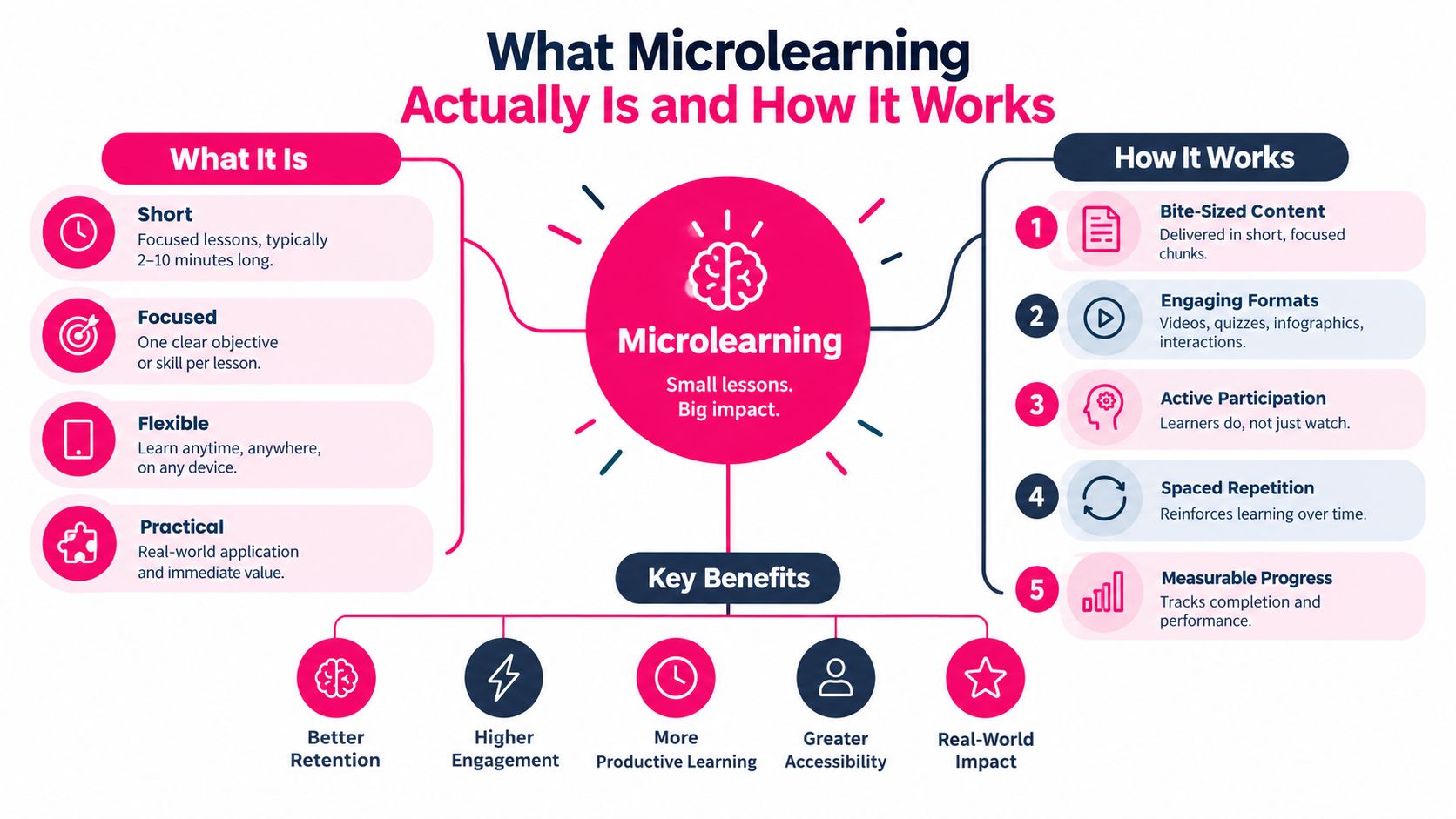
What Microlearning Is and How It Works
A compliance course can explain the full policy, while a microlearning lesson helps an employee choose the correct action at the point of need. Microlearning is a focused learning experience with enough explanation, retrieval, and practice to support one complete objective, rather than any short piece of media.
A lesson usually addresses one task, concept, or decision. Formats include a short video, scenario card, knowledge check, annotated process image, audio explanation, or job-aid snippet. Teams can deliver it through a learning platform, mobile device, desktop browser, or a tool employees already use.
Start with one objective
A practical design sequence is:
1. Name the action. State what the learner should be able to do after the lesson. 2. Remove nice-to-know material. Keep information that supports that action. 3. Choose the format. Use a demonstration for a physical process, a scenario for judgment, and a checklist for a repeatable workflow. 4. Require retrieval. Ask a question, present a decision, or use a prompt that makes the learner recall and apply the idea. 5. Connect the lesson to work. Specify what the learner should apply, observe, or discuss next.
Chunking limits the amount of competing information a learner processes at once. A focused lesson can reduce unnecessary mental effort, but shortness alone does not create learning. Without retrieval, feedback, and follow-up, a polished clip may produce recognition during training without reliable performance later.
Short-form production also benefits from clear visual communication. Teams creating educational video can use an explainer video resource for edtech companies to translate a complicated idea into a concise visual explanation without turning the lesson into a dense presentation.
Spacing determines whether that first exposure lasts. A learner may recognize an idea immediately after a lesson and still fail to recall it later. Revisit the idea across the learning journey, ask for retrieval before showing the answer, and provide feedback. For complex topics, pair these focused lessons with longer instruction, discussion, coaching, or repeated practice. Microlearning works best as one component of that system, not as a universal replacement for it.
The Core Benefits of Microlearning for L&D Programs
The benefits of microlearning become clearer when they're tied to program decisions rather than treated as a list of marketing promises. A team should ask which outcome matters most, then design and measure around it.
Research provides meaningful support for retention and learning outcomes. A 2025 meta-analysis synthesized 42 studies involving 15,673 participants across 18 countries and found a pooled retention odds ratio of 1.87, with a 95% confidence interval of 1.45 to 2.41 and p < 0.001. The same analysis reported a standardized mean difference of 0.74 for learning outcomes, with a 95% confidence interval of 0.58 to 0.90 and p < 0.001. These results support microlearning as a high-impact format in the studied higher-education contexts, though workplace transfer still needs careful design (meta-analysis of microlearning in higher education).
| Benefit | Evidence | Practical impact | |---|---|---| | Retention | Spacing, focused objectives, and retrieval support stronger recall. | Build refreshers into the learning journey instead of relying on one exposure. | | Engagement | Shorter experiences can fit more naturally into busy schedules. | Reduce the friction that stops employees from starting or finishing training. | | Speed to deploy | Small objectives are easier to script, review, update, and localize than broad courses. | Release a targeted policy or product update without rebuilding an entire curriculum. | | Scalability | Digital lessons can be reused across locations and delivery channels. | Standardize core guidance while adapting examples for roles or regions. | | ROI visibility | Focused interventions can be connected to completion, assessment, performance, and time-to-competency measures. | Move the conversation beyond certificates and activity counts. |
A recent evidence review reported that microlearning courses can reach about 80% to 90% completion, compared with roughly 20% to 30% for longer eLearning courses. It also associated short content formats with an improvement in retention of about 20% and a reduction in re-reading needs by a factor of three (evidence review summarized by Makeheadway). Those figures shouldn't become a universal promise. Completion depends on relevance, access, management support, and the quality of the learning experience.
The speed advantage is practical. A narrow lesson needs fewer approvals, a smaller script, and a more manageable review cycle. That makes it easier to update compliance guidance or customer education when the underlying information changes.
Scalability comes from reuse, not from copying the same lesson everywhere without thought. A core lesson can support multiple regions, while examples, language, scenarios, and job aids are adapted for the people who will apply it.
For ROI, completion is an entry metric, not the finish line. Pair it with assessment performance, observed behavior, time to competency, error reduction, or another business measure that reflects the objective. Teams comparing formats can also review the operational advantages of asynchronous learning, especially when learners work across different schedules.
Where Microlearning Works Best in Practice
Microlearning works best when the learner needs a focused intervention, the context is fragmented, or reinforcement matters more than a one-time information dump. The format can support several workflows, but each one needs a different lesson design.
L&D skill-building
For a sales team, a lesson called “Open a discovery conversation” is more useful than a broad module called “Consultative selling.” The lesson can show a short interaction, ask the learner to choose a response, and direct them to use the technique in their next customer conversation. A later lesson can address a different skill, such as handling an objection, without forcing the learner through unrelated material.
The same pattern works for manager development. A short scenario can ask a manager how to respond to missed expectations, then provide feedback and a prompt for a real conversation. The lesson doesn't replace coaching. It prepares the learner to use coaching more effectively.
Compliance training
Compliance content often changes in small increments, and employees need to apply it in specific situations. A short anti-bribery scenario can present a supplier offering an inappropriate benefit, ask the learner to choose a response, and explain why the decision matters. Follow-up questions can revisit the distinction later.
That approach is more useful than sending a dense policy document and assuming that a completion record proves understanding. Microlearning can reinforce a formal compliance course, highlight a policy update, or provide a quick decision aid. It shouldn't be the sole method when employees need to interpret complicated regulations or exercise significant judgment.
Employee onboarding
A frontline onboarding path can deliver a sequence of focused lessons across the employee's first days. One lesson might cover clock-in procedures, another a customer greeting, and another a safety check. Each lesson should connect to an action the new hire can perform with a manager or buddy.
This structure gives the onboarding team a way to introduce information close to the moment it becomes relevant. It also gives managers more opportunities to observe performance rather than waiting for a final assessment.
Customer education
Customer education benefits when guidance appears close to the product feature or task. A contextual tutorial can show how to configure a workflow, interpret a report, or resolve a common issue. The customer doesn't need to search through a full academy course for one answer.
The operational test is simple. If learners regularly need one answer, one procedure, or one decision while working, microlearning is a strong candidate. If they need a connected mental model, extended practice, or feedback from an expert, the short lesson should sit inside a broader experience.
When Microlearning Falls Short on Complex Topics
A five-minute lesson can clarify one contained objective. It can also leave learners lost when a procedure depends on several connected ideas. The issue is not duration alone. Spacing, retrieval practice, and opportunities to apply the material determine whether short lessons build capability.
Clinical device operation, advanced troubleshooting, and sales negotiation all expose the risk. If each activity becomes an isolated fragment, learners may remember terms without understanding sequence, conditions, or consequences. They can pass a quick knowledge check yet struggle when the situation changes.
A systematic review of empirical studies and meta-analyses found that interventions lasting 5 to 15 minutes can improve retention compared with longer instruction, associating the result with reduced cognitive overload and repeated retrieval (systematic review of microlearning interventions). The finding supports short modules as part of a learning plan. It does not make them a substitute for deliberate practice, feedback, or integrated instruction in every subject.
| Topic type | Microlearning alone | Microlearning plus spacing and retrieval | |---|---|---| | Discrete facts | Suitable for definitions, policy terms, and reminders. | Later checks strengthen recall. | | Simple procedures | Useful for a clear, repeatable workflow. | Practice at work improves execution. | | Interconnected systems | Can fragment the learner's mental model. | Progressive lessons and application connect the system. | | Judgment and negotiation | Too thin when learners only watch examples. | Scenarios, feedback, coaching, and reflection support decisions. | | High-stakes technical skills | Insufficient as the sole learning method. | Useful for preparation, reinforcement, and performance support within blended training. |
A 2025 study concluded that microlearning may need to be integrated with additional learning approaches for complex topics, rather than used alone (research on microlearning and complex learning). That conclusion reflects a practical constraint. Microlearning can develop one component of mastery, while mastery usually requires a connected path.
> A short lesson can be efficient without being sufficient.
Teams can deploy short modules quickly, but depth requires time and guided work. Use workshops, simulations, mentoring, guided practice, and longer explanations when learners must reason across multiple variables. Use microlearning to prepare them, reinforce difficult steps, and provide support at the point of work.
Design Choices That Make Microlearning Stick
A short compliance lesson can earn a completion record while leaving the learner unable to apply the policy. Lesson length matters, but sequencing, practice, device fit, and follow-through determine whether microlearning builds usable capability.
1. Distribute practice
Avoid placing every lesson in one sitting when the goal is long-term recall. Spread related modules across days or weeks, then revisit the key decision after learners have had time to forget part of it. Spacing requires them to retrieve the idea instead of recognising it immediately after viewing.
A systematic review of microlearning, spacing, and mobile delivery reports positive effects on learning and retention across the research it examines (systematic review of microlearning, spacing, and mobile delivery). Mobile access can support the schedule, but the device is not the learning method. Set a reinforcement plan with later prompts, questions, or workplace practice.
2. Use the learner's real device
A lesson for warehouse, retail, clinical, or field staff must function in those settings. Test readability, captions, audio controls, loading behaviour, and offline requirements before launch. Desktop-first content may fail when a learner is standing on a shop floor, working with gloves, or sharing a device.
3. Build retrieval into every module
A screen recording followed by a completion button shows viewing, not performance. Add a low-stakes question, branching choice, recall prompt, or request to identify the next step. Keep the task close to the behaviour the lesson is meant to support.
Feedback should explain the reasoning rather than only mark an answer correct or incorrect. For a customer complaint scenario, explain why one response protects the relationship and why another could escalate the problem.
4. End with an action
Every lesson should specify what the learner will do differently afterward. The action could involve completing a checklist, using a phrase in a customer conversation, reporting a risk, or practising a system task with a manager.
Designers should also review lesson structure and pacing. Even a concise lesson needs a clear opening, explanation, example, practice, and close. Cutting transitions does not automatically improve pacing. For complex skills, combine these short units with coaching, simulation, or guided application so retrieval leads to performance rather than isolated recognition.
Putting Microlearning to Work in Your Training Program
A compliance update may need a two-minute refresher, while a new system rollout may require guided practice and coaching. Choose microlearning when the objective is narrow, the content changes often, or learners need support during work. It suits policy refreshers, product updates, onboarding tasks, customer tutorials, and reinforcement. Pair it with longer formats for procedural fluency, systems thinking, emotional skills, and sustained practice.
Start with an audit of existing training. Mark sections built around one task, recurring question, policy distinction, or product demonstration. These sections can become reusable micro-units, but publish them only after defining the objective and adding a retrieval question, assessment, or workplace action.
Pilot one high-stakes use case. Phishing awareness, a recurring compliance risk, or a frequently missed onboarding task gives the team a focused test. Define the expected behavior before production, then compare completion and assessment results with workplace observations, manager feedback, or time-to-competency measures. Completion shows participation. Performance evidence shows whether the lesson changed work.
The delivery system needs ownership. Assign content owners, schedule reviews for changing material, map lessons to roles or skills, and specify how reminders and follow-up practice will work. Without sequencing, a growing content library becomes another place where employees search, hesitate, and abandon training.
> Design decision: Microlearning is not a duration choice. It is a decision about objective, sequence, practice, delivery, and evidence of performance.
A common launch mistake is cutting a long course into short videos without redesigning the learning experience. Shorter files may improve navigation, but they do not automatically improve recall or transfer. A recent review of implementation quality and learning context identified a gap between learning activities and sustained workplace application. That finding supports a practical measurement rule: track what learners do after the lesson, not only what they complete.
For new material or a legacy curriculum, training content creation can help organize source material into focused lessons. VideoLearningAI turns existing training material into bite-sized training videos for workflows such as onboarding, compliance, sales enablement, and customer education. The platform can support production, while L&D teams remain responsible for objectives, practice, sequencing, and performance evidence.
---
VideoLearningAI helps educators and corporate trainers turn existing materials into structured, bite-sized training videos without requiring editing expertise. Visit VideoLearningAI to explore LMS-ready microlearning workflows for onboarding, compliance, sales enablement, and customer education.