A 100% completion rate can make a compliance dashboard look healthy while leaving the underlying risk untouched. Employees may finish an annual course, pass a quiz, and still hesitate when a supplier offers an improper gift, a customer asks for restricted information, or a manager pressures them to bypass a control.
A useful compliance training program doesn't exist to produce certificates. It exists to help people make the right decision under pressure, then give the organization credible evidence that those decisions are improving. That requires role-specific learning, continuous reinforcement, reliable records, and measurement tied to behavior rather than attendance alone.
Table of Contents
- Completion proves exposure, not readiness - Replace the annual dump with a decision system - Build the matrix from real work - Make updates traceable - Write the decision before the script - Use AI for speed, not authority - Choose the right reporting layer - Design evidence an auditor can follow - Build a measurement chain - Give managers a role in the feedback loop - Use a cadence employees can absorb - Localize the operating modelWhy High Completion Rates Are a Dangerous Illusion
Most compliance leaders are rewarded for getting assignments closed. The LMS shows green status indicators, overdue reminders disappear, and executives receive a reassuring completion report. The problem starts when the organization treats that administrative result as proof that employees understand the policy or will apply it in practice.
A 2025 Thomson Reuters compliance-learning report surveyed 258 respondents across 10 countries and found that 32% said employees viewed compliance as too time-consuming, while 16% cited a lack of training budget as a barrier. Those findings describe the operating environment clearly. Teams have had to make compliance learning scalable and efficient, but efficiency becomes a liability when it strips away context and practice.
Completion proves exposure, not readiness
The historical behavior-change gap is even more concerning. In a Gallup analysis of ethics and compliance training, 52% of employees who had taken compliance training in the previous year received it digitally or through the web, and 25% received a blended format. Yet only 10% strongly agreed that the training changed how they did their work.
That distinction matters. A completion record tells you that a learner reached the end of an assigned experience. It doesn't tell you whether the learner recognized a conflict of interest, used the correct reporting channel, or challenged an unsafe instruction.
> Practical rule: Treat completion as an administrative control. Treat changed decisions, reporting behavior, and fewer repeat issues as evidence of effectiveness.
Annual training marathons fail because they ask employees to retain too much information without a connection to the moment of need. A warehouse supervisor, software engineer, sales representative, and finance analyst can all complete the same module while facing very different risks. Generic examples encourage passive clicking because employees quickly recognize that much of the material doesn't apply to their work.
Replace the annual dump with a decision system
A stronger model keeps the required foundational course, but surrounds it with short scenario-based interventions. Employees might review a conflict-of-interest decision before procurement activity, complete a privacy prompt inside an onboarding workflow, or answer a brief reporting scenario after a policy update.
The design should also measure whether the learning experience itself works. Review this guide to training effectiveness measurement alongside your compliance reporting process, then separate four questions:
- Did people access it? Track assignment, attendance, completion, and overdue status.
- Did they understand it? Use role-based knowledge checks and scenario decisions.
- Did they retain it? Revisit critical concepts after the initial assignment.
- Did work change? Compare relevant incidents, escalations, manager observations, and repeat violations.
The annual event has a place in an audit file, but it shouldn't carry the entire behavior-change burden. The objective is a learning workflow that meets employees close to the decisions your organization needs them to make correctly.
Mapping Regulatory Requirements to Specific Roles
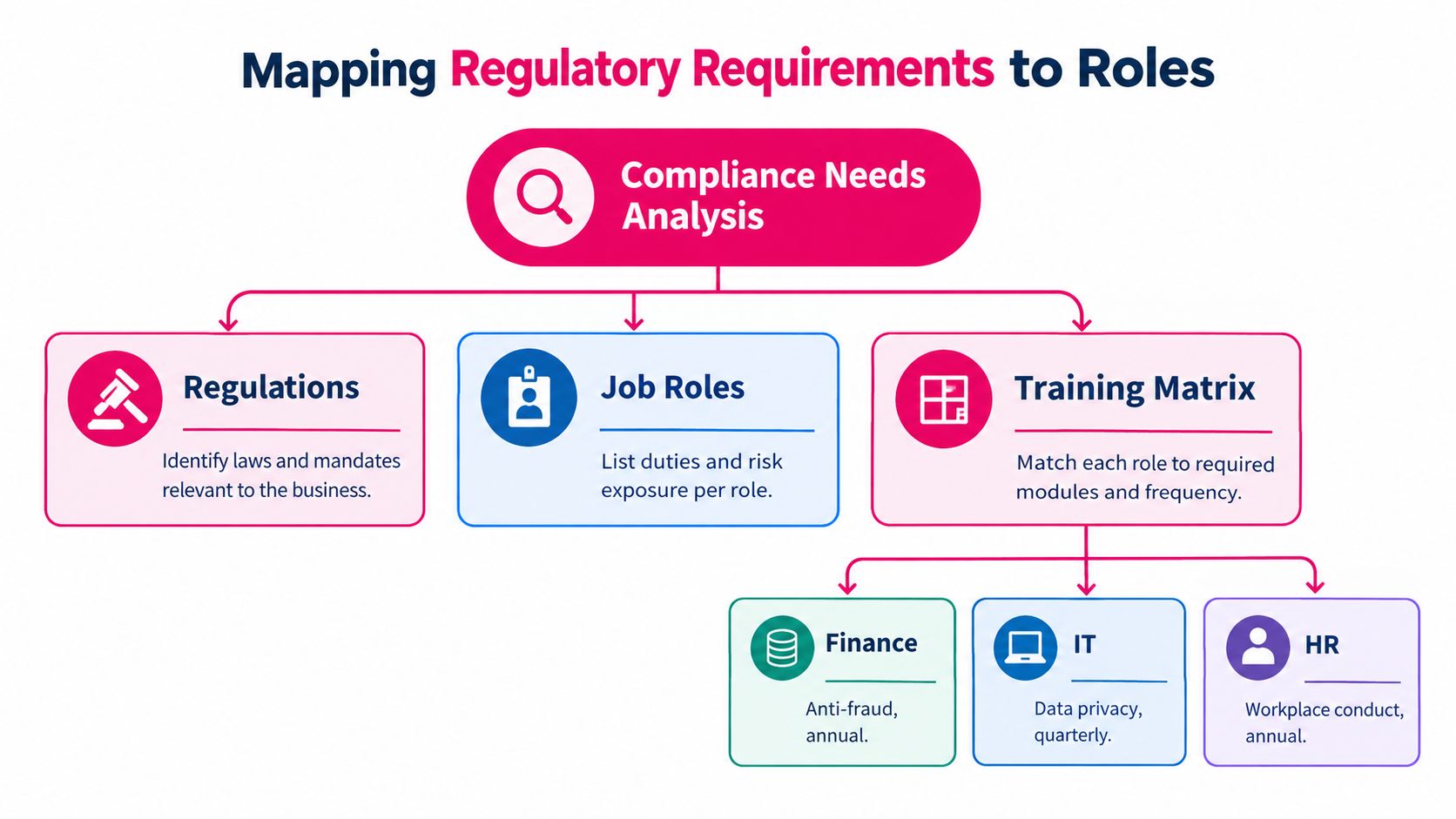
Start with the risk, not the course catalog. A legal register can tell you which obligations affect the business, but it won't tell you who encounters those obligations during a normal workday. That connection comes from a structured needs analysis.
The practical sequence is organizational analysis, task analysis, and person analysis. First, identify the organization's markets, products, policies, incident history, audit findings, and regulatory exposure. Next, identify the tasks that create or control each risk. Finally, segment employees by role, authority, location, experience, and exposure.
Build the matrix from real work
Create a living matrix with one row for each role or meaningful risk group. Useful columns include:
- Risk area: The regulatory or internal-control issue being addressed.
- Triggering task: The activity where an employee could create, miss, or escalate the risk.
- Required behavior: The observable action the employee must take.
- Learning objective: What the learner should recognize, decide, or perform.
- Evidence: The knowledge check, attestation, manager observation, or operational measure that supports the objective.
- Refresh condition: The event that requires new or repeated learning.
A software engineer may need practical instruction on data access, retention, and privacy implications within development workflows. A warehouse manager may need safety decision scenarios and guidance on escalation. A procurement employee may need deeper practice with third parties, gifts, conflicts, and documentation. Everyone may need a code-of-conduct foundation, but the depth and examples should follow risk exposure.
Keep the language operational. “Understand applicable anti-bribery requirements” is too broad to guide design. “Recognize an improper supplier incentive, pause the transaction, document the concern, and escalate through the approved channel” gives an instructional designer something testable.
Make updates traceable
Assign ownership for each matrix row. Compliance or Legal can own the regulatory interpretation, process owners can validate the job scenarios, and L&D can maintain the learning objective, format, and assignment logic. When a policy or process changes, the owner should be able to identify which roles, modules, assessments, and records require review.
Small organizations can use an external compliance gap analysis framework for small businesses to structure that initial review, then adapt the findings to their own processes. The resource is most useful when it informs a working matrix rather than becoming another static document.
One benchmark analysis found that only 10% of employees strongly agreed compliance training changed how they work, and only 11% strongly agreed that coworkers apply the learning daily, as reported in this comparison of compliance training effectiveness. That is why the matrix must connect each module to a behavior and an evidence source. If a course has no clear audience, decision, or follow-up measure, it probably doesn't belong in the curriculum.
Designing Microlearning Modules with AI Video Tools
Dense regulatory text isn't a learning experience. It may be authoritative, but employees need to know what to notice, what to do, and where to go next when a situation unfolds quickly.
AI video tools can reduce the production friction, but they don't replace instructional judgment. The compliance owner still has to approve the interpretation, the process owner still has to validate the scenario, and L&D still has to shape the experience around a specific decision.
!Screenshot from https://www.videolearningai.com
Write the decision before the script
A reliable microlearning workflow starts with a narrow objective. Don't begin with “teach the anti-bribery policy.” Begin with “help a buyer identify when a supplier invitation creates a conflict and choose the correct escalation route.”
Use this production sequence:
1. Extract the approved rule. Pull the relevant policy language, procedural steps, definitions, and escalation contacts into a controlled source document. 2. Choose a workplace moment. Use a situation employees can recognize, such as approving an invoice, sharing customer data, reviewing an advertisement, or responding to a suspicious message. 3. Create the tension. Give the learner a realistic pressure point, such as a deadline, an important customer, an incomplete record, or an ambiguous request. 4. Offer decisions. Present plausible responses, not an obvious correct answer surrounded by absurd alternatives. 5. Explain the consequence. Connect the correct action to the policy, the business process, and the reporting path. 6. Add a short check. Ask the learner to make a decision or identify the next action. 7. Secure approval. Route the script and final video through Compliance, Legal, and the process owner before publishing.
Short videos work best when each one handles one decision, one risk, and one action. Captions, clear visual hierarchy, translated versions, and downloadable policy references can support accessibility and global delivery, but every localization should receive review from someone who understands the local process and language.
For teams evaluating external production support, this guide to best corporate video production companies can help clarify when a project needs a production partner rather than an internal workflow. For recurring compliance updates, however, a repeatable authoring process often matters more than a single polished film.
Use AI for speed, not authority
An AI-generated draft can turn approved content into a script, scene sequence, voiceover, and branded visual treatment. That makes it practical to refresh a module when a process changes, rather than leaving an obsolete annual course in the LMS because production is too slow.
The controls must remain human. Review every generated script for incorrect legal nuance, invented policy language, inappropriate examples, cultural assumptions, accessibility issues, and escalation details. Never allow an AI tool to create a new obligation or interpret an unresolved legal question without qualified review.
A text-to-video generator workflow can support the conversion from approved text to a structured learning asset. The important design choice is not the avatar or animation. It's whether the video helps the learner rehearse a decision that resembles the work they perform.
Use the following publishing checklist:
- Scenario quality: The situation reflects a real task and includes a credible source of pressure.
- Policy alignment: Every instruction matches the current approved policy.
- Decision quality: The knowledge check tests judgment, not word recall.
- Escalation clarity: Employees know who to contact and what information to preserve.
- Localization control: Translations, captions, names, and examples receive local review.
- Version control: The owner, approval date, review date, and superseded version are recorded.
Short-form learning isn't automatically effective. A brief video can still be a compressed lecture. Make the learner choose, explain why the choice matters, and return to the same decision later through a reinforcement prompt.
Integrating with Your LMS and Securing Audit Trails
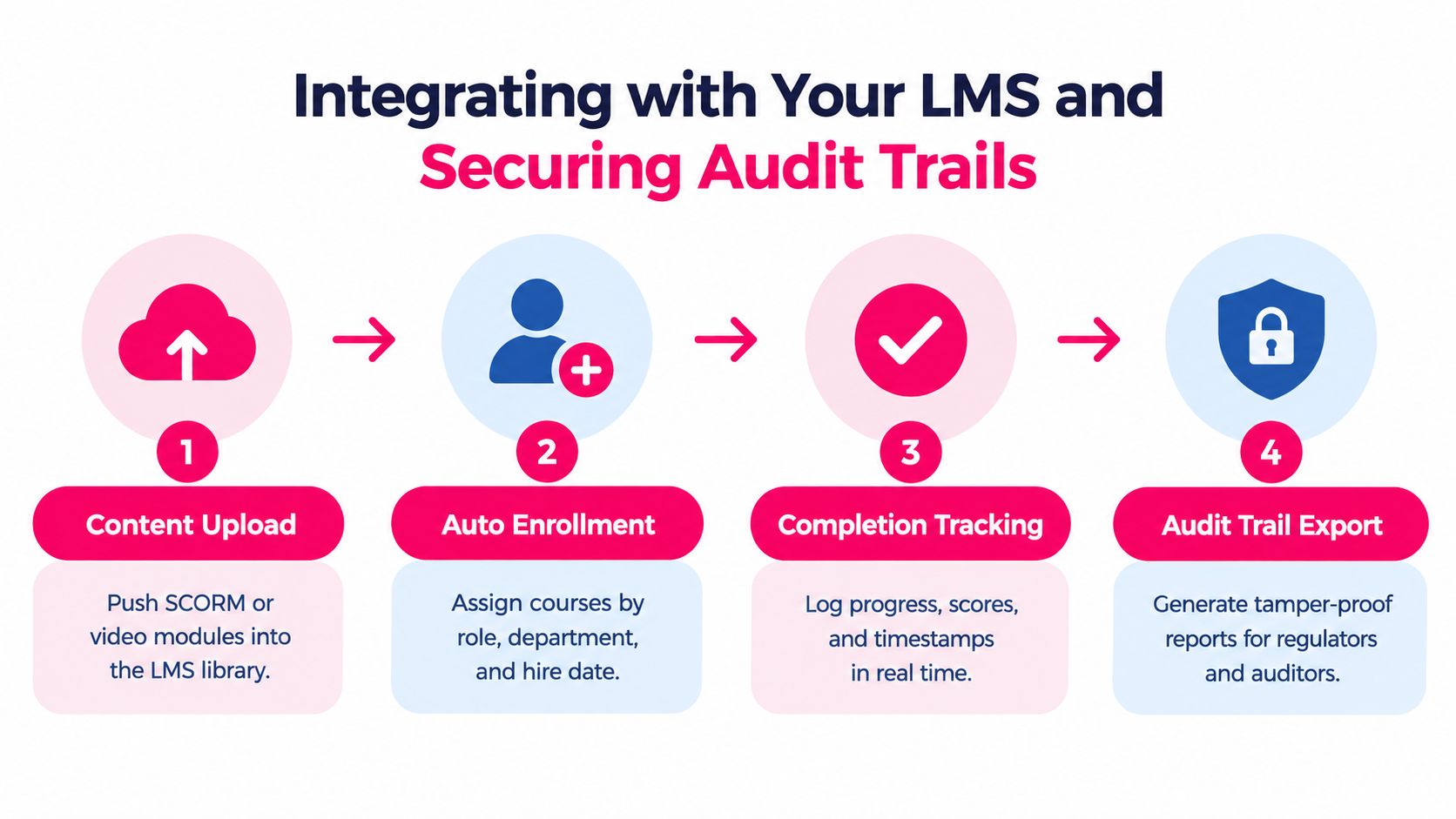
Good content doesn't create an auditable program until the delivery system records what happened. Your LMS should show more than a green completion mark. It should connect the learner, assignment reason, content version, assessment result, required action, and evidence of follow-up.
Start by defining the record before uploading the module. That prevents a common implementation mistake, where teams publish content first and discover later that their reports can't answer an auditor's basic questions.
!A flow chart illustrating four steps for integrating content into an LMS for securing audit trails.
Choose the right reporting layer
SCORM is useful when the primary requirement is a packaged course that reports status, score, and related session data back to the LMS. Before publishing, test launch behavior, completion rules, failed-assessment handling, resume behavior, and whether the package records the intended status when a learner exits early.
xAPI is more suitable when the program needs to capture learning activity beyond a traditional course launch. A team might want to record scenario responses, policy searches, manager-led discussions, or learning activity in another system. If you use xAPI, define the statement vocabulary and governance rules first, then decide which events are meaningful enough to store.
Don't collect every possible event just because the technology permits it. Excessive event data creates noise, privacy questions, and reporting overhead. Capture information that supports a program decision, an audit question, or a behavior measure.
The audit trail requirements guide is a useful reference when translating those needs into a reporting design. Your compliance and privacy teams should also agree on retention, access permissions, correction procedures, and the handling of employee identity data.
Design evidence an auditor can follow
A defensible record should answer five questions without requiring a spreadsheet reconstruction:
| Audit question | Evidence to retain | |---|---| | Who was assigned? | Employee identifier, role, department, location, and assignment rule | | Why were they assigned? | Risk category, policy, regulatory requirement, onboarding event, or role change | | What did they receive? | Course title, module version, language, owner, and approval record | | What did they do? | Launch status, completion, assessment response, score, attestation, and timestamp | | What happened afterward? | Remediation, reassignment, manager follow-up, or documented exception |
Use automated assignment rules where possible, but inspect them. A role change, transfer, leave period, or new hire can create gaps if the HR and LMS records don't synchronize correctly. Establish exception reports for overdue learning, failed checks, missing attestations, and assignments attached to inactive employees.
Protect the history from casual alteration. Limit administrative permissions, retain version identifiers, record changes to assignment rules, and export reports in a controlled format. A report that can be covertly overwritten won't provide much confidence during an investigation.
Finally, test the audit trail as an exercise, not only during an inspection. Ask a colleague to select a learner, a policy, and a time period, then reconstruct the complete training history. If the evidence is scattered across email, shared drives, and manual files, the system isn't ready.
Measuring Actual Behavior Change and Risk Reduction
The hardest question in compliance learning is simple: What changed because people took the training? Completion and quiz results help diagnose the learning experience, but they don't prove that employees behave differently in the workflow.
A useful measurement design connects three layers. The first is learning activity, such as access, completion, assessment performance, and confidence. The second is behavior, such as escalation quality, policy use, manager observations, and reporting decisions. The third is risk, such as repeat violations, incident patterns, investigation themes, or audit findings related to the trained process.
Build a measurement chain
Start with a baseline that already exists. If the topic is phishing, use the organization's approved security-testing measure. If the topic is reporting misconduct, review reporting-channel awareness and the quality of initial triage. If the topic is data handling, examine access exceptions, confirmed process breaches, and recurring investigation themes.
Don't assume that every increase is bad. More incident reports can reflect a stronger speak-up culture rather than worsening conduct. Interpret the direction alongside severity, quality, substantiation, response time, and employee confidence.
The European Institute of Management and Finance discussion on rethinking compliance training reports that only 21% of organizations track behavioral metrics such as policy violations, disciplinary actions, or incident rates, while 6% have no formal effectiveness assessment. Those figures explain why completion remains dominant. It's easier to export than a behavior signal, but convenience isn't evidence of risk reduction.
Give managers a role in the feedback loop
Managers see application earlier than most dashboards do. Give them a short observation guide with questions such as:
- Recognition: Can employees identify the risk in a realistic work situation?
- Action: Do they follow the correct process without being prompted?
- Escalation: Do they know when to stop and whom to contact?
- Consistency: Do they apply the rule when deadlines or commercial pressure rise?
- Friction: Which policy, system, or approval step makes the right action difficult?
Review those observations with Compliance, HR, Security, Internal Audit, and process owners. Compare trends by role or risk group, but avoid using the data as a simplistic employee-ranking tool. The purpose is to find weak controls, unclear guidance, and learning gaps that the organization can address.
To demonstrate real training ROI, build an executive view that pairs learning activity with an operational outcome and a clear caveat. For example, report that a targeted intervention reached the intended audience, improved decision performance in the assessment, and coincided with a change in relevant incident patterns. Avoid claiming that training alone caused the result when policy changes, system controls, leadership action, or external events also influenced it.
A credible dashboard may show stable completion alongside fewer repeat violations, faster escalation, stronger reporting quality, or improved manager observations. That is a more honest account of performance than celebrating a certificate count in isolation.
Scaling Continuous Reinforcement Across Global Teams
Annual training is easy to schedule and difficult to remember. A continuous model works better when it has a predictable rhythm, clear limits, and a reason for every message. The answer isn't to add more mandatory courses. It's to distribute the right practice across the year and reserve intensive learning for material that genuinely requires it.
One industry summary identifies structural weaknesses across compliance programs: 37% of organizations had no formal training plan, 40% rated their programs as basic or reactive, and only 70% attempted to measure effectiveness. The same summary reports that about 34% considered their compliance training effective, 49% of workers admitted skipping or not fully listening to mandated training, and 74% said employees forget what they learned within a month. It also reports that more than 40% said employees couldn't recall basic responsibilities without looking them up. These figures are compiled in Lorman's compliance training statistics overview, and they point to a design problem, not a motivation problem alone.
Use a cadence employees can absorb
A practical annual rhythm can look like this:
- Onboarding: Assign the foundational code of conduct, reporting channels, security expectations, and role-specific essentials when the employee enters the organization.
- Early role practice: Use short scenarios that reflect the employee's first meaningful decisions, rather than assigning every topic on the first day.
- Regular reinforcement: Send brief videos, quizzes, or manager discussion prompts tied to the highest-exposure risks.
- Event-driven updates: Trigger focused learning after a policy revision, product launch, system change, incident trend, or regulatory interpretation change.
- Annual attestation: Preserve the formal review and acknowledgment required by the organization's governance process.
- Program review: Use behavior, incident, feedback, and audit signals to decide what to retire, revise, or expand.
This cadence should vary by role. A high-exposure team may need frequent scenario practice, while a lower-exposure group may need concise awareness prompts and clear access to policies. Employees shouldn't receive a stream of irrelevant reminders because the platform makes mass assignment easy.
Localize the operating model
Global delivery requires more than translating a script. Confirm that examples, reporting routes, manager responsibilities, terminology, captions, voiceover, and policy references work in each local context. Maintain one approved source of truth, then create controlled variants with named owners and review dates.
AI video tools can help teams produce localized versions and refresh a scenario without restarting an entire production project. They still need human review for legal meaning, cultural fit, accessibility, and local escalation procedures. The same governance rule applies globally: automation can accelerate production, but the accountable policy owner approves the final learning asset.
Keep reinforcement connected to work. Place a short prompt near the process it supports, give managers a discussion question they can use in a team meeting, and make the relevant policy easy to find after the learner finishes. Compliance becomes durable when employees encounter it as part of normal decision-making rather than as an isolated HR campaign.
A mature compliance training program doesn't chase perpetual completion. It builds a measurable system in which people receive relevant guidance, practice decisions, access current policies, and create evidence that the organization responds to risk. Review the program when the business changes, not only when the annual assignment date returns.
---
VideoLearningAI turns approved training material into short, structured videos for compliance and other learning workflows, with templates and LMS-ready publishing options. Use VideoLearningAI to create scenario-based reinforcement that supports a shift from completion reporting toward practical behavior change.