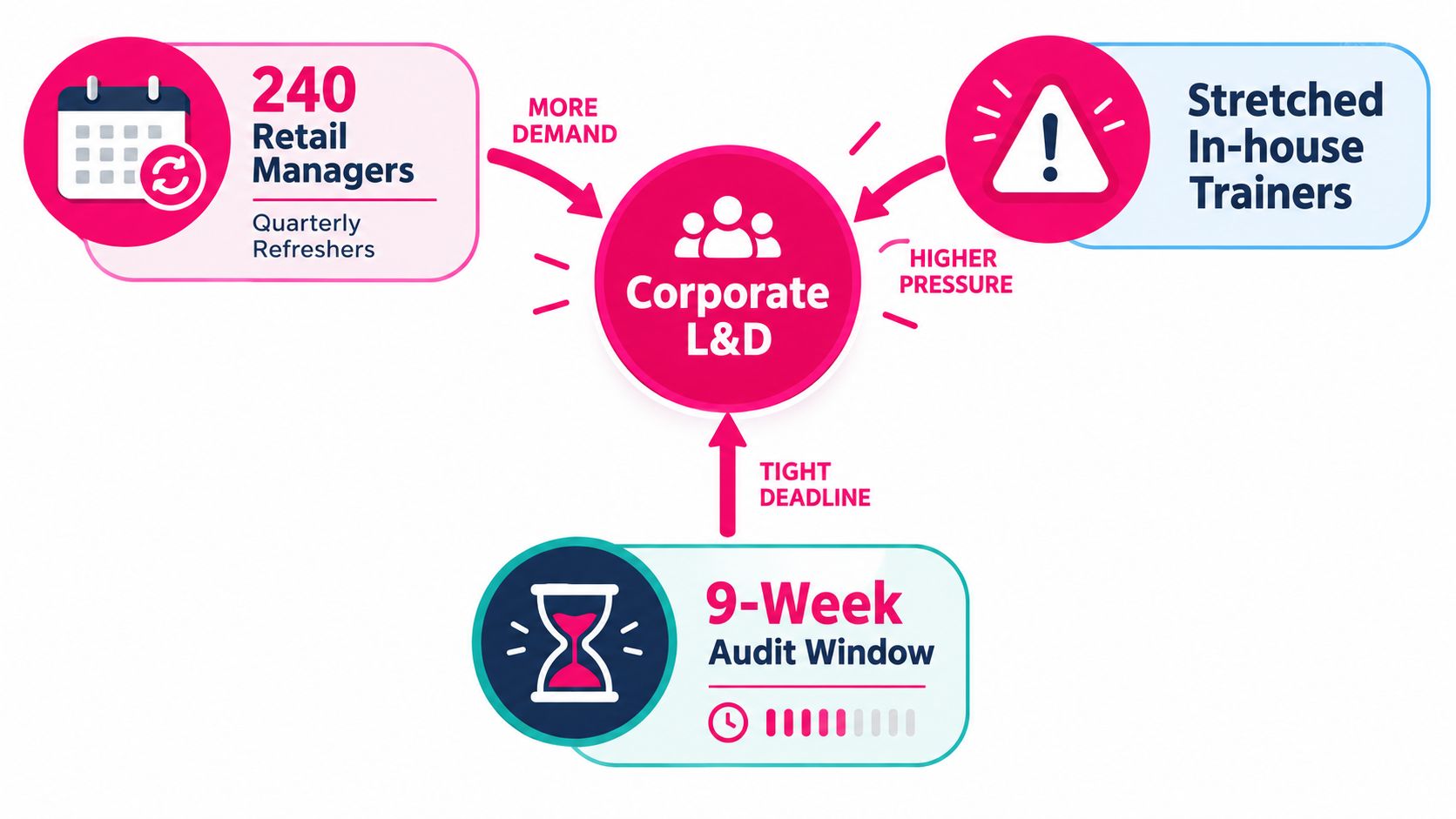
A corporate L&D lead has a familiar problem. Internal trainers need to prepare a large manager population for recurring coaching sessions, the trainers themselves are already overloaded, and an audit deadline is approaching. The organization has plenty of slides, recordings, quizzes, and attendance records. What it lacks is reliable evidence that each trainer is qualified to deliver the material consistently and remains authorized to do so.
That distinction changes the buying decision. Train the trainer software shouldn't be judged as another course library. It should help you qualify facilitators, prepare them to teach, observe what they do, capture evidence of transfer, and maintain an audit-ready record of their authorization.
Table of Contents
- Reusable content templates - Delivery flexibility - Assessment and authorization - Progress and behavior tracking - Integration and compliance reporting - The practical comparison - Trainer authorization engine - Microlearning authoring - xAPI depth - LMS and HRIS connectivity - Audit-ready reporting - Phase one discovery and pilot scoping - Phase two build and qualify - Phase three controlled pilot - Phase four scale and govern - Build a layered KPI stack - Before the call - During the demo - Before signingWhat Train the Trainer Software Actually Does
A useful platform gives the L&D lead more than a way to distribute a facilitator guide. It creates a controlled pathway from learning the content to demonstrating delivery competence. A trainer studies the approved material, rehearses a difficult explanation, completes a knowledge check, submits a teach-back, receives a rubric-based review, and becomes eligible to deliver only after meeting the defined standard.
That makes the software a closed-loop evidence system. It connects preparation, authorization, delivery, observation, remediation, and renewal. An LMS remains important for enrollment, assignments, access control, and standard learning records. Train the trainer software adds the trainer-specific operating layer that many LMS products handle poorly.
> Practical rule: If a platform can't distinguish “completed the module” from “approved to teach,” it isn't managing trainer capability. It's managing consumption.
The three outcomes worth demanding are clear:
- Faster cohort ramp: Trainers get structured material, practice prompts, reusable scenarios, and clear prerequisites.
- Observable teaching behavior: Reviewers can assess explanations, questioning, feedback, pacing, and adherence to required messages.
- Defensible records: Administrators can show who was qualified, which evidence supported the decision, when authorization expires, and what refresher activity followed.
The market around this workflow is already substantial. Industry estimates reported for 2023 indicate that 82% of organizations worldwide used an LMS for training, while another estimate placed employee-training LMS adoption at 89% after a 40% increase following the pandemic. A separate estimate valued the global LMS market at $5.2 billion in 2024 and projected a 10.8% compound annual growth rate from 2024 through 2031. These are directional industry estimates rather than audited totals, but they show why a trainer enablement layer must fit existing digital learning operations. See these 2026 talent strategy insights for broader context on how talent systems are evolving.
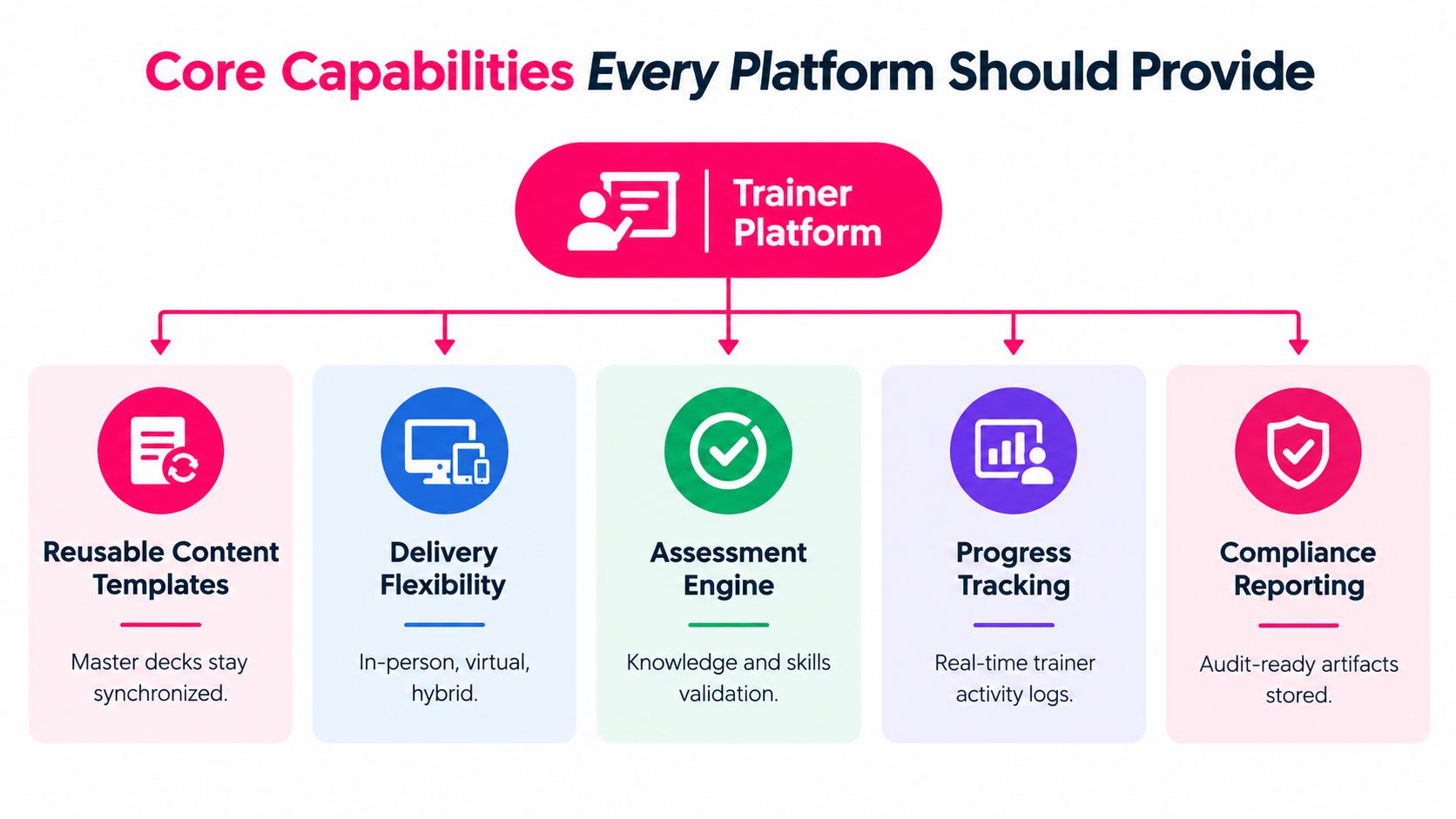
Core Capabilities Every Platform Should Provide
Don't accept a feature tour as proof of operational fit. Ask the vendor to demonstrate each capability using one of your real facilitator workflows, including a content update, a failed assessment, a manager observation, and a renewal decision.
Reusable content templates
A serious platform needs master templates, controlled versions, approval states, and change history. Without them, every regional trainer creates a local copy of the facilitator deck, and the approved message gradually fragments.
Test whether an administrator can update a central scenario, identify every affected module, notify assigned trainers, and preserve the prior version for audit purposes. Check whether trainers can adapt examples without changing protected compliance language or learning objectives.
Delivery flexibility
Microlearning works best when it supports action, not just shorter videos. A long certification pathway can be divided into focused units containing a demonstration, a scenario, a rehearsal prompt, and a clear submission requirement.
Ask the vendor to build a unit for virtual delivery, another for in-person practice, and a third for hybrid facilitation. Confirm that the same competency record follows the trainer across formats. VideoLearningAI, for example, is designed to turn scripts or topic ideas into structured training videos with narration, captions, visuals, and AI-avatar presenters, while supporting SCORM package export for LMS delivery. Treat that as one content-production option, not as proof that the wider qualification workflow is covered.
Assessment and authorization
A quiz can confirm recall. It can't confirm that a trainer can explain a concept, handle a misconception, or run a practice activity. The platform should support observed delivery assessments, reviewer rubrics, remediation, and approval gates.
Ask what happens when a trainer passes the quiz but fails the teach-back. The correct answer includes targeted remediation, another attempt, reviewer notes, and an authorization status that remains blocked until the required evidence exists.
Progress and behavior tracking
Aggregate completion dashboards are inadequate for trainer governance. Administrators need records at the individual level, including playback behavior, practice attempts, feedback, rubric results, coaching interactions, and subsequent delivery evidence.
xAPI or cmi5-style event tracking becomes useful here. The platform should make events queryable by trainer, competency, cohort, content version, and delivery date.
Integration and compliance reporting
The system should connect to the LMS and, where relevant, the HRIS. Verify single sign-on, SCORM import and export, roster synchronization, competency updates, and evidence export. Manual CSV workarounds are tolerable for a pilot, but they become a control weakness at scale.
For regulated environments, ask for credential records, expiry alerts, reviewer sign-off, retention settings, and immutable audit history. Australian vocational-training standards for 2025 require providers to demonstrate current trainer and assessor credentials, current industry skills, authenticated evidence, and retention of certain training-product records completed after July 1, 2025, for two years, as described in the ASQA standards FAQs. The broader lesson is simple: completion records and authorization records must remain separate.
SCORM and xAPI Interoperability Explained
Every serious demo will eventually raise SCORM and xAPI. Don't treat them as competing badges. They answer different operational questions.
SCORM packages a course for delivery through a compatible LMS and commonly reports completion status, assessment score, and session time. xAPI records activity statements in an external Learning Record Store, which allows the organization to capture events across devices, applications, simulations, offline activities, and workplace practice.
The history matters. The U.S. Department of Defense's ADL Initiative drove common e-learning specifications because training content was difficult to reuse across separate LMS environments. ADL consolidated work from groups including AICC, IMS Global, and the IEEE Learning Technology Standards Committee into SCORM. SCORM 1.0 appeared in 2000, SCORM 1.2 was released in October 2001, and SCORM 2004 fourth edition arrived in March 2009, according to this SCORM interoperability history. SCORM 1.2 remains especially influential because major LMS products still support it.
The practical comparison
| Dimension | SCORM | xAPI | |---|---|---| | Primary use | LMS-based course delivery | Cross-system activity evidence | | Typical records | Completion, score, session time | Practice, observation, coaching, delivery, workplace behavior | | Infrastructure | Compatible LMS | Learning Record Store and statement model | | Best fit | Foundational self-study and compliance modules | Trainer-specific qualification and transfer evidence | | Main limitation | Limited detail outside the LMS | Requires stronger data governance and implementation discipline | | Buyer question | Did the trainer complete and pass? | What did the trainer do, where, and with what result? |
SCORM is sufficient when your only requirement is to record whether a trainer completed foundational content. It becomes inadequate when you need to know whether the trainer rehearsed a difficult section, submitted a teach-back, received coaching, or delivered a session after certification.
xAPI requires more than switching on a setting. You need a Learning Record Store, durable activity identifiers, controlled verbs, consistent statement design, and validation tests. Ask the vendor to show the raw statements and explain how you can query them by trainer ID. The LMS integration guidance is useful background, but your vendor should still demonstrate the exact data path in your environment.
For most organizations, the sensible architecture is hybrid. Use SCORM for broad LMS compatibility and straightforward completion reporting. Use xAPI or cmi5 for the evidence layer that captures rehearsal, observed facilitation, coaching, and post-certification behavior.
How to Choose the Right Platform
A vendor committee needs a shared scoring method. Otherwise, the most attractive interface wins, while authorization controls and data export receive polite attention at the end of the meeting.
Trainer authorization engine
Verdict: Live delivery must depend on demonstrated competence, not a manager's informal approval.
Verify prerequisites, assessment gates, reviewer workflows, failed-attempt handling, and expiry rules. Ask whether the system can prevent assignment of a restricted course to a trainer who hasn't met the required conditions.
Microlearning authoring
Verdict: Choose reusable practice design over a large template gallery.
Build a real scenario during the demo. Test branching, scenario reuse, embedded prompts, captions, version control, and localization. A platform that creates attractive clips but can't preserve the relationship between a master competency and its local variants will create maintenance work.
xAPI depth
Verdict: Require queryable trainer events, not a dashboard that merely displays completion.
Ask the vendor to emit statements for a practice attempt, teach-back submission, reviewer decision, coaching interaction, and live delivery. Confirm that the organization owns or can export the underlying data. If the vendor refuses to explain its verb vocabulary or identifiers, assume cross-cohort analysis will be difficult.
LMS and HRIS connectivity
Verdict: Integration must support the full lifecycle, not only user provisioning.
Check single sign-on, roster changes, enrollment rules, SCORM import, competency synchronization, and deactivation when a trainer leaves or changes role. Verify whether updates flow both ways. A one-way connector can leave the LMS showing an active trainer after authorization has expired.
Audit-ready reporting
Verdict: Every authorization decision needs a traceable evidence trail.
Look for credential logs, version history, reviewer sign-off, retention controls, expiry alerts, and exports in a documented format. Australian guidance emphasizes that assessment evidence should be valid, reliable, fair, retained, and verifiable, so “the dashboard says complete” isn't enough for a regulated program.
| Evaluation Criterion | What to Verify | Weight (%) | One-Line Verdict | |---|---|---:|---| | Authorization engine | Prerequisites, observed practice, approval gates, expiry | High | No demonstrated competence, no live delivery | | Microlearning authoring | Reusable scenarios, branch logic, version control | Medium | Reuse matters more than template volume | | xAPI depth | Trainer-level statements and query access | High | Evidence must be exportable and analyzable | | LMS and HRIS connectors | SSO, SCORM, roster and competency synchronization | High | Manual re-entry shouldn't control authorization | | Audit reporting | Credential history, retention, sign-off, export | High | A reviewer must be able to reconstruct the decision |
Use the same tests for every vendor. The video training platform comparison can help frame the content-production discussion, but don't let video quality substitute for governance evidence.
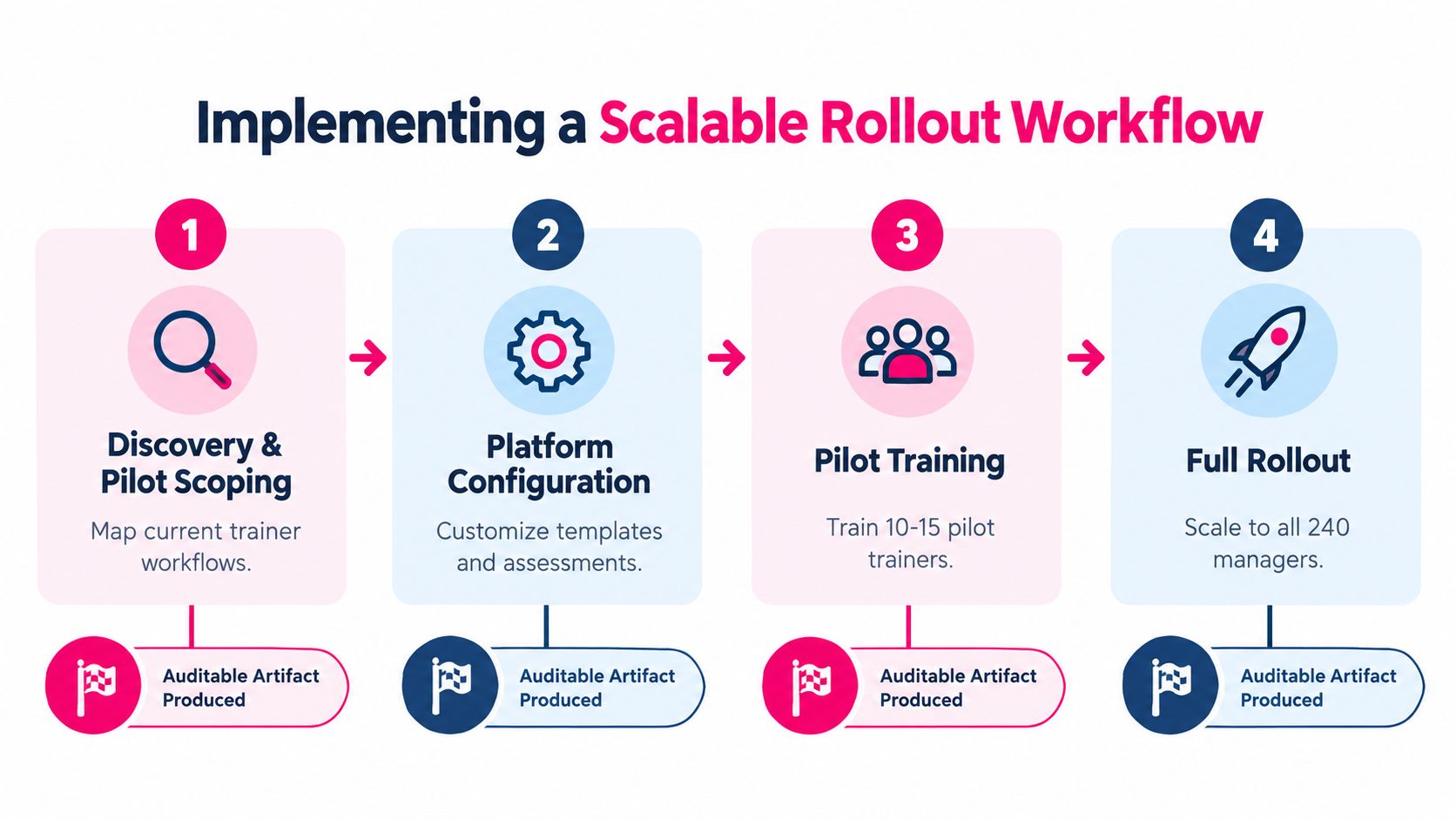
Implementing a Scalable Rollout Workflow
A software purchase becomes useful only when the organization turns it into a repeatable operating process. Build the rollout around approval gates, and require an artifact at each gate. That protects the program when ownership changes and gives compliance reviewers something more substantial than screenshots.
Phase one discovery and pilot scoping
Map current trainer roles, assigned subjects, existing credentials, approval practices, and evidence gaps. Define what “authorized to deliver” means for each role before configuring the platform.
Select a contained pilot from one business unit and include trainers with different experience levels. Produce a program charter and competency map. The charter records scope, ownership, risks, and decision rights. The competency map defines observable behaviors, required knowledge, reviewer roles, and renewal conditions.
Phase two build and qualify
Convert existing facilitator guides, decks, recordings, and assessments into reusable microlearning templates. Don't migrate every legacy asset automatically. Remove duplicate instructions, identify outdated claims, and mark content that requires subject-matter approval.
Configure the event model before the pilot starts. Define the activity identifiers for study, rehearsal, submission, observation, remediation, and approval. Then run dry-run deliveries with reviewers. The output should include a trainer credential log showing the evidence required for each authorization state.
Use synthetic user testing for product teams as a useful model for testing unusual pathways, such as a failed assessment, a revoked credential, a late reviewer, or a content version change. The relevant synthetic user testing for product teams can help your implementation team think beyond the happy path.
Phase three controlled pilot
Authorize pilot trainers only after they meet the defined assessment standard. Capture reviewer decisions, disagreement patterns, remediation activity, and trainer feedback. Don't expand because the first cohort completed the content. Expand when the process produces consistent evidence and the reviewers can apply the rubric reliably.
Schedule follow-up observations after trainers deliver live sessions. Produce a transfer evidence report that records what trainers applied, where they struggled, which adaptations were useful, and what content needs revision.
Phase four scale and govern
Extend the workflow to additional business units only after the pilot owner signs off on the evidence. Establish refresher rules, content review ownership, credential expiry behavior, escalation routes, and reporting responsibilities.
The final artifact is a governance memo. It should state who can approve trainers, who can revoke authorization, how evidence is retained, which system is authoritative, and how changes are communicated. The platform then supports an operating capability rather than becoming another abandoned content repository.
Measuring Trainer Performance Beyond Completion Rates
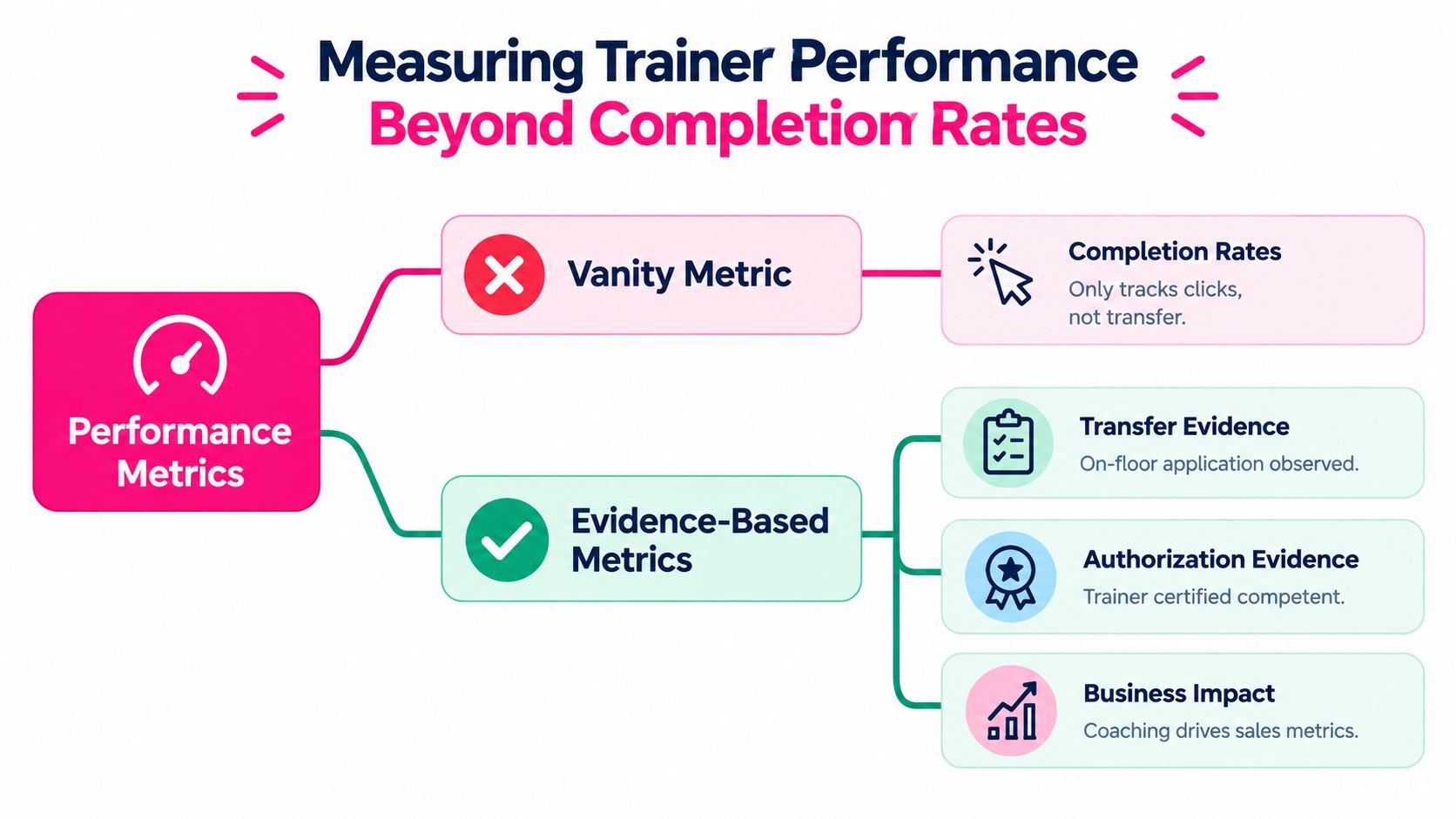
Completion is a weak proxy for trainer readiness. It tells you that a person reached the end of an assigned activity. It doesn't tell you whether they can explain the material, facilitate practice, respond to a difficult question, or adapt an example without weakening the intended outcome.
Research on train-the-trainer effectiveness identifies trainer characteristics, training design, and workplace environment as interacting factors. It also recommends examining whether trainers apply new methods in real teaching situations rather than relying only on reaction surveys or post-tests. That means your measurement design must continue after certification.
Build a layered KPI stack
Qualification evidence comes first. Track observed delivery assessment results, rubric dimensions, remediation attempts, reviewer agreement, and authorization decisions. A trainer should be able to demonstrate the required behavior, not merely pass a knowledge check.
Transfer evidence follows delivery. Compare baseline capability with later observations, manager assessments, learner feedback, teaching-quality rubrics, and evidence from live sessions. The research on evaluating trainer transfer supports connecting training records to workplace application and organizational outcomes.
Business evidence depends on the program. It might include quality defects, sales conversion, safety incidents, customer outcomes, or compliance findings associated with trained cohorts. Don't claim that training caused every movement in a business metric. Use the data to identify patterns, then investigate the operational factors behind them.
System evidence shows whether the enablement process itself works. Track time to authorization, unresolved remediation, expired credentials, overdue observations, content update latency, and the proportion of active trainers with current evidence.
> The useful question isn't “Who finished?” It's “Who is authorized, what can they demonstrate, and what happened after they delivered?”
A platform should expose these layers through event data and reports, not bury them inside a decorative dashboard. Ask for a live query by trainer ID, content version, competency, reviewer, and delivery activity. The training effectiveness measurement framework offers a useful reference point for separating participation from evidence of impact.
Performance coaching deserves its own distinction. A trainer who receives targeted feedback on facilitation behavior needs a different intervention from someone who needs broader career support. This explanation of performance coaching versus general coaching helps clarify why the remediation path should match the observed gap.
For transfer, preserve the difference between content fidelity and useful adaptation. Approved terminology, safety instructions, and compliance messages may need exact handling. Examples, questions, and practice scenarios may need local adjustment. Your reporting should show whether the trainer adapted appropriately and whether the adaptation supported the intended learning outcome.
Buyer Checklist and Final Decision Prompts
Take this checklist into the vendor call and make the vendor answer with a workflow, not a slide.
Before the call
- Map authorization: Write down what a trainer must know, demonstrate, and maintain before delivering live training.
- List evidence gaps: Identify missing credential records, inconsistent rubrics, expired approvals, and manual reporting steps.
- Prepare a real scenario: Bring one facilitator guide, one difficult learner interaction, and one content update for the demo.
During the demo
- Test the gate: Ask the vendor to block live delivery after a failed teach-back and then show the remediation path.
- Inspect the data: Ask whether xAPI statements can be queried by trainer ID, competency, content version, and delivery activity.
- Change the content: Update an approved master asset and watch how the platform handles affected versions and assigned trainers.
- Expire a credential: Confirm how the system alerts owners, changes authorization, and preserves the historical record.
- Export evidence: Request a sample export containing credentials, assessment decisions, reviewer sign-off, and retention metadata.
Before signing
- Reference the operating model: Ask a current customer how reviewers, managers, and administrators use the platform after launch.
- Clarify ownership: Confirm who owns content, event data, credentials, and exported records if the contract ends.
- Reject three red flags: Disqualify vendors with opaque pricing, no documented data export format, or a demo account that avoids the reporting module.
The final decision should force an explicit trade-off. Are you choosing a feature-rich platform with weak evidence capture, or a leaner system that can prove authorization, transfer, and renewal? For most L&D teams, the second option is the safer foundation. Content can be improved over time. An untraceable qualification decision is much harder to repair.
---
VideoLearningAI helps teams turn scripts, existing materials, or topic ideas into structured training videos with narration, captions, visuals, and AI-avatar presenters, including SCORM export for LMS delivery. If you want to test a faster content workflow alongside a stronger trainer-evidence process, visit VideoLearningAI and evaluate it against the qualification and reporting requirements in this guide.