Replace long courses with short lessons, and better performance will follow. That popular advice skips the question L&D teams should ask first: What will employees do differently at work? Finishing a lesson, enjoying it, and remembering its content aren't the same as applying it under pressure.
The useful comparison in microlearning vs traditional learning isn't short versus long. It's which combination of explanation, retrieval, rehearsal, and feedback helps learners perform the target task. The evidence supports microlearning for some knowledge outcomes, but it doesn't justify replacing every workshop with a video sequence.
Table of Contents
- What the controlled comparisons establish - Turn the retention target into a schedule - Check retention without confusing it with transfer - Diagnose the missing condition - Measure the task, not its digital proxy - Onboarding needs context and timely application - Compliance and sales require different checks - Make access a launch requirement - Restore opportunities to ask and discuss - Design the performance path - Connect publishing to workplace checks - Set decision criteria before launchMicrolearning and Traditional Learning Side by Side
Microlearning uses short, focused units, each organized around a specific objective and suitable for delivery or review over time. Traditional learning uses longer, connected sessions or courses to develop a topic through explanation, discussion, and potentially supervised practice.
Neither definition determines delivery technology. A live workshop can include retrieval questions, and an online course can provide sustained discussion and coaching.
Microlearning vs traditional learning by design and delivery
| Criterion | Microlearning | Traditional Learning | |---|---|---| | Typical unit length | A brief lesson sized to a specific objective | A longer session sized to a topic or practice activity | | Scope per unit | One objective per lesson | A connected topic or curriculum | | Delivery pattern | Lessons and reviews distributed over time | One event or a structured course term | | Common success measure | Completion and lesson quizzes, ideally supplemented by delayed recall and task performance | Course completion and final assessment, ideally supplemented by task performance | | Cost to update | Edit or replace the affected module, then check related materials | Revise the affected course materials and repeat delivery where necessary | | Best-fit topics | Reinforcement, onboarding tasks, individual procedures, policy updates | Deep theory, judgment, interpersonal skills, complex sequences | | Evidence on knowledge gains | Higher gains in the specific comparisons described below | Improved learning in those comparisons, but smaller gains |
These are design defaults, not guaranteed results. A modular course isn't automatically inexpensive to maintain: duplicated explanations, translations, and assessment dependencies can make a small change extensive. Equally, a well-organized traditional course needn't be rebuilt whenever a policy changes.
What the controlled comparisons establish
A 2026 quasi-experimental nursing study involving 140 students found that both formats improved knowledge and beliefs about autism-spectrum disorder, but the microlearning group improved significantly more. That finding matters because the advantage concerned measurable learning, not merely willingness to finish the material.
The study supports considering focused units even when the subject is complex. However, its quasi-experimental design doesn't establish that microlearning would outperform classroom teaching with every audience, instructor, or assessment.
A 2025 randomized comparison published in Scientific Reports found that participants taught with the MIND microlearning model averaged 86.000 on the post-test, compared with 79.312 for participants taught with the traditional ADDIE instructional model. This compares named instructional models, not every possible short lesson against every possible classroom course.
That distinction prevents a misleading purchasing decision. An organization can't assume it will reproduce a study's result by shortening its videos while leaving its objectives, questions, and feedback unchanged.
Use the comparison table to identify a plausible design, then test that design against your actual objective. For a fair comparison, align baseline proficiency, content coverage, assessment difficulty, and exposure time rather than giving one group more practice and attributing its advantage to lesson length.
How Spacing Shapes Long-Term Retention
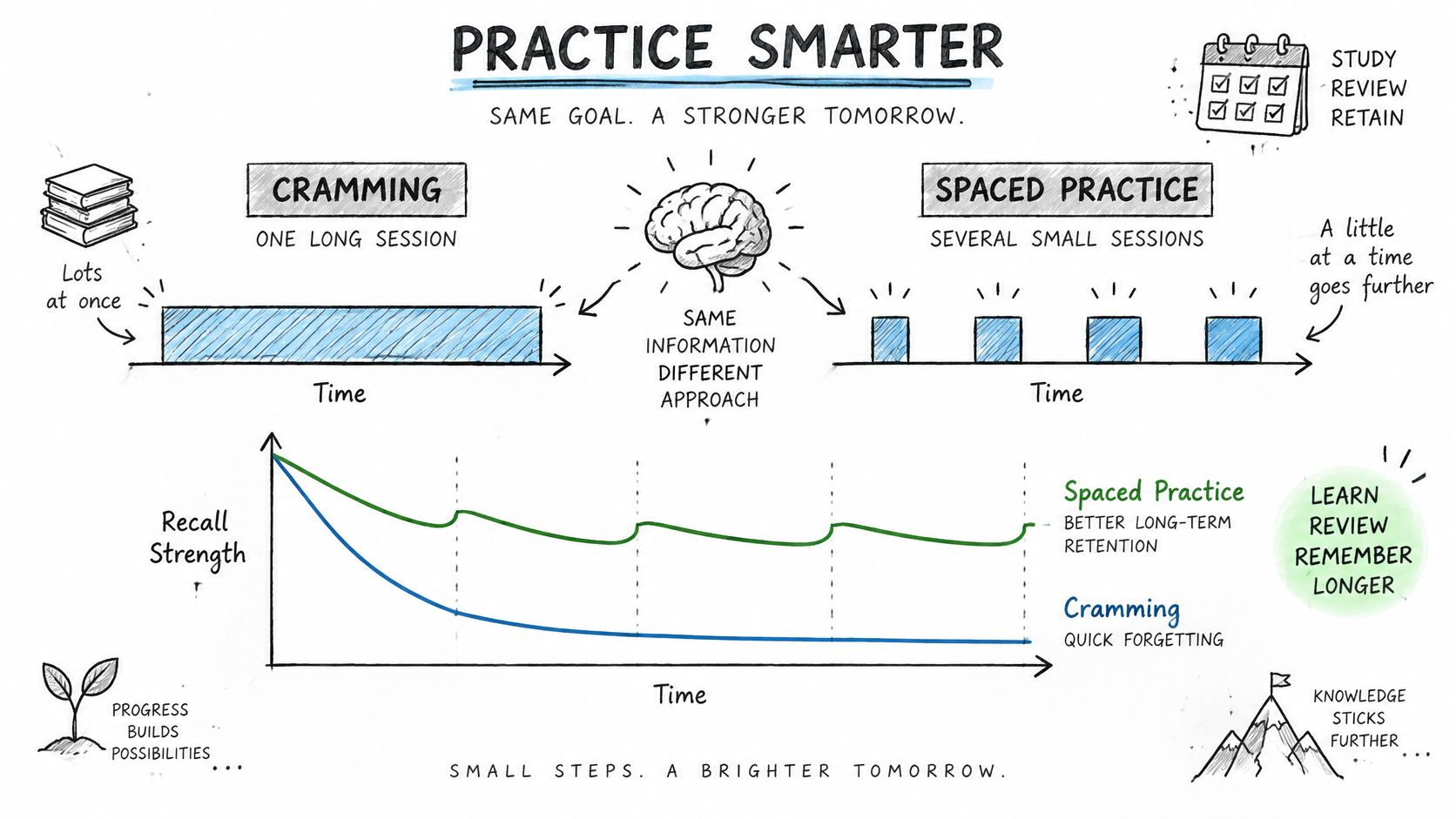
Spacing concerns when learners practice, not just how long a lesson lasts. Distributed practice gives learners repeated opportunities to retrieve material after a gap. A short lesson watched once doesn't provide that pattern, while a longer course with scheduled follow-ups can.
The visual below contrasts concentrated study with practice distributed over time.
A BBF Digital overview of spacing evidence describes a major review synthesizing 839 effect-size comparisons from 317 experiments across 184 publications, which found better long-term retention from distributed than massed practice; it also gives a review-interval guideline of approximately 10 to 20 percent of the desired retention interval.
Turn the retention target into a schedule
The following intervals are calculated from that guideline and rounded to practical calendar days. Treat them as starting points for scheduling, not a universal optimum for every learner and task.
Review intervals for each retention target
| Retention Target | Review Interval (10 to 20 percent) | |---|---| | 7 days | About 1 day | | 30 days | 3 to 6 days | | 60 days | 6 to 12 days |
For a hypothetical month-long onboarding objective, introduce the task, ask learners to retrieve the key decisions the following day, then schedule reviews using the corresponding interval. Don't send the identical video repeatedly. Ask learners to choose an action, explain a rule, or resolve a scenario before showing the answer.
Use the guide to spaced repetition learning to translate a refresh schedule into a repeatable workflow. Put review dates in the learning plan before publishing, rather than leaving reinforcement to an optional reminder.
This video offers another way to explore the distinction between concentrated study and distributed practice.
Check retention without confusing it with transfer
Use delayed assessments rather than relying on same-day satisfaction. Include questions that require an answer from memory, not recognition of the wording learners just saw.
Short follow-up periods remain a limitation in microlearning evidence. Pair knowledge checks with an operational measure, such as procedure errors or time to competency, before concluding that retained information improved work.
For an existing course, check these design requirements:
- Focused objective: Identify the specific knowledge or decision each lesson addresses.
- Retrieval opportunity: Require an answer before revealing the explanation.
- Dated refresh schedule: Assign reviews to the calendar and identify who maintains them.
> Practical rule: Choose the review pattern separately from the initial delivery format. A workshop can be spaced; a microlearning library can remain unreviewed.
Learning Gains Versus On-the-Job Behavior Change
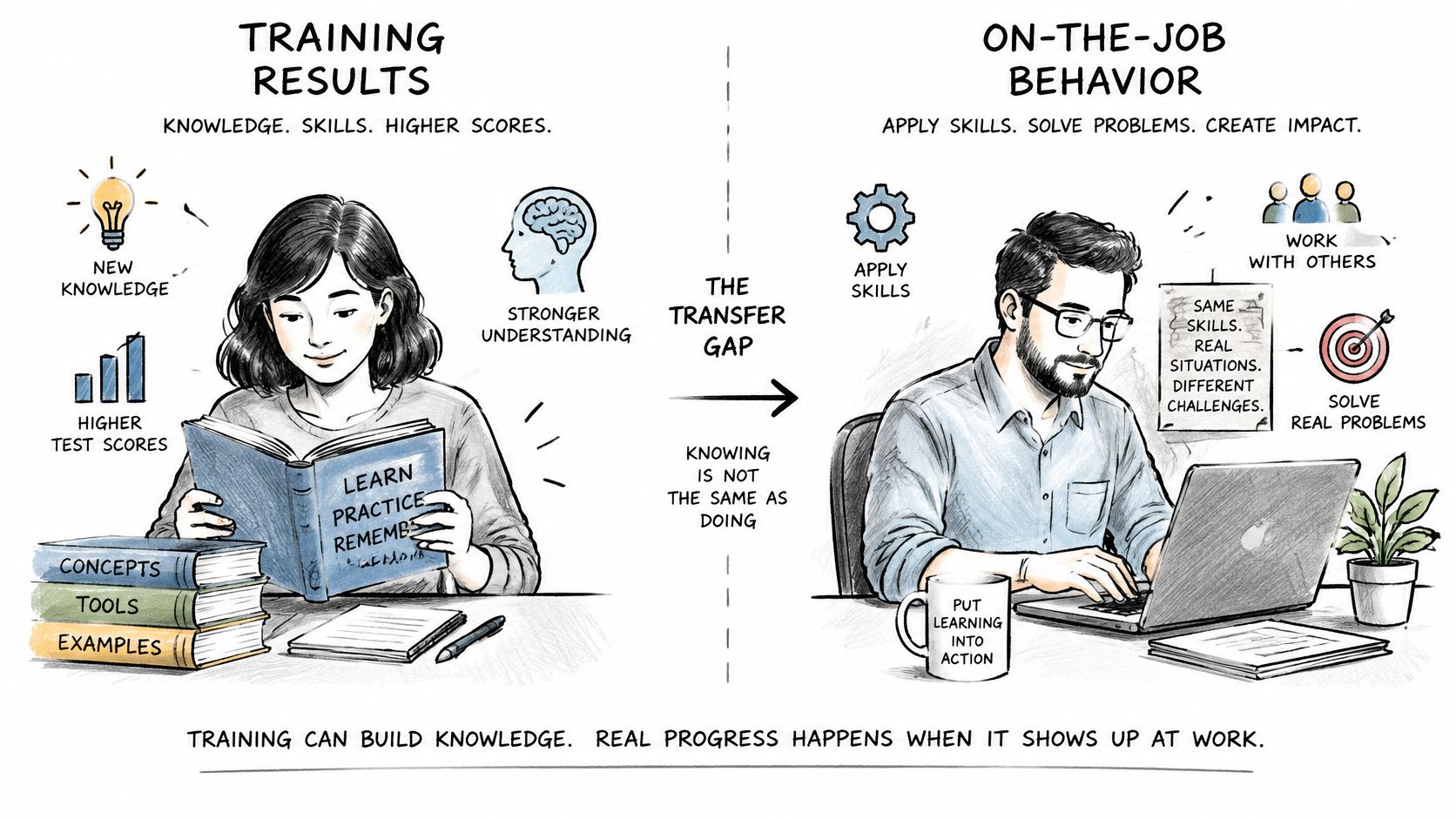
Learning gains and workplace behavior change are different outcomes. A learner can identify the correct response in a quiz yet fail to use it during a difficult customer conversation. The quiz establishes something useful, but narrower than job readiness.
A 2025 quasi-experimental employee study in the Journal of Information Technology Management compared prerequisite microlearning, post-requisite microlearning, and traditional training among 90 employees: the microlearning groups performed significantly better on learner reactions and measured learning, but the groups showed no significant difference in behavioral change, p = 0.115.
That result doesn't prove the formats produce identical workplace effects. It means this study didn't establish a behavioral advantage, despite finding advantages on other measures.
The diagram makes the assessment boundary explicit.
Diagnose the missing condition
Suppose a customer-service employee can correctly describe a de-escalation technique but doesn't use it during an angry call. Assigning another explanatory video assumes the remaining problem is knowledge.
Instead, examine whether the employee can recognize the relevant moment, select appropriate language, and carry out the response while handling interruptions. Also check whether supervisors allow the time and discretion the technique requires.
Those are different problems with different interventions. A scenario can assess recognition; role-play can expose execution difficulties; a manager conversation can uncover conflicting expectations.
The evidence leaves an important question open: When must microlearning be combined with coaching, simulation, feedback, or manager reinforcement to produce transfer? As a design rule, include observed practice when the target involves judgment, interpersonal skill, or a complex procedure. Treat that rule as a hypothesis to evaluate, not proof that a workshop will necessarily work.
Measure the task, not its digital proxy
Choose measures that correspond to the intended behavior:
- Observed task performance: Score the required actions against a shared rubric.
- Error rates: Define the error and its opportunity to occur, so workload differences don't distort comparisons.
- Time to proficiency: Specify the performance standard before measuring how quickly employees reach it.
- Sustained behavior: Repeat observations after employees have returned to ordinary working conditions.
> A higher quiz score can justify confidence in learning. It can't, by itself, justify confidence in job performance.
Microlearning may be a valuable component of the learning system without being a replacement for deliberate practice. The stronger decision is to preserve whichever element addresses the actual performance barrier, rather than favoring a format because learners prefer it.
Which Format Fits Each Training Situation
| Situation | Better Fit | Why | |---|---|---| | New-hire onboarding | Kickoff session followed by a microlearning sequence | Introduce context together, then align task lessons with opportunities to use them | | Annual compliance refresh | Microlearning with scheduled reviews | Maintain opportunities to retrieve rules between formal training events | | Sales conversation skills | Workshop and role-play, plus short refresher lessons | Rehearse judgment and interpersonal responses, then refresh supporting knowledge | | Complex technical procedure | Hands-on traditional session, then short job aids | Practice the complete sequence and provide support at the point of work | | Product or policy update | Single microlearning lesson | Isolate the change and explain the required action | | Leadership or change program | Cohort workshop plus microlearning follow-ups | Combine discussion and practice with workplace application and manager support |
These are starting recommendations, not a ranking established by head-to-head trials in every situation. Adjust them for your audience, required approvals, available practice environment, and existing platform.
Onboarding needs context and timely application
Use a kickoff to explain how the organization works, what the role contributes, and where employees should take questions. Then assign task-specific lessons close to the work they support, rather than requiring new hires to absorb every process before they encounter it.
For example, introduce expense submission when the employee is preparing an expense claim. Ask the manager to check the submitted claim, not just whether the employee opened the lesson.
The GCA guide to course lengths, from German Cultural Association Hong Kong (GCA), offers a useful parallel for thinking about short versus sustained study commitments. Use that comparison to clarify scope and commitment, not as workplace evidence that a shorter course produces better performance.
Compliance and sales require different checks
For compliance refreshers, distinguish remembering the rule from following the procedure. Short scenario questions can check whether employees recognize a reporting obligation; a workflow audit can check whether they report through the correct channel. Preserve any formal sign-off your organization requires rather than assuming a lesson sequence can replace it.
For sales conversations, separate product knowledge from conversational execution. A short update can explain a changed feature or approved claim. Use role-play to assess whether the salesperson asks relevant questions, responds to uncertainty, and avoids unsupported promises.
A broader comparison of training delivery methods can help teams select among facilitated discussion, self-paced content, and practice instead of treating delivery as a binary choice.
> Selection test: If success requires performing an interaction or sequence, include a performance opportunity. If success requires retrieving a discrete fact or step, start with focused instruction and test application.
Public performance isn't the only reason to rehearse. A technician working alone may need supervised practice just as much as a salesperson speaking in front of others.
Access, Inclusion and Who Gets Left Out
Short, mobile-first lessons aren't universally convenient. Before calling a program accessible, ask who has a reliable device, a usable connection, protected learning time, and a suitable way to interact with the material.
A systematic review of microlearning identifies connectivity and digital-tool dependence as potential sources of access disparities, alongside reduced peer collaboration and instructor interaction. It also emphasizes adaptation for learners with intellectual disabilities and differing proficiency levels rather than a uniform format.
The practical trade-off is clear. Self-paced delivery can offer flexibility, but a phone-based lesson doesn't solve a learner's lack of bandwidth, assistive-technology compatibility, or confidence using the platform.
Make access a launch requirement
Build accommodations into the production checklist:
- Captions and transcripts: Provide usable alternatives to audio and review them for terminology errors.
- Low-bandwidth access: Offer downloadable or lightweight versions without removing essential instructions.
- Accessible navigation: Test keyboard operation, screen-reader labels, focus order, and assessment controls.
- Language support: Provide the workforce's required languages and review meaning, not just literal translation.
- Human assistance: Name a route for questions, clarification, and alternative instruction.
The Online College of Art & Design (OCAD) discusses flexible online photography courses as an example of access through online delivery. For workplace programs, treat flexibility as an opportunity to design well, not evidence that every employee can participate without support.
Restore opportunities to ask and discuss
A 2024 randomized controlled trial in Humanities and Social Sciences Communications examined whether participation in online communities improved microlearning effectiveness and learner experience. The trial's topic makes community participation a design option worth testing, but doesn't, by itself, establish a proven fix for lost interaction.
Pilot a moderated question channel or facilitated discussion alongside the lessons. Assign someone to answer questions and check whether employees who need help really receive it.
Accessibility and interaction belong in acceptance criteria. Don't publish first and wait for excluded learners to identify the gaps.
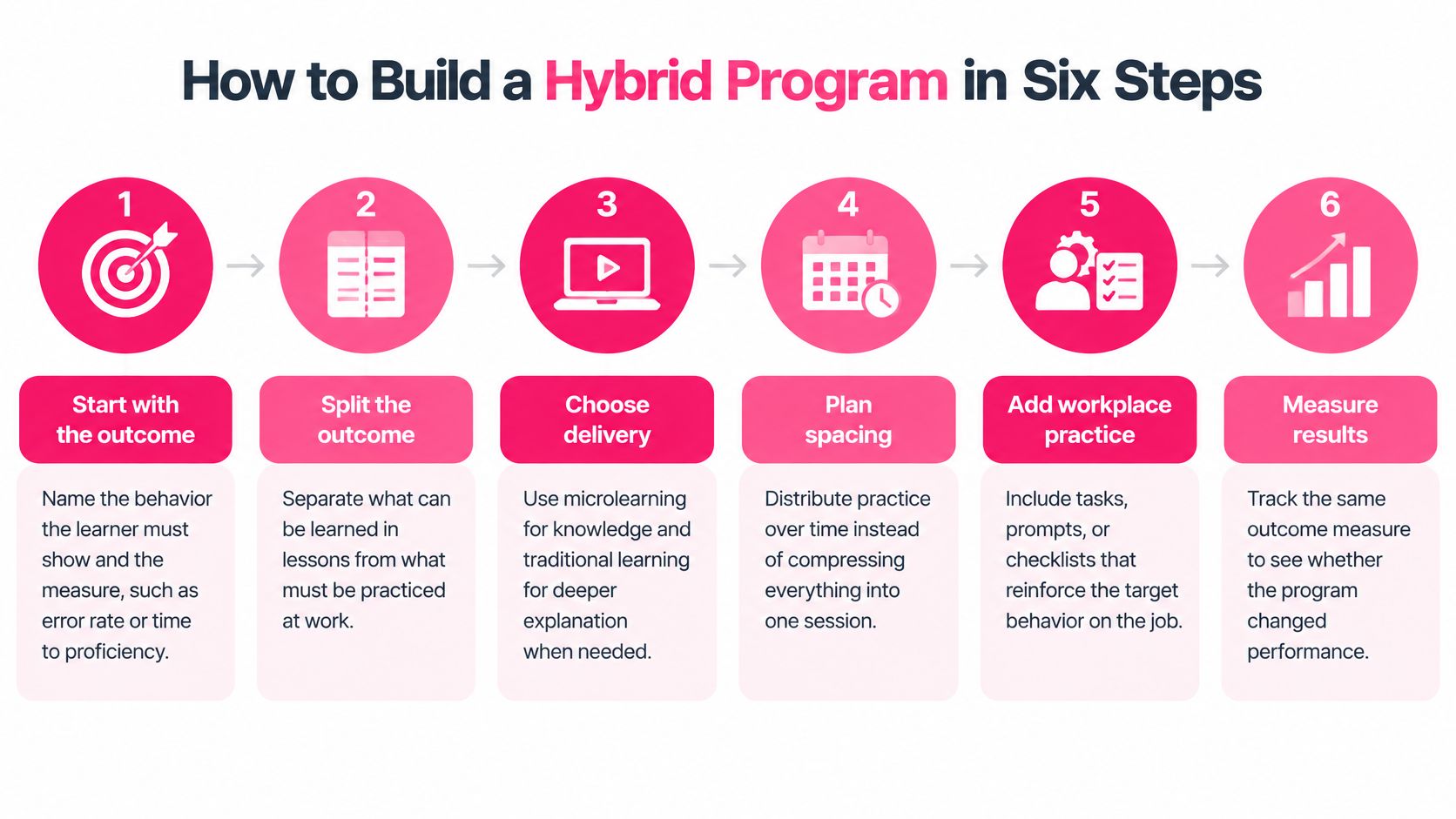
How to Build a Hybrid Program in Six Steps
A hybrid program needs more than a workshop followed by a video library. Give each component a defined purpose, an owner, and an assessment that matches the intended outcome.
Access Courses Online's explanation of the mix of online and face-to-face learning provides context for combining delivery modes. For workplace design, the decisive issue is what learners do in each mode, not merely whether both appear in the schedule.
The process below connects production decisions to workplace evaluation.
Design the performance path
1. Start with the outcome. Write an observable behavior and its measure, such as correctly completing an exception-handling procedure with fewer errors. Avoid objectives such as understand the policy, which don't specify what a manager should observe.
2. Split the outcome into teachable objectives. Separate the knowledge employees need from the actions they must practice, and assign a delayed assessment to each objective. Our implementation checklist at VideoLearningAI recommends defining one clear learning objective per lesson before production.
3. Choose delivery around the difficult part. Put supervised rehearsal before independent application when a task requires judgment, interpersonal responses, or a connected sequence. Don't remove practice because every step has been explained in a short lesson.
Connect publishing to workplace checks
4. Publish lessons with retrieval and scheduled reviews. Write questions that require employees to select or explain an action, then provide corrective feedback. Use the retention target to plan the refresh schedule, adjusting it when learners demonstrate difficulty rather than sending reminders without checking answers.
5. Give managers an observation prompt. State the behavior to look for, the situation in which it should occur, and the feedback to give if it doesn't. A useful prompt for an escalation lesson might ask whether the employee recognized the trigger, used the correct route, and documented the handoff.
6. Review performance and revise deliberately. Our implementation checklist recommends publishing, measuring completion, and iterating every two weeks; add delayed recall and operational outcomes to that production cycle. Rewrite unclear lessons, but investigate workflow barriers before assuming every missed target requires more content.
Our templates cover onboarding training, compliance training, sales enablement, and customer education. Use them to standardize production structure, while keeping the behavior target and observation criteria specific to the job.
The guide to blended learning approaches can help organize the delivery mix. Keep a shared design record linking each objective to its lesson, practice activity, manager prompt, and outcome measure.
That record also makes maintenance more disciplined. When a procedure changes, the owner can identify which explanation, assessment, and workplace checklist require revision instead of updating the video alone.
Confirm the Format Mix With a 90-Day Pilot
Use the proposed pilot period as a planning window, not a research-backed guarantee of results. Choose a high-value program with a measurable behavior target, then collect baseline performance before changing delivery.
Compare the hybrid design with a traditional-only group or prior cohort where feasible. Document differences in role, experience, workload, and manager support, especially when you can't assign learners randomly. Test delayed recall at planned checkpoints and observe performance after learners have had realistic opportunities to apply the training.
Set decision criteria before launch
- Recall and behavior improve: Retain the format mix, then check whether the improvement persists.
- Recall improves but behavior doesn't: Investigate practice, feedback, incentives, access, and workflow constraints.
- Neither improves: Reassess the objective, content, and assessment rather than automatically keeping either format.
Don't interpret failure in both groups as proof that traditional training should remain. Neither approach has demonstrated success for that component.
Track production, revision, administration, and employee learning time alongside delivery costs. A low publishing cost isn't sufficient if the program requires extensive maintenance or fails to improve the target task.
For a small production test, our Starter plan costs $59/month and includes 10 videos up to 60 seconds each. Every account starts with 100 free credits, and no credit card is required; treat those as production inputs, not evidence of instructional effectiveness.
Choose the program, write its behavior target in a sentence, and collect baseline data this week. Decide what success looks like before producing the first lesson.
---
VideoLearningAI turns existing course materials into focused training videos, with templates for onboarding, compliance, sales enablement, and customer education. Visit VideoLearningAI to create the lesson component of your pilot, then pair it with workplace practice and observation so you can evaluate performance, not just completion.