A formal customer education program can deliver a 7.6% increase in revenue for the products it targets, a 38.3% increase in product adoption, a 26.2% improvement in customer satisfaction, and a 15.5% reduction in customer support costs, according to a major 2024 Forrester study summarized by Intellum's customer education research. Those figures change the operating question. Customer education isn't merely a library of tutorials or a support team's overflow task. Properly designed, it becomes a system for helping customers reach value, use more of the product, and stay successful without requiring constant human intervention.
The challenge is building that system without creating a slow, expensive course factory. Modern teams need shorter lessons, contextual guidance, behavior-based measurement, and an AI-assisted production workflow that keeps content accurate as the product changes. The strongest programs connect education to specific customer actions, from completing onboarding workflows to adopting advanced features and preparing for renewal.
Table of Contents
- Position education around business outcomes - Legacy content versus journey-mapped learning - What mature programs coordinate - Build around small, reusable units - Match formats to moments - Use a maturity matrix - Audit the friction - Design the smallest useful path - Launch with a feedback loop - Scale through release operations - Optimize for performance, not volumeThe Business Case for Customer Education
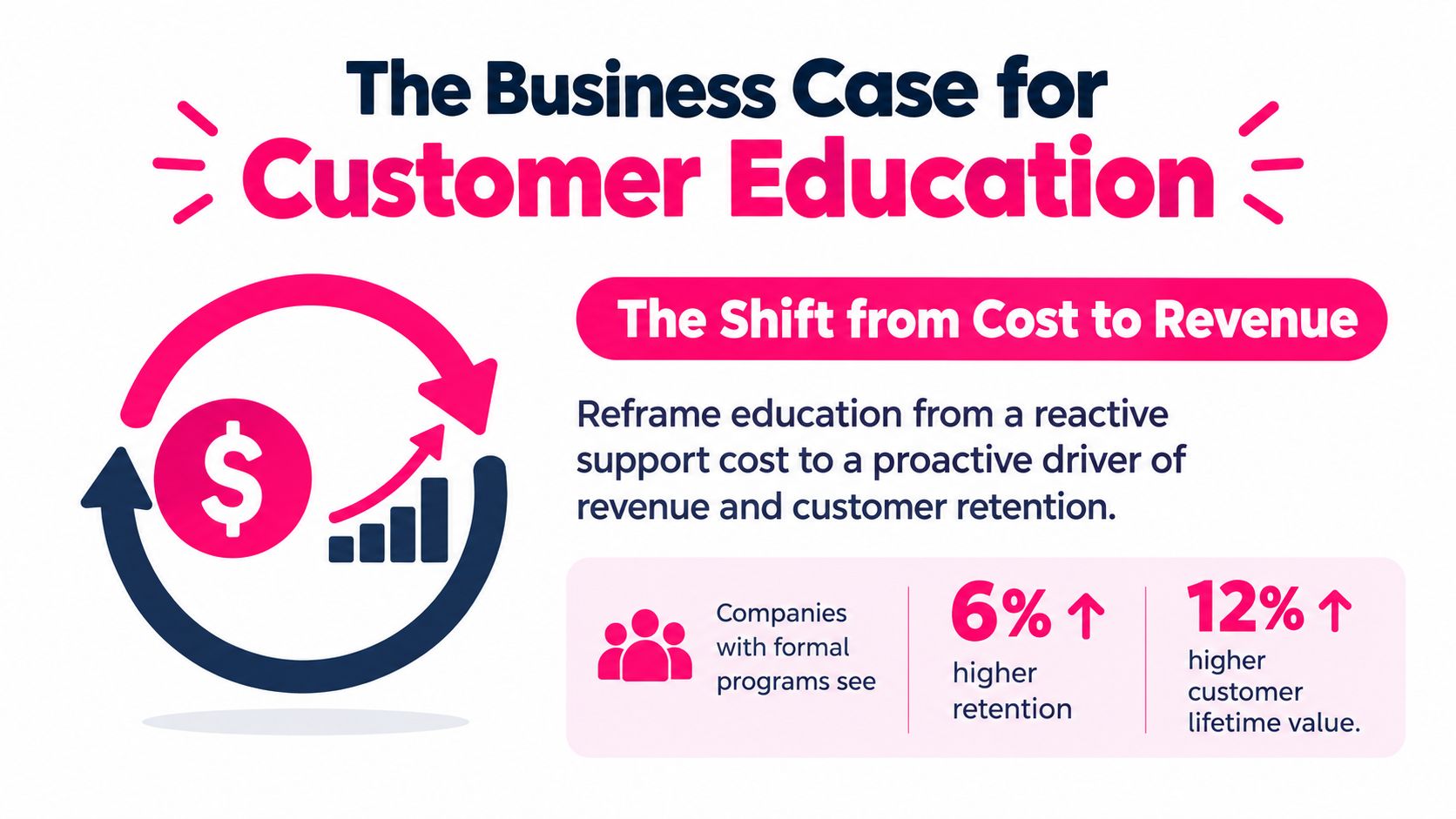
The financial case starts with product behavior. Customers who understand how to use a product effectively are more likely to activate relevant features, complete important workflows, and continue receiving value after the initial purchase. Education gives customer success teams a repeatable way to influence those behaviors before they become support issues or renewal risks.
The Forrester research summarized by Intellum found that formal customer education programs produced a 7.6% increase in revenue for targeted products, a 38.3% increase in product adoption, a 26.2% improvement in customer satisfaction, and a 15.5% reduction in customer support costs. The same research reported that 96% of organizations had at least broken even on their customer education investment, while 86% reported a positive return. These results support a stronger executive narrative: education can affect revenue, retention conditions, satisfaction, and operating efficiency at the same time.
Position education around business outcomes
A budget request framed as “more training content” sounds discretionary. A request framed around adoption of an underused feature, faster time to value, or fewer repetitive support interactions gives finance and leadership a business problem to evaluate.
Use a simple chain:
- Learning intervention: A customer receives a role-specific lesson at the point of need.
- Behavior change: The customer completes a workflow or begins using a relevant feature.
- Customer outcome: The account achieves more value with less friction.
- Business outcome: Adoption, satisfaction, expansion potential, or support efficiency improves.
TSIA research summarized by Gainsight found that 68% of customers reported using products more after training, 56% used more product features than they would without training, and 87% said they could work more independently when trained. The same research linked engaged B2B accounts with 50% higher revenue, 34% higher profitability, and 55% higher share of wallet, while a related Salesforce example cited 2x deal size and an 85% higher propensity for cross-sell and upsell from active accounts. These figures appear in Gainsight's customer education statistics overview.
> Practical rule: Ask which customer behavior the program must change before asking which course the team should create.
Executive buy-in becomes easier when the program starts with a narrow commercial objective. Select a high-friction onboarding task, a frequently misunderstood feature, or a recurring support theme. Then connect the lesson to a measurable product event rather than reporting views or completions alone.
Defining the Modern Customer Education Program
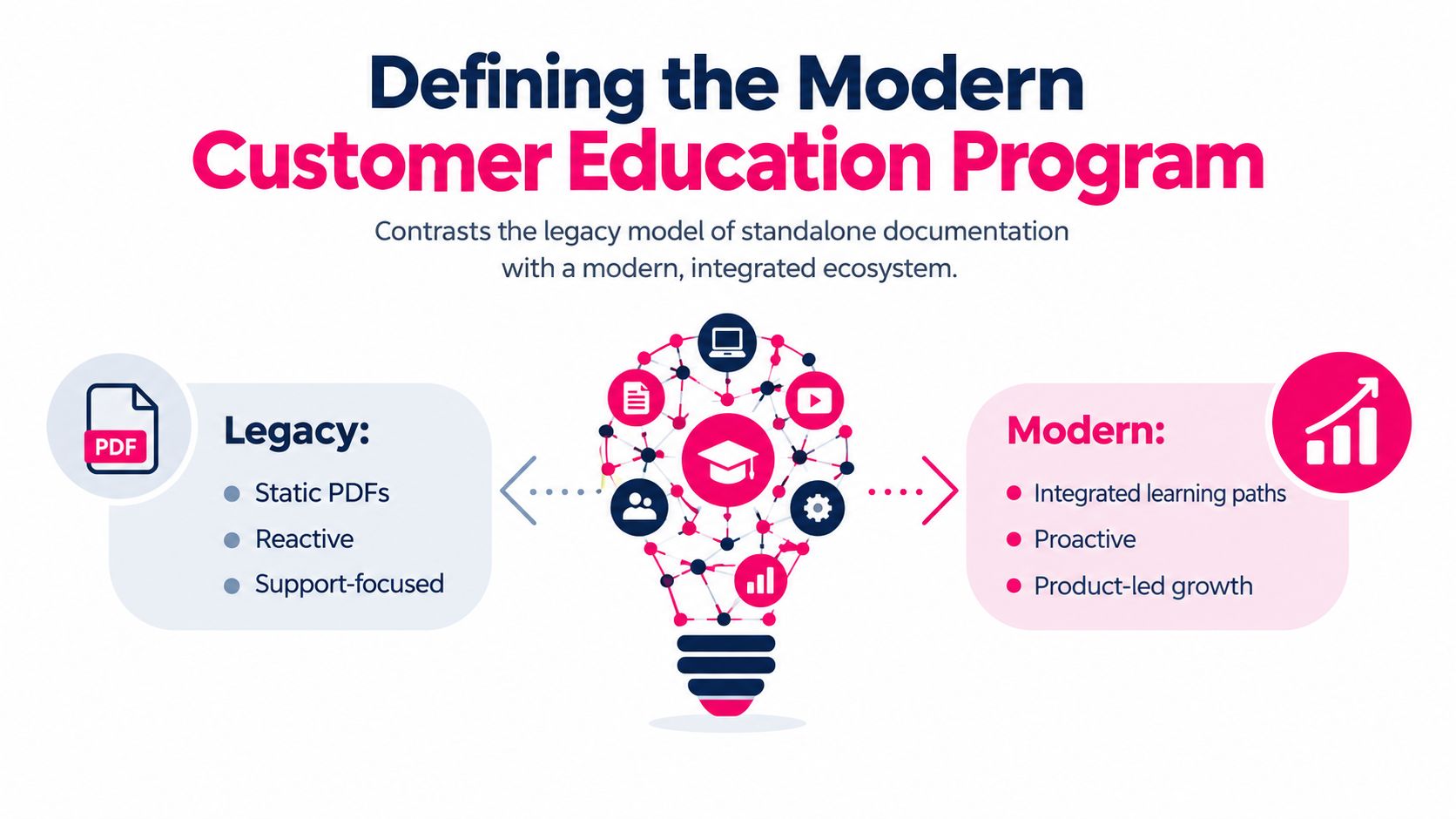
A modern customer education program is an operating layer across the customer journey. It helps a new user reach initial value, gives an administrator the confidence to configure the product, supports advanced users as they adopt deeper capabilities, and equips customer success managers with resources for adoption and renewal conversations.
That definition separates a program from a content collection. A content collection stores information. A program assigns the right information to a customer segment, role, lifecycle stage, and product moment, then checks whether the customer used what they learned.
Legacy content versus journey-mapped learning
The legacy model usually begins with a long webinar, a PDF, or a static knowledge base article. Customers search when they're stuck, support agents send links, and education teams measure activity without knowing whether the resource resolved the underlying problem. That model still has a place for reference material, but it breaks down when customers need guidance inside a workflow.
A journey-mapped program starts with customer tasks:
- Onboarding: Complete the first meaningful workflow and understand the product's operating model.
- Activation: Connect the product to a real use case rather than merely exploring the interface.
- Adoption: Introduce features that deepen regular usage and support team-level outcomes.
- Advanced enablement: Help specialists, administrators, and champions handle more complex scenarios.
- Renewal readiness: Reinforce realized value and close known knowledge or usage gaps.
Each stage needs different content, delivery, and evidence of success. A new user might need a short screen demonstration. An administrator might need a guided configuration exercise. A champion may benefit from a use-case series that helps them teach colleagues.
What mature programs coordinate
A mature program aligns customer success, support, product, marketing, and learning operations around shared customer outcomes. Support identifies repeated friction. Product explains intended workflows and release changes. Customer success identifies adoption and renewal risks. Education turns those inputs into reusable learning experiences.
The delivery model should also reflect the customer's context. A course portal can house structured paths and certifications, while an in-product prompt, embedded video, or searchable guide can answer a question during the task itself. Teams evaluating this model can review VideoLearningAI's customer education use case for an example of how AI-generated video learning paths fit into customer enablement workflows.
The modern program isn't “all video” or “all in-app guidance.” It's a coordinated system that uses each format where it removes the most friction.
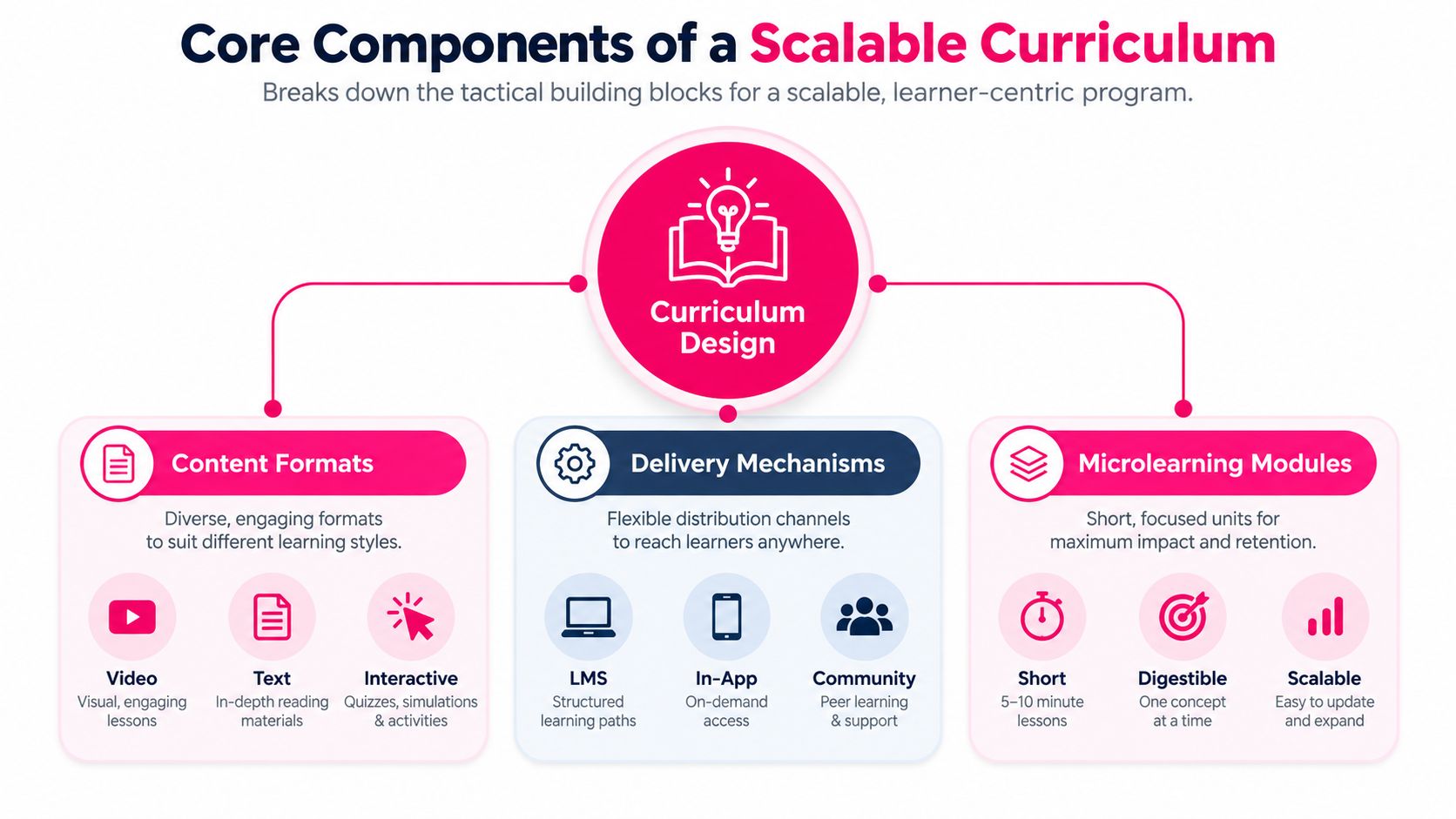
Core Components of a Scalable Curriculum
Scalability comes from curriculum architecture, not from asking educators to publish faster. A useful architecture separates the learning objective, the customer role, the delivery moment, and the evidence that the customer can perform the task.
Start with a curriculum map. For every priority workflow, document the target persona, prerequisite knowledge, desired action, common failure point, lesson format, and product signal that indicates success. This prevents teams from producing attractive lessons that don't solve a meaningful customer problem.
Build around small, reusable units
Microlearning works best when each lesson answers one practical question or supports one action. A module might show how to configure a setting, explain when to use a feature, or demonstrate the correct sequence for completing a workflow. Short lessons are easier to update, localize, embed, and recombine into role-specific paths.
Use a consistent lesson pattern:
1. Orient: State the customer task and why it matters. 2. Demonstrate: Show the actual interface, decision, or workflow. 3. Apply: Ask the learner to perform the action in the product. 4. Verify: Check the result through a practical task or product event.
AI video tools can accelerate the conversion of source material into this format. A product manager's release notes, a support article, or a compliance document can become a draft script and a sequence of focused lessons. The subject matter expert still needs to verify terminology, screenshots, permissions, edge cases, and the intended customer behavior.
Match formats to moments
Use video when motion, sequence, or interface context matters. Use text when customers need searchable detail, definitions, or a reference they can scan. Use interactive elements when the learner must make a decision or demonstrate competence.
A scalable content system might include:
- Onboarding videos for first-use workflows.
- Role-based paths for admins, operators, managers, or technical users.
- In-product guidance for contextual prompts and feature discovery.
- Reference articles for edge cases and troubleshooting.
- Live sessions for complex changes, customer questions, and community learning.
- Assessment activities that require customers to complete or reason through a task.
Distribution should follow the customer rather than force every learner into an LMS. An LMS can organize formal paths, records, certifications, and reporting. Product tours and embedded lessons can support in-flow learning. Community spaces can capture peer questions and reveal topics that need a more durable resource.
VideoLearningAI can convert existing training materials into bite-sized training videos and supports templates for customer education, onboarding, compliance, and sales enablement. That kind of workflow is useful when the bottleneck is production, but it doesn't remove the need for instructional review, product validation, or outcome measurement.
Measuring Impact Beyond Course Completion
Completion is easy to report and often weak as evidence. A customer can finish a lesson without changing behavior, while another customer can watch only the relevant segment and immediately complete the target workflow. The program should therefore treat engagement as an input, not the outcome.
Forrester Consulting's Intellum study associated formalized customer education programs with a 6.2% increase in organizational bottom-line revenue, a 7.4% increase in customer retention, and a 6.1% decrease in support costs. The figures, available in the Forrester Consulting report commissioned by Intellum, provide a useful benchmark, but they shouldn't be treated as automatic proof of causation for every program. Your reporting model must show how a specific intervention connects with a specific customer outcome.
Use a maturity matrix
| Metric Category | Vanity Metric Avoid | Business Impact Metric Track | |---|---|---| | Engagement | Video views or enrollment | Completion of the target product action | | Learning | Quiz score alone | Demonstrated ability to perform the workflow | | Adoption | Course attendance | Use of the feature or workflow taught | | Support | Article visits | Repeated issue reduction or support deflection | | Customer health | Path completion | Adoption movement within a risk or onboarding segment | | Commercial impact | Certificates issued | Expansion activity, renewal readiness, or realized use case |
Create a measurement chain for each priority path. Record the customer segment, lesson exposure, target behavior, observation window, and comparison method. If the goal is feature adoption, track usage before and after education for the relevant cohort. If the goal is support efficiency, compare the volume and type of questions associated with the taught workflow.
> Measure the action that proves learning, not the activity that merely surrounds it.
Attribution needs discipline. A customer may adopt a feature because of training, a product improvement, a new mandate, or a customer success intervention. Use controlled tests where practical, compare exposed and unexposed cohorts carefully, and document limitations rather than claiming certainty. Leaders who need a broader framework for connecting usage patterns to retention and revenue can consult Creem's analytics guide for digital product makers.
For a deeper treatment of outcome-based evaluation, see this training effectiveness measurement guide. The reporting cadence should put product outcomes first, with completion and satisfaction used as diagnostic signals.
A measurement gap remains common. Recent benchmark coverage reports that only 19% of customer education programs meet the maturity benchmark, and more than half of programs whose teams are very confident in ROI still report at least one fundamental measurement gap, as discussed by Learning News. That finding should make teams more rigorous, not less ambitious.
A Roadmap for Building and Scaling
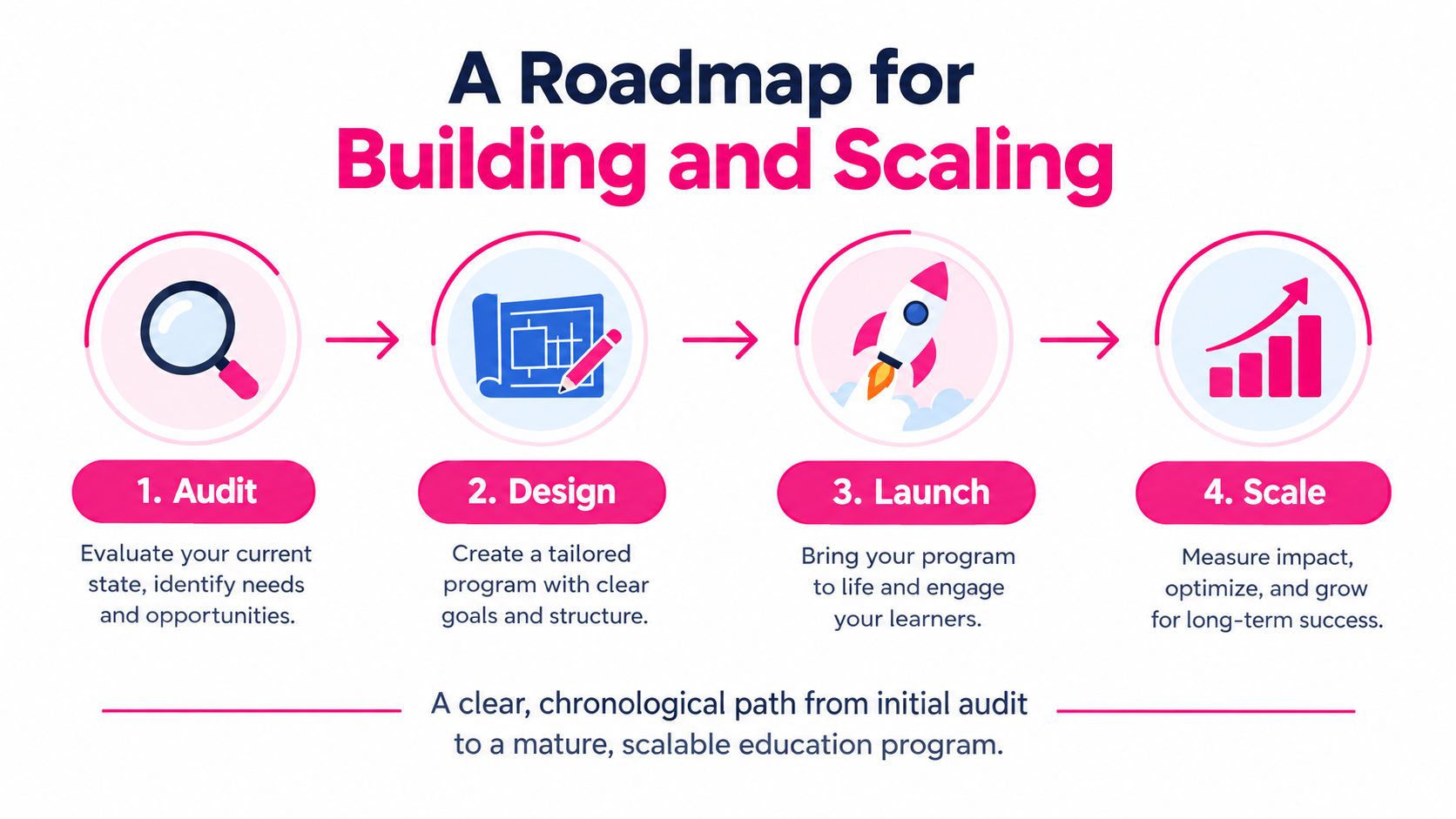
The safest launch is narrow, evidence-led, and tied to a workflow customers already struggle to complete. Don't begin by trying to build an academy for every persona and use case. Begin with the gap that creates the clearest customer and operational cost.
!A four-step roadmap for building and scaling a customer education program from audit to scale.
Audit the friction
Review support conversations, onboarding notes, product analytics, customer success plans, and churn feedback. Group problems by customer task rather than by internal department. A vague theme such as “customers need more training” isn't actionable. A specific pattern such as “administrators can't complete the permissions workflow without assistance” gives the team a curriculum target.
Interview the people closest to the problem. Support agents know which questions repeat. Customer success managers know which accounts remain stuck after onboarding. Product managers know which features have confusing states or weak discoverability.
Design the smallest useful path
Choose one audience and one outcome. Define the prerequisite, the short lesson sequence, the in-product destination, and the success event. Reuse existing documentation where it's accurate, but don't place long articles into a course and call the problem solved.
A structured platform can help when the program needs enrollment, learning paths, records, or certification. Teams comparing build-versus-buy decisions may find this guide to building an online course platform useful for understanding the broader product and infrastructure considerations.
Use the customer education template to standardize lesson planning, audience definition, learning objectives, and delivery requirements.
Launch with a feedback loop
Release the path to a defined customer group and watch both learning signals and product behavior. Ask whether learners reached the intended workflow, where they hesitated, and which explanations failed to match the interface. Give support agents a direct way to flag outdated content or recurring questions that the path missed.
Treat the first release as a working product. A lesson isn't finished because it has been published. It's finished when customers can use it, support can rely on it, and product teams can keep it accurate.
Scale through release operations
Add education review to the product launch process. Every significant feature change should identify affected learning paths, screenshots, in-product prompts, help content, and customer success guidance. AI can help detect source changes, draft revisions, and generate alternate formats, while a subject matter expert remains accountable for correctness.
Scaling this way increases reuse rather than headcount. A single verified explanation can support a video, article, tooltip, live session, and success playbook, provided each version preserves the same learning objective and product truth.
The Shift to AI and In-Product Learning
Traditional courses and long webinars still work for complex material, formal accreditation, and situations where customers benefit from a complete sequence. They fail when a customer needs one answer while actively trying to complete a task. In that moment, a ten-minute lecture can be less useful than a focused demonstration placed beside the relevant control.
AI-assisted production changes the economics of creating those smaller assets. Teams can draft scripts from product documentation, generate visual sequences, create versions for different roles, and refresh lessons when source material changes. The speed is valuable because customer education often falls behind product releases when every update requires manual recording and editing.
Speed also introduces risk. AI-generated content can preserve an outdated instruction, flatten an important distinction, use the wrong product terminology, or produce a polished lesson that teaches the wrong behavior. Governance must therefore cover the source of truth, review ownership, accessibility, permissions, versioning, and retirement rules.
Optimize for performance, not volume
The emerging model favors modular assets, in-flow education, AI support, and authentic assessment. Recent coverage of customer education trends describes a shift away from traditional courses and notes that 29% of teams report significant or fundamental change from AI, according to Check N Click's analysis of customer education in 2026.
That shift creates a useful decision test:
- Choose AI production when the constraint is drafting, localization, formatting, or repetitive editing.
- Choose in-product guidance when the customer needs help during a workflow.
- Choose a structured course when concepts build on one another or completion records matter.
- Choose performance checks when the risk lies in incorrect execution rather than forgotten terminology.
Multiple-choice quizzes may confirm recognition without confirming competence. Ask learners to configure a setting, interpret an output, choose a workflow, or complete an action in a safe environment. The assessment should resemble the customer's real work.
The strongest AI workflow is not “publish everything automatically.” It's a controlled loop: generate, review, test with customers, observe behavior, revise, and retire content that no longer reflects the product.
Integrating Education with Product and Support
A customer education program becomes durable when no single team owns every part of it. Support should surface recurring knowledge gaps. Education should turn those gaps into reusable interventions. Product should provide accurate workflows and release context. Customer success should use the learning paths during onboarding, adoption reviews, and renewal planning.
Create a shared intake process with clear fields: customer task, affected persona, evidence of friction, current workaround, proposed learning objective, and target product behavior. Rank requests by customer impact and repeatability. A one-off explanation for an unusual edge case may stay in support, while a repeated question about a core workflow deserves a durable lesson or in-product guide.
Embed education where customers already work. Place a short demonstration near a complex setting, link a relevant path from the onboarding checklist, and give customer success managers a way to recommend specific modules during account reviews. Don't make customers search a separate academy for help that could appear at the moment of need.
> Education should be part of the product experience, not a destination customers visit only after they fail.
Close the loop with regular reviews. Support can report whether ticket themes change. Product can flag interface changes. Customer success can identify accounts that need targeted enablement. Education can retire obsolete assets and publish replacements before confusion spreads.
The strategic imperative is simple: teach customers to achieve value, then make that teaching available repeatedly and contextually. A program built around customer behavior can reduce avoidable friction, support deeper adoption, and give the business a more reliable path from onboarding to retention and expansion.
---
VideoLearningAI helps teams turn existing materials into polished, bite-sized training videos without requiring editing expertise, using templates for customer education and other structured learning workflows. Visit VideoLearningAI to create focused lessons that fit in-product guidance, onboarding paths, and scalable customer enablement programs.