Your LMS dashboard says the compliance cycle went well. Completion is high, the certificates are filed, and the annual report is ready for leadership. Then a manager reports that an employee shared sensitive information in the wrong channel, a new hire follows an outdated policy, or an auditor asks who completed which version of the training and what happened after someone failed the assessment.
That gap is the real problem with compliance training for staff. A course can be completed without changing a decision, a habit, or a manager's response to risky behavior. The practical answer isn't automatically a new LMS or a larger content library. It's a behavior-change system that connects role-specific learning, reinforcement, manager follow-up, and audit evidence.
Table of Contents
- The four failure modes - Build the map in sequence - Set a threshold for separate modules - Give each unit one decision - Trigger reinforcement from the LMS - Run the evidence test before launch - Use three signal layers - Days 1 to 20, define exposure - Days 21 to 45, build and test - Days 46 to 70, expand the population - Days 71 to 90, lock the operating rhythmWhy Most Compliance Programs Quietly Fail
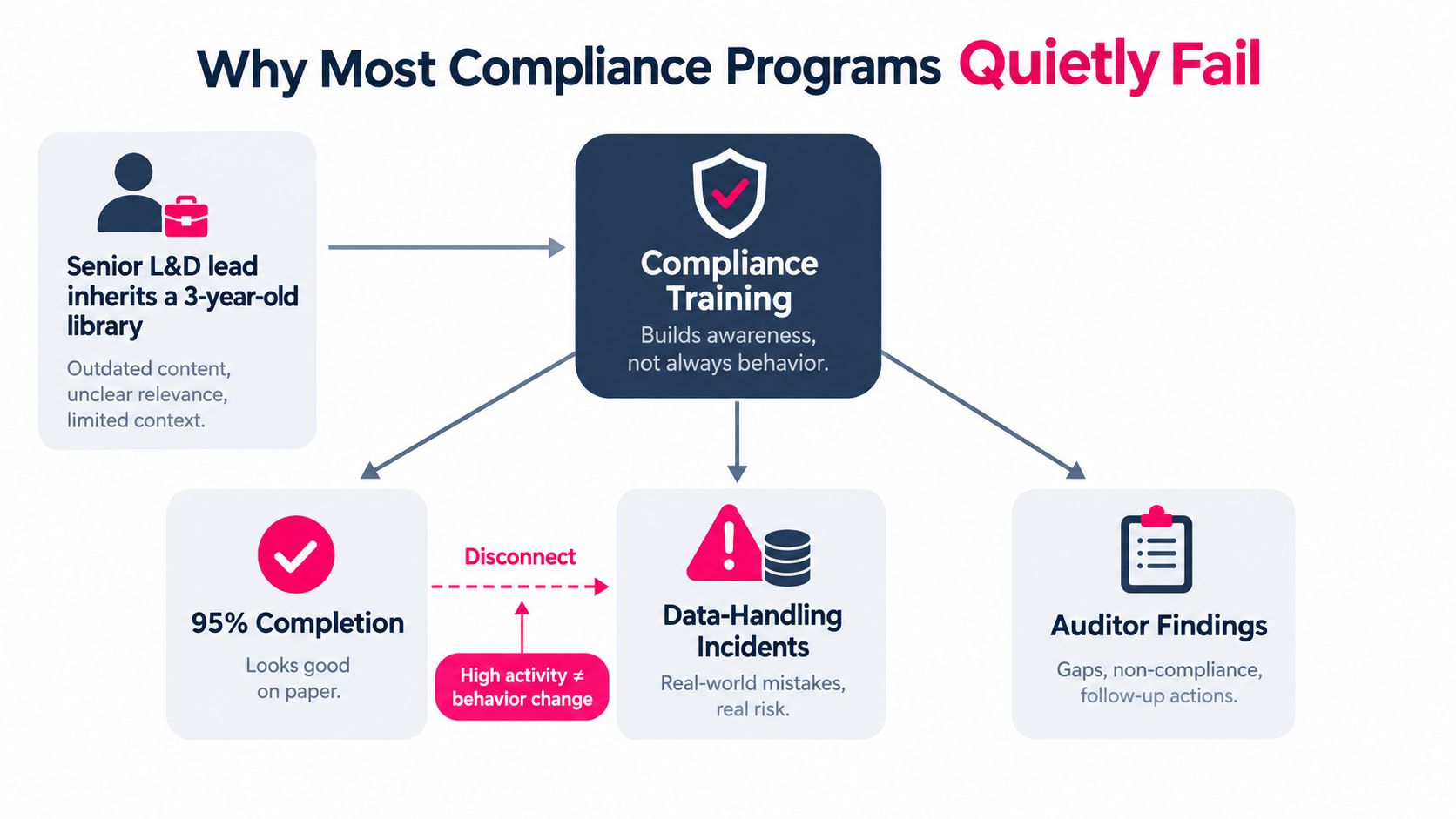
A senior L&D lead inherits a three-year-old compliance library. The dashboard shows 95% completion, yet the business has experienced two data-handling incidents, an HR complaint, and an auditor finding that several modules still reference stale policy versions. Nothing appears broken in the reporting layer. The failure sits between activity and behavior.
The distinction matters because many organizations still lack a mature operating model. One industry summary reports that 23% of companies have no formal compliance training plan, 40% describe their processes as basic or reactive, and only 31% report an advanced compliance and ethics training program (industry summary of employee training data). The same source says only 70% attempt to measure whether compliance training works, which leaves many teams proving attendance rather than risk reduction.
The four failure modes
Annual delivery replaces reinforcement. Staff receive a large module, pass a quiz, and hear little about the topic afterward. Knowledge then competes with daily priorities, changing systems, and local workarounds.
Policy text replaces decisions. A policy may define acceptable conduct, but employees need to recognize a risky situation, choose an action, and know when to escalate. Copying paragraphs into slides rarely answers those questions.
Scenarios are skipped. Without practice, learners can recognize terminology without knowing what to do when a customer request, colleague instruction, or deadline creates pressure.
Completions become orphaned records. L&D owns the dashboard, Legal owns the policy, managers own the work, and nobody owns the conversation after a learner struggles. The result is a clean certificate trail with weak operational follow-up.
> Practical rule: Design the evidence trail and the desired workplace behavior at the same time. If the audit record can't show what people learned, where they struggled, and who followed up, the program is incomplete.
A useful definition of what compliance training means in practice starts with that operating reality. Rebuilding doesn't require replacing every course. It requires deciding which risks deserve practice, which behaviors managers must observe, and which records the organization must retain.
Map Policies to Real Workplace Risks
Start with a policy-to-risk matrix before writing a slide, script, or quiz. The matrix prevents two expensive mistakes: training everyone on every policy, and leaving a high-exposure role with only generic awareness content.
Build the map in sequence
1. Inventory the policies in scope. Include external obligations, internal standards, procedures, escalation rules, and approved exceptions. Record the policy owner, current version, review date, affected locations, and business processes.
2. Assess operational risk. Rate each policy area by likelihood, severity, and detectability. The point isn't to create a mathematically perfect score. It's to identify where a small decision could create serious exposure and where the organization might discover the problem late.
3. Cluster related risks. Data handling, access control, phishing, and incident escalation may belong to one privacy and security family. Conflicts of interest, gifts, reporting concerns, and accurate records may sit within a conduct and ethics family.
4. Map clusters to roles. Ask where employees encounter the risk, not where the policy sits organizationally. Engineering, sales, customer support, facilities, contractors, and managers may need different examples from the same policy.
Consider GDPR data handling. An engineer may decide whether a production dataset can be copied into a test environment. A salesperson may receive personal information in an email attachment and need to choose a secure transfer method. A facilities employee may encounter visitor records or printed documents. The governing policy is shared, but the decision path isn't.
The same principle applies to a code of conduct. A sales employee may face gifts or conflicts of interest, while a manager may need to respond to a report from a direct report. Shared principles can support common coverage, but role-specific scenarios should carry the practice burden.
| Policy | Risk Tier | Primary Roles | Module Type | |---|---|---|---| | Data protection and privacy | High | Engineering, sales, support, facilities | Role-based scenario modules with escalation practice | | Code of conduct | Medium to high | All staff, people managers, procurement | Shared principles plus manager and function scenarios | | Information security | High | All staff, IT, privileged users | Short awareness units plus simulations for higher-risk roles | | Records and communications | Medium | Sales, marketing, legal, operations | Decision-based examples and documentation checks |
Set a threshold for separate modules
Give a policy its own module when the risk is high, the affected role must perform a distinct procedure, the policy changes often, or an audit requires discrete evidence. Use shared coverage when the rule is broadly applicable and the decision is substantially the same across roles.
Over-mapping creates training fatigue. Under-mapping creates audit gaps and leaves employees guessing. The matrix should therefore determine not only what gets taught, but also assessment difficulty, assignment rules, refresher timing, and who receives the resulting evidence.
Design Modules Built for Microlearning
Long annual modules create a difficult trade-off. They can cover a broad policy set in one sitting, but employees often experience them as an interruption to work. Compliance leaders report that 33% say programs take employees five or more hours to complete, while 46% feel pressure to shorten training time (training time and delivery data). That pressure doesn't justify removing important content. It does justify separating essential decisions from background explanation.
Industry summaries report steep retention loss without reinforcement, including roughly 50% forgotten within an hour, 70% within 24 hours, and 90% by the end of the first week (corporate training retention summary). These figures should be treated as a warning against one-time delivery, not as a reason to compress every topic into a tiny video.
Give each unit one decision
A practical microlearning unit should answer three questions:
- Recognition: What situation should the employee notice?
- Action: What should the employee do next?
- Escalation: When should the employee stop and ask for help?
A four-to-seven-minute lesson can open with a realistic scenario, explain one rule, show one correct example, identify one common mistake, and finish with a quick check. That structure works for a data-sharing decision, a conflict-of-interest disclosure, or a suspected phishing message because it keeps the learner close to the action.
The production cost shifts, though. Short lessons require more authoring discipline per minute. Subject matter experts often want to add every exception, definition, and historical note. The instructional lead has to protect the decision objective while linking to controlled reference material for people who need more detail.
> Shorter content isn't automatically better. A focused lesson is better when it gives the employee enough context to make the right decision.
Use a reusable shell so updates don't require a new design process. Keep the visual language, narration pattern, accessibility treatment, assessment style, and metadata consistent. Tools such as VideoLearningAI can turn approved policy content into short training videos with captions, localization support, and LMS-oriented publishing workflows. Other teams may use an authoring tool, a video editor, or a template library already approved by IT.
For immersive or physical workflows, training employees with 360 tours can provide a useful reference for placing learners inside a visual environment rather than relying only on slides.
The format should follow the risk. Use mobile-friendly video and short checks for awareness. Add branching decisions, simulations, or manager-supported practice where the employee must apply a procedure under pressure.
Build Assessments and Reinforcement Loops
A quiz at the end of a course is an assessment feature. A reinforcement loop is a control system. The difference is whether the organization uses the learner's response to decide what happens next.
Match the question type to the risk. Multiple-choice recall can test a policy fact, such as where to report a concern. Scenario branching is more appropriate when an employee must weigh competing pressures, such as a customer deadline against secure data handling. Drag-and-drop or procedural sequencing can test a role-specific workflow. For high-risk work, a simulation or observed task may provide stronger evidence than a knowledge check alone.
Place a short check inside every microlearning unit, not only at the end of an annual curriculum. If a learner misses a question, route them to a concise refresher and let them try again. Locking the course without teaching the missed concept produces a record of failure, but not necessarily better performance.
Trigger reinforcement from the LMS
Use LMS events to schedule follow-up rather than asking an administrator to remember every assignment. A practical sequence can include refreshers at 30, 60, and 90 days, with the schedule adapted to the risk and the organization's policy requirements. The learner's path might look like this:
1. Initial assessment: establish whether the employee can recognize and respond to the risk. 2. Spaced reinforcement: deliver a short prompt, scenario, or policy reminder. 3. Scenario application: ask the employee to make a decision in a realistic context. 4. Final assessment: confirm whether the key behavior remains accessible.
For higher-risk topics, add a manager confirmation. The manager might verify that the employee followed the escalation path, used the approved system, or understood a role-specific control. That record shouldn't become a ceremonial approval. Give managers a clear observation prompt and an escalation option when they see uncertainty.
Checks for understanding should support the learning decision, not decorate the course. Use actual incidents from your industry, with identifying details removed and legal review completed. Generic vignettes often make the correct answer obvious. Realistic cases force learners to process the ambiguity that causes mistakes at work.
Publish to Your LMS Without Losing Audit Trails
Publishing is where a well-designed program can become difficult to prove. The package opens, the learner reaches the final screen, and the LMS marks the course complete. Months later, nobody can show which policy version was assigned, whether a failed attempt led to remediation, or whether a manager acknowledged a high-risk requirement.
Choose the publishing route based on the evidence you need, not only on launch speed.
| Dimension | SCORM 1.2/2004 | xAPI + LRS | Embedded Portal | |---|---|---|---| | Rollout speed | Fast and broadly compatible | Requires statement design and LRS readiness | Depends on integration work | | Core tracking | Completion, score, status | Detailed events, retries, remediation, and behavior signals | Potentially rich, depending on API design | | Audit detail | Often limited to package fields | Strong when statements are governed and retained | Strong only if the integration preserves evidence | | Maintenance burden | Lower after upload | Higher data and integration governance | Higher integration and ownership burden | | Best fit | Standard course completion | Programs needing granular evidence | Organizations running parallel learning systems |
SCORM 1.2 or 2004 remains practical when the priority is a quick rollout across a compatible LMS. It generally gives teams the broadest deployment path, but the available data can be too coarse for detailed behavior analysis.
xAPI with an LRS can capture richer events, including time on task, retries, scenario choices, and remediation paths. That flexibility comes with responsibility. Someone must define statement vocabulary, identity handling, storage, access controls, and retention.
An embedded portal or external microsite can suit organizations operating across multiple systems. It can also create integration debt, especially when completion data, user identity, version history, and downstream assignments move through separate services.
Run the evidence test before launch
- Reporting fields: Confirm that learner identity, policy name, version, completion date, score, attempt status, and remediation fields map to the audit template.
- Workflow triggers: Verify that completion starts the right recertification, notification, or manager task.
- Version control: Test whether a later policy update preserves the learner's historical assignment and result.
- Retention: Confirm that records remain available for the required organizational and regulatory period.
- Failure handling: Check what happens when a learner loses connectivity, closes the window, or completes remediation outside the original package.
A successful upload isn't the same as a defensible audit trail. The audit trail requirements guide is useful when teams need to translate learning activity into controlled evidence.
Measure Behavior Change, Not Just Completions
Completion measures whether an assigned activity reached a recorded endpoint. It doesn't prove that an employee recognized a risk, used the correct process, or felt safe escalating a concern.
That weakness is visible in workplace feedback. Gallup research cited in the Harvard reference reports that only 23% of employees rated recent compliance or ethics training as excellent, 10% strongly agreed they learned something that changed how they work, and 11% strongly agreed coworkers apply it daily (Harvard paper on compliance training and workplace behavior). The same evidence describes temporary effects from in-person compliance training, with behavior effects lasting about two months, and no average reduction in misconduct overall.
Use three signal layers
Leading indicators show whether learning is taking hold. Track knowledge-check performance, retry patterns, remediation rates, and the questions employees consistently miss.
Behavior proxies show whether the learning appears at work. Ask managers to confirm a specific action during a normal workflow, such as secure file handling, proper approval, or escalation. Keep the prompt narrow enough that a manager can answer from observation rather than guesswork.
Lagging outcomes show where risk materialized. Review incident reports, hotline flags, audit findings, and policy exceptions alongside training data. A rise in reports isn't automatically evidence that training failed. It may indicate that employees now recognize and report problems. Investigate the context instead of treating every number as a scorecard.
You can run this process without rebuilding the LMS. Each quarter, L&D can combine completion and assessment exports with incident or audit data from adjacent systems. The important change is where the conversation goes. Don't send an aggregate score upward and stop. Give each people manager a small set of relevant signals and a required follow-up action.
If data-handling refresher scores fall for a customer-support team, the response shouldn't be another all-staff email. The manager can review the missed decision, observe the approved workflow, ask what made the correct path difficult, and report whether the procedure or incentive structure needs attention.
> Audit-ready reporting should identify the content version, learner, completion date, result, remediation taken, manager action, policy owner, and accountable follow-up date.
This record connects training evidence to operational ownership. It also helps expose a deeper issue: employees may understand a rule but ignore it when targets, systems, or supervisors reward the opposite behavior. Training can clarify the decision. Leaders must make the compliant decision workable.
Your 90-Day Compliance Training Rollout Plan
A controlled rollout is safer than a dramatic library replacement. Assign one accountable owner, include Legal, Compliance, IT, HR, and representative managers, and give every phase a clear exit criterion.
Days 1 to 20, define exposure
- Scope the risks: Inventory the highest-exposure policies, confirm current versions with Legal, and identify the roles that encounter each risk.
- Select the pilot: Choose 50 to 100 employees across two departments for a representative pilot, using the rollout parameters in the working plan rather than treating the group as a convenience sample.
- Set the baseline: Capture existing completion, assessment, incident, and audit signals where available.
- Exit criterion: Approve the policy-to-role matrix, pilot cohort, content priorities, and evidence fields before production begins.
Don't skip the pilot to meet a launch date. A small group reveals confusing language, broken assignment rules, accessibility problems, and reporting gaps while changes are still cheap.
Days 21 to 45, build and test
Ship the microlearning units, scenario assessments, remediation paths, and manager prompts. Test the course on the actual devices and LMS configuration employees use. Capture completion, scores, retries, and manager observation notes.
Run a weekly 30-minute standup with the accountable owner and decision-makers. Resolve policy ambiguity quickly, but don't let subject matter experts expand every lesson beyond its decision objective.
Exit criterion: Pilot learners can complete the assigned path, managers can perform the follow-up, and the audit export contains the required version and result fields.
Days 46 to 70, expand the population
Release the approved learning paths to the full population by role and location. Enable recurring refreshers, confirm notifications, and verify that xAPI statements or equivalent tracking data flow into the audit warehouse if that architecture is in use.
Watch for operational friction. A missed assignment, an inaccessible video, or a manager who can't find the observation task can undermine adoption even when the content is sound.
Exit criterion: Full-population assignments, completion records, remediation events, and manager tasks reconcile across systems.
Days 71 to 90, lock the operating rhythm
Finalize the recertification cadence, manager dashboards, policy ownership, and evidence packet. The packet should include completion rates, assessment scores, policy acknowledgements, remediation logs, content versions, and documented follow-up owners.
Under-resourcing manager coaching is the second major execution risk. Managers need time, prompts, and escalation routes. Without those supports, the organization will measure learning activity while leaving workplace incentives untouched.
Exit criterion: Leadership approves the recurring review calendar, owners accept their policy responsibilities, and the next audit request can be answered from a controlled evidence set.
---
VideoLearningAI helps teams turn approved compliance content and policies into structured, bite-sized training videos, with captions, localization support, interactive learning options, and LMS-ready publishing workflows. Visit VideoLearningAI to explore a practical way to refresh staff compliance lessons without rebuilding your entire learning operation.