A completed module and a signed policy acknowledgment prove that someone clicked through. They don't prove that person will act when a supplier offers a gift, or when a manager asks them to skip a vendor check so a deadline can be met.
Table of Contents
- Training is one control - Rewrites that pass the watch test - Depth follows exposure - When the manager is the pressure - Score the decision, not the guess - What a leadership summary should contain - A record counsel can followWhat Compliance Ethics Training Must Achieve
Tips, not audits, are how most occupational fraud is found, so the people closest to the work are part of the control system. The Association of Certified Fraud Examiners' 2024 Report to the Nations analyzed 1,921 occupational-fraud cases investigated between January 2022 and September 2023 across 138 countries and territories. Those cases represented more than $3.1 billion in reported losses. Tips identified 43% of cases, and employees supplied 52% of those tips.
Compliance ethics training is structured learning aimed at four results: recognizing misconduct, knowing the rule, judging a gray situation, and reporting with enough confidence to follow through. A click records none of that.
> A fire certificate says the building has exits. A drill shows which stairwell people actually use.
Training is one control
The same case set found that more than half of occupational frauds involved either inadequate internal controls or management override of existing controls. Lessons can support the control environment. They don't replace an independent hotline, a manager who owns the response, or a documented investigation. If any of those is weak, staff can spot a problem and still have nowhere safe to take it.
Security programs make the same split. A training guide for IT providers is useful when it sits next to monitoring and response, not when it stands in for them.
Build each module around a behavior someone can see. Tie it to the risk that role creates, practice it in a scenario, score the decision, and keep a record that matches the rule you claim to teach.
Writing Learning Objectives That Describe Behavior
Could a manager watch someone do this on a normal Tuesday? If not, the objective won't survive contact with the job, and the quiz that follows it will only prove recall.
Understand the gifts policy names a feeling. Decline a vendor gift above the policy limit and log it within two business days names an action, a threshold, and a deadline. The second version tells you what the module has to ask the learner to do.
| Level | Observable verb | Example objective | | --- | --- | --- | | Awareness | Name the rule and its owner | Name the owner of the conflict-of-interest policy | | Recognition | Spot the warning sign in a case | Identify a split invoice designed to avoid approval limits | | Judgment | Choose the right action under pressure | Decide whether a client gift needs pre-approval | | Reporting | Use the correct channel within a set time | Submit a concern through the ethics hotline within one business day of noticing it | | Behavior | Show the action in a workplace task | Pause a contract approval when third-party due diligence is incomplete |
Awareness can be a short recall item. Recognition, judgment, reporting, and behavior need a case. A definition quiz can't show the choice someone makes when a deadline is staring at them.
Rewrites that pass the watch test
- Anti-bribery: "Know the anti-bribery law" becomes identify three red flags in a third-party payment request.
- Harassment: "Understand the harassment policy" becomes choose the right reporting channel for a complaint about a direct manager.
- Privacy: "Know data privacy rules" becomes stop and escalate when a colleague asks for customer records by email.
Hold each module to one objective. Five objectives in one lesson blur the scenario, the feedback, and the score, so you can't tell which skill failed.
Close with a two-person review. The compliance lead checks that the objective matches the current policy. The line manager checks that the behavior is visible in daily work. If the manager says the task never happens, change the objective before you script anything. The same test is spelled out in how to write learning objectives.
Building a Content Framework by Risk and Role
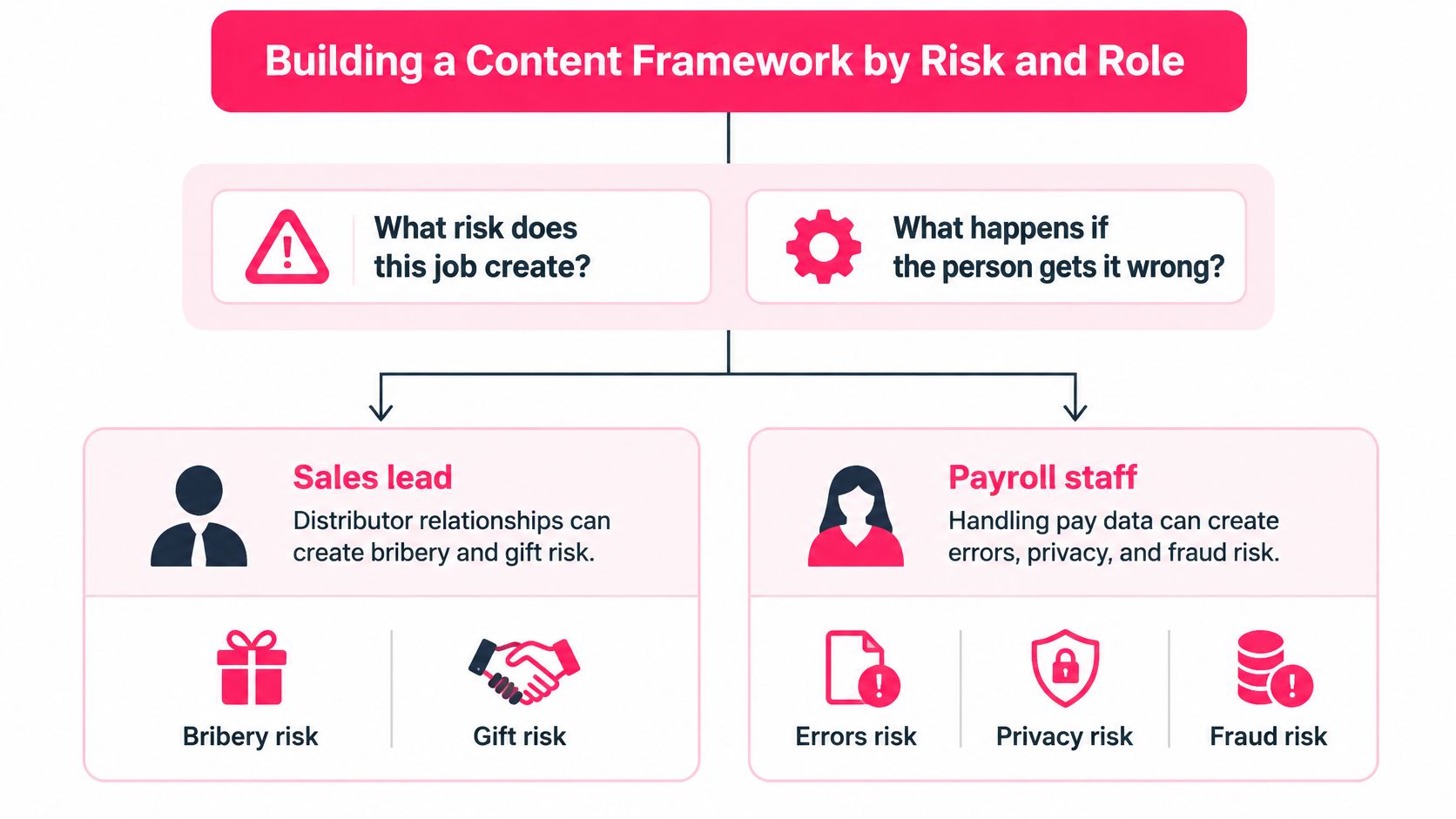
Ask two questions before you assign a course. What risk does this job create? What happens if the person gets it wrong?
A sales lead who meets distributors can be offered a gift or asked to route a payment through a partner. Get that wrong and you may have a bribery problem and a contract you can't defend. Payroll staff touch pay data every cycle. A bad export exposes salaries. A bad code pays the wrong person.
List the risks before the catalog. Conflicts of interest, bribery and gifts, data protection, harassment and retaliation, financial record accuracy, and competition law don't land evenly across the company.
Depth follows exposure
A factorial survey experiment with 1,005 managers at a multinational European corporation, published in the Journal of Business Ethics, found that program design influenced ethical intentions. More specific training was more effective than general training, and repeated compliance training was associated with a stronger willingness to engage in whistleblowing. Case-based work and active participation beat passive lectures, and effects may fade after approximately two years.
All staff get a baseline on shared risks. Roles with third-party contact, personal data, or financial authority get the scenario module. People managers get an extra module on how to respond when a concern lands on their desk.
| Risk area | Priority audience | Refresh cycle | | --- | --- | --- | | Conflicts of interest | All staff; managers approving vendors | Annual, plus on role change | | Bribery and gifts | Sales, procurement and anyone with third-party contact | Annual with quarterly reminders | | Data protection | Staff handling personal data | Annual, plus after a system change | | Harassment and retaliation | All staff; people managers with an extra module | Annual; managers twice a year | | Financial record accuracy | Finance staff and budget holders | Annual | | Competition law | Sales, marketing and trade association attendees | Before each high-risk event, then annual |
Treat each cycle as a starting point. Shorten it after an incident, a policy change, or a new market. A warehouse worker doesn't need the full sales-channel bribery module. Minutes you don't assign there are minutes people will still give you on the risks they hold.
How to Build Scenario-Based Microlearning Step by Step
Generic modules state the rule. They rarely answer what to say when a target, a loyal manager, or fear of payback pulls the other way. LRN's 2025 global study on ethics and compliance program maturity.pdf) reported that only 38% of organizations provide specific guidance on integrating ethics into business decisions, while only 27% focus on preventing retaliation. Time pressure, generic content, and mixed professional backgrounds keep showing up as barriers to engagement.
In a 2025 Compliance Week survey of 134 respondents, 33% said employees needed five or more hours to finish the company's compliance training. Short lessons protect that time. They don't, by themselves, build judgment.
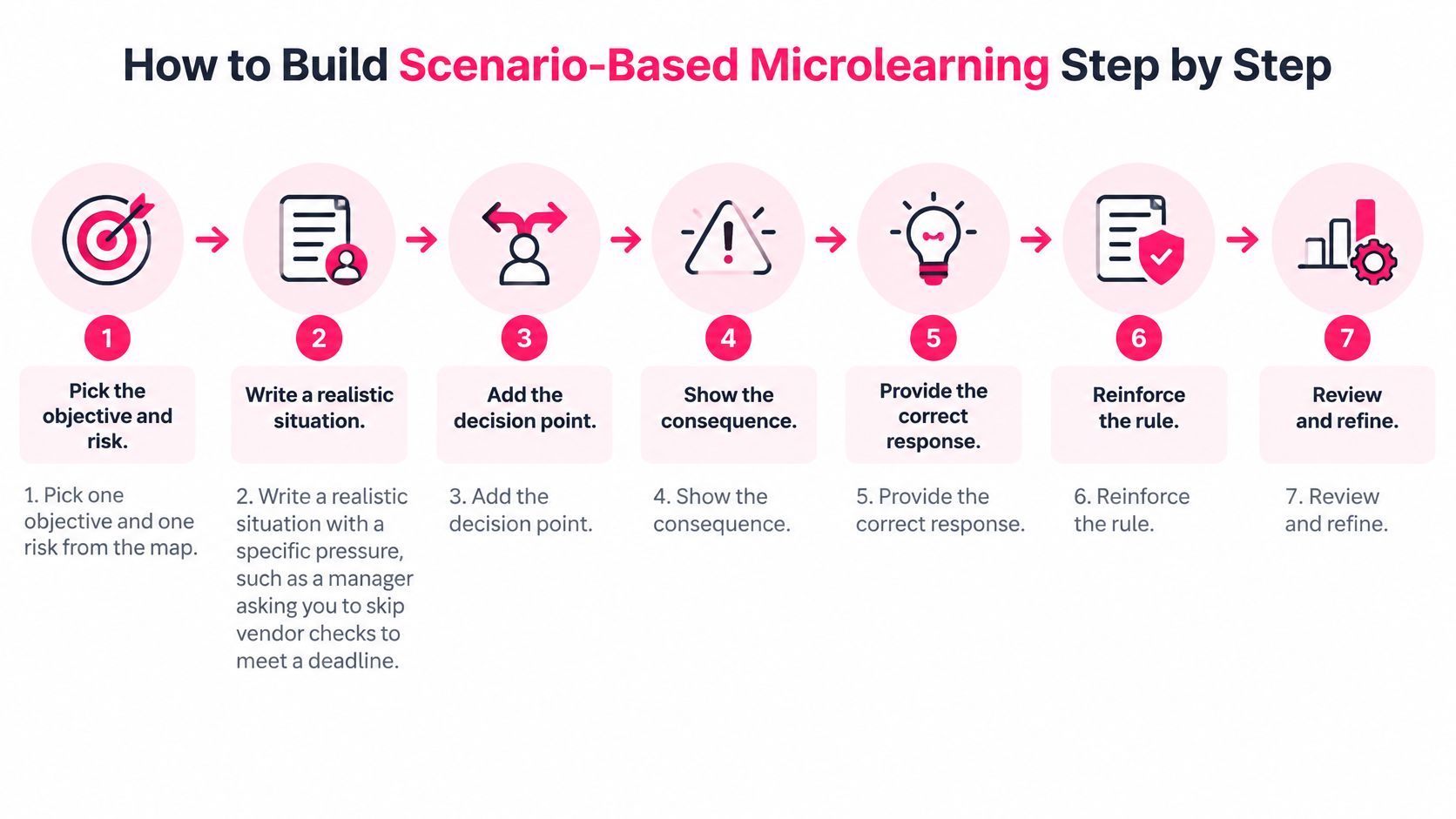
Keep the lesson to three to seven minutes so the decision stays the point. Build it in this order.
1. Pick one objective and one risk from the role map. Don't add a second theme because the policy PDF has another heading. 2. Write a realistic situation with one pressure. A manager asks you to skip vendor checks so a contract can be signed before Friday. 3. Offer three or four choices, including the tempting wrong one, such as "I'll note it after we close." 4. Branch each choice to a consequence the learner sees in 30 to 60 seconds. Show the contract delay, the hidden payment, or the protected report. 5. Ask for the choice and one line on why. The line exposes a lucky guess. 6. Give feedback that names the rule, the consequence, and a safe escalation route, including one that doesn't depend on the manager in the scene. 7. Schedule one follow-up prompt two to four weeks later, using a fresh fact pattern and the same objective.
If you're new to this format, what scenario-based training is is a useful primer before you script the first branch.
When the manager is the pressure
For retaliation and power, put a manager in the scene who disagrees with the employee. Show the response the policy expects from that manager, not only the employee's "correct" click. In the feedback, separate the legal minimum from the company value. The law may allow a modest gift. Your policy may still require pre-approval.
> Concise modules can lift completion. Complex judgment still needs realistic ambiguity, a chance to discuss the branch, and a prompt weeks later.
Our AI-generated videos may not be factually accurate and shouldn't be relied on as a source of truth. You're solely responsible for reviewing, editing, and validating every generated video before use. A policy owner should match each scenario to the source policy before it is assigned.
Assessment Methods Beyond Completion Scores
Without a baseline, a later change is a guess. Before launch, record how often staff ask compliance questions, raise concerns, and pick the wrong action in test scenarios. LRN's 2025 ethics and compliance programme maturity report found that only 44% of organizations assess comprehension and just 37% monitor misconduct trends after training. Most programs can't say what changed.
Use the methods together. Completion tells you the file was opened. It doesn't tell you the person would pause a payment.
| Method | What it proves | When to run | | --- | --- | --- | | Completion record | The module was opened and finished | At module close | | Knowledge quiz | Recall of rules and definitions | Immediately after the module | | Scenario decision with rationale | Judgment in a realistic situation | Before launch as baseline, then after each module | | Delayed recall check | Retention after the content fades | 60 to 90 days after the module | | Manager observation checklist | Behavior in daily work | Quarterly | | Speak-up confidence survey | Willingness to report concerns | Annually | | Concern volume and resolution times | Reporting trends, read with caution | Quarterly |
Score the decision, not the guess
Rate three things separately: the correct action, the correct reason, and the correct escalation route. A learner who picks the right button and writes "because it felt wrong" hasn't shown judgment. The delayed check matters because people forget when nothing asks them to decide again.
Report results only for groups large enough that no person can be identified. Keep manager observation notes out of disciplinary files. A checklist is a learning signal. Mixing it into a performance warning will shut down the behavior you're trying to see.
Reporting Results Without Overclaiming Impact
Completion is a hygiene metric. It is not proof that misconduct fell. Leaders still ask for one number, and a single percentage is easy to overread.
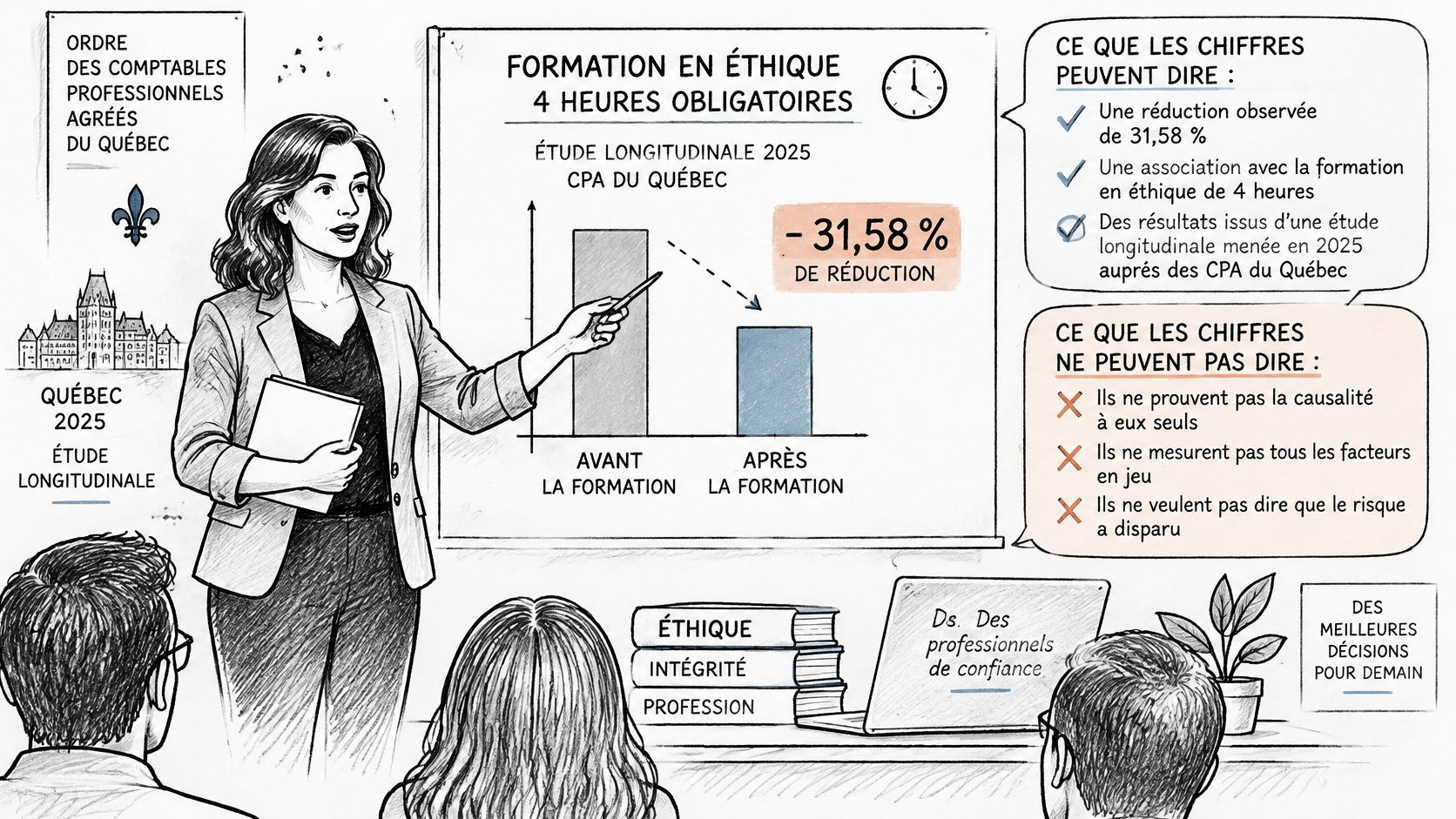
!A presenter explaining a chart showing a 31.58% reduction in risks after ethics training for CPAs.
A 2025 longitudinal study in Accounting Education compared disciplinary outcomes for Quebec Chartered Professional Accountants before and after a four-hour mandatory ethics-training requirement introduced in 2018. The study reported a 31.58% reduction in the number of infractions after implementation. The moral intensity of the remaining infractions increased, and repeat offenders continued to generate more serious violations.
That pattern sets three reporting rules. Segment by role, risk exposure, and prior incidents, not one company average. Treat completion as evidence the assignment ran, not that conduct changed. Separate lower-level, preventable misconduct, where education helps, from serious failures, which need escalation paths, supervisory review, investigations, and protection for the person who reported.
What a leadership summary should contain
> State what changed, what you measured, and what you can't yet claim. Stop when the evidence stops.
A rise in concerns after training can mean people trust the channel more. Read volume next to speak-up confidence, not as a failure of the course. A drop in incidents can mean underreporting. Say so in the same paragraph as the chart.
A short briefing on how to talk about training results without inflating them is worth watching with the pack in front of you.
Send leaders six items, and no vanity dashboard: completion by segment, scenario pass rate, repeat-incident rate, time to escalation, speak-up confidence, and substantiated versus unsubstantiated investigations. For people with prior serious violations, pair the baseline module with targeted remediation and closer monitoring. Training alone hasn't held that group.
Mapping Training to Regulatory Requirements
Regulators rarely name your course. They look for a documented, risk-based program that shows you know the duties that apply and that you acted on them. This isn't legal advice. Have counsel confirm the list for your jurisdictions and sectors.
Start with the regimes that touch you: anti-bribery law, data protection, workplace harassment rules, and financial reporting duties. A mortgage lender, for example, has to show how BSA and FinCEN rules for MLOs are taught, not buried in a generic ethics hour.
A record counsel can follow
1. List each applicable requirement by jurisdiction and by the business line that triggers it. 2. Match it to a risk already on the content map, so you don't invent a parallel curriculum. 3. Record the audience, module, date, and completion evidence for that requirement. 4. Link every module to the policy version it teaches, so you can show what staff saw on a given day. 5. Set a review trigger for each law. A rule change starts a content update, not a note to "refresh next year." 6. Keep records for the period your regulators expect, and confirm that period with counsel before you set the retention clock.
For cross-border teams, check local-language needs and how disagreement is usually voiced. A case that reads as a clear refusal in one country can read as insubordination in another. Adjust the dialogue, not the rule. Store the mapping where an auditor can trace a requirement to a module, a policy version, and a completion file, the same discipline described in audit trail requirements.
Launch Your Compliance Ethics Training Plan
Don't assign the full catalog on day one. A module is ready to pilot only when it has one objective, a risk and audience from the map, a scenario with a rubric, a baseline measure, and a slot in the reporting pack.
Pilot with the highest-risk group first. That is often managers who approve vendors, or staff who handle personal data. One weak decision there costs more than a missed quiz in a low-exposure role.
1. Choose the pilot group and one module. Don't bundle three risks to "get it over with." 2. Publish, then compare completion and scenario results with the baseline you stored before launch. 3. Review the data every two weeks and write each review into the reporting pack, including what you won't claim yet. 4. Change one element at a time, the objective, the scenario, or the feedback, so a shift in results points to a single cause. 5. Expand to the next audience only when the scenario pass rate and speak-up confidence move in the direction you defined.
Production time is often what stalls the first pilot. The practical path is to turn an approved policy into a short lesson, then have the policy owner check it. VideoLearningAI supports corporate training, onboarding, customer education, and compliance training. Teams typically launch a first version in days if they reuse templates, keep one objective per lesson, and review engagement data weekly. Our implementation checklist is to publish, measure completion, and iterate every two weeks. Judge the output by whether it still matches the source policy after a human edit, not by how fast the draft appeared.
---
VideoLearningAI helps learning and compliance teams turn approved policy material into short, scenario-based lessons for compliance ethics training, with a human review before anyone is assigned. If you're ready to pilot one objective with the highest-risk group, start from a compliance template and measure the decision, not just the click. Visit VideoLearningAI and build that first module from a policy you already trust.