One framework won't solve every training problem. Lean can expose wasted production effort, but it won't automatically explain why learners abandon a module. A dashboard can reveal weak completion, but it won't fix unclear ownership, inconsistent review standards, or an outdated procedure. Treating continuous improvement methods as interchangeable management theories usually creates activity without durable change.
L&D teams need a connected operating system. The ten methods below address different failure points across culture, workflow, quality, diagnosis, measurement, and feedback. The practical decision lens is simple: choose the method that matches the problem, define a baseline, run a focused intervention, measure the result, and reinforce the new behavior with short learning assets. This approach also supports real results with continuous improvement, because improvement becomes part of the operating rhythm rather than a one-time workshop.
VideoLearningAI is one relevant example of how teams can support that rhythm. By converting existing training materials into bite-sized videos, an L&D team can turn a new SOP, review checklist, or method-specific lesson into an accessible reinforcement asset without building a large production project around every process change.
The methods aren't competing answers. Lean Six Sigma may address variation, Kaizen may build participation, Agile may improve delivery speed, and feedback loops may reveal what learners need. Used together, they create a practical system for finding friction, testing changes, standardizing what works, and teaching people how to sustain it.
Table of Contents
- Apply it to one high-friction workflow - Make small changes teachable - Organize work around useful increments - Build quality into the workflow - Let evidence determine the next move - Use benchmarks to form testable questions - Connect measures to decisions - Turn procedures into usable support - Make feedback operational - Use microlearning to reinforce the system1. Lean Six Sigma
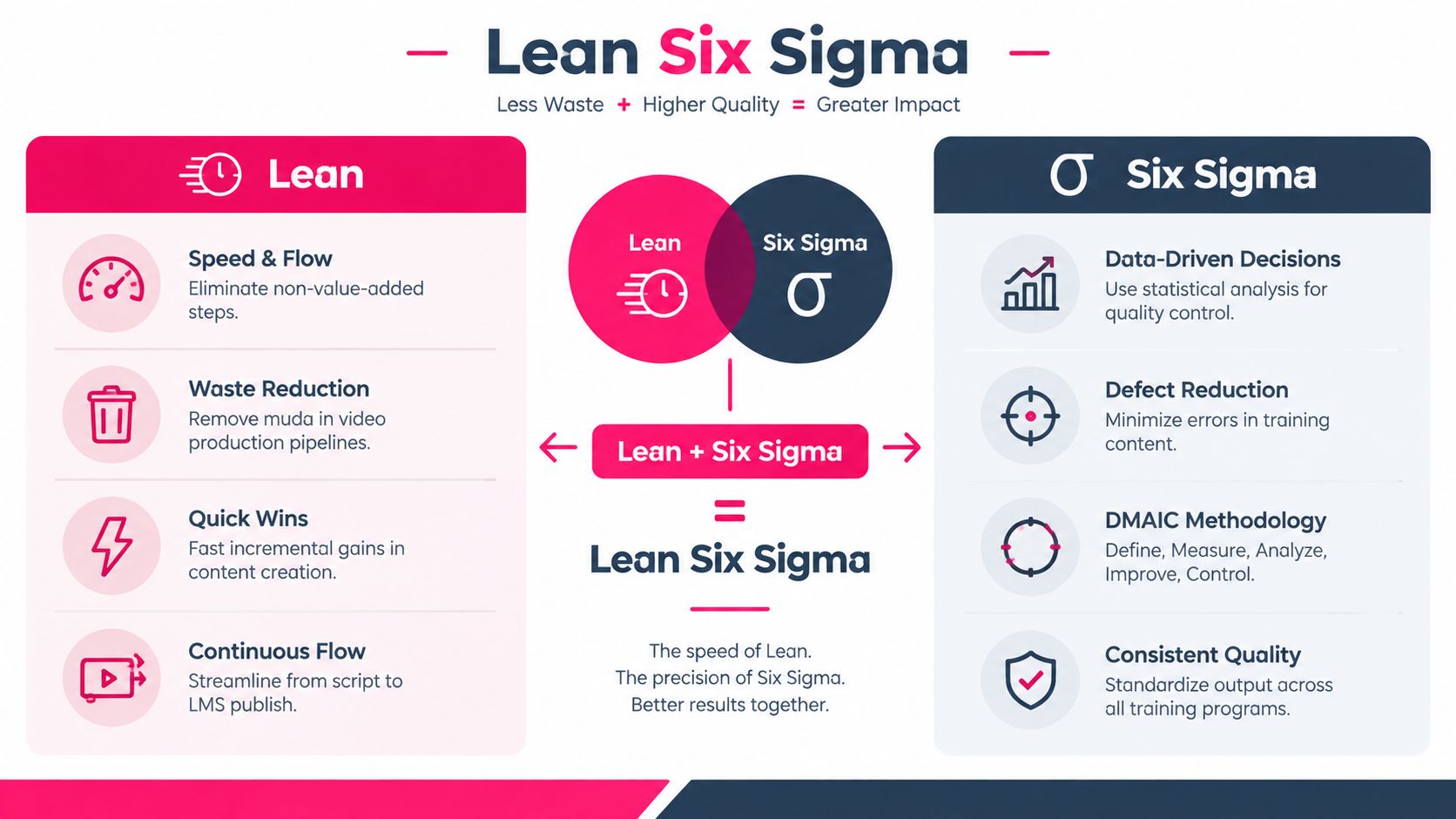
Lean Six Sigma combines two useful disciplines. Lean asks where work is being wasted, while Six Sigma asks where variation and defects are entering the process. For an L&D team, that distinction matters. A video workflow may be slow because of unnecessary approvals, or it may be inconsistent because different designers interpret quality standards differently. Those are related problems, but they need different diagnoses.
Start by mapping the path from learning request to published asset. Include intake, scripting, subject-matter review, recording or generation, editing, accessibility checks, LMS upload, and approval. Mark waiting, duplicated work, repeated corrections, and unclear handoffs. Then establish a baseline using measures your team can maintain, such as time from approved brief to publication, number of review rounds, rework causes, and content defects found after release.
The manufacturing overview of continuous improvement reports that 57% of executives focused on cost containment, 43% wanted real-time data for faster corrective action, and 80% said organizational interest in desired changes had increased. Those priorities translate directly to L&D, where cost pressure and faster feedback make production discipline increasingly important.
Apply it to one high-friction workflow
Don't launch a certification program for every team member before you know where the biggest constraint sits. Choose one high-impact workflow, create a process map, and test a narrowly defined change. A reusable script structure may reduce variation, while a decision rule for SME reviews may remove unnecessary waiting.
> Practical rule: Measure the workflow before optimizing it. Otherwise, faster delivery may simply hide lower quality.
Lean Six Sigma works best when the team can access reliable process data. It becomes excessive when a small content team spends more time documenting the process than improving it.
2. Kaizen
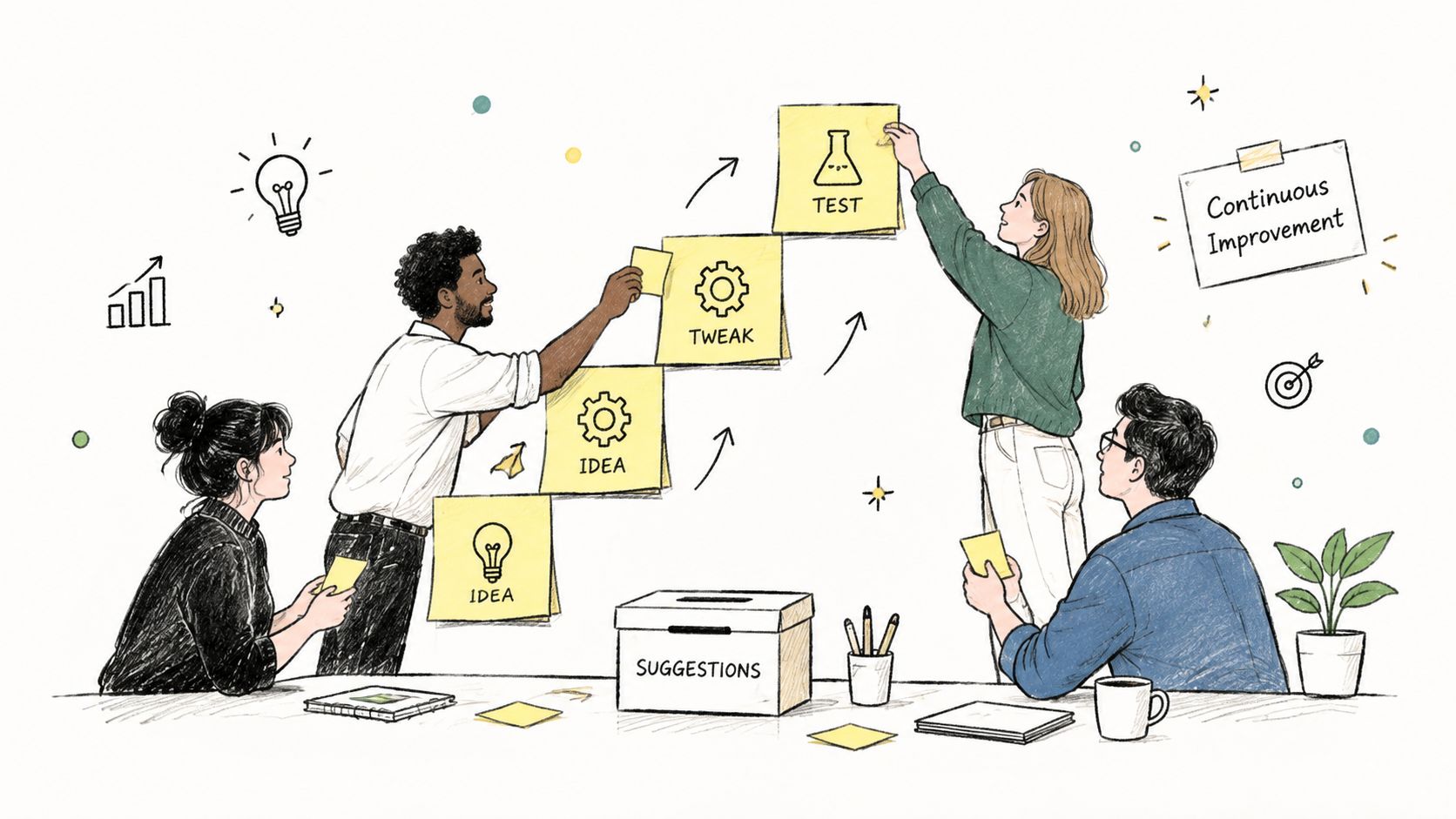
Kaizen is less a project toolkit than a daily improvement culture. It assumes that the people closest to the work can identify small sources of friction that leadership may never see in a quarterly review. For L&D, that might be a confusing naming convention, a repetitive accessibility check, a script template that encourages bloated explanations, or a learner question that appears after every release.
The method works when suggestions become visible actions. Create a shared improvement backlog where instructional designers, facilitators, LMS administrators, and subject-matter experts can record small ideas. Each item should have an owner, a decision, and a review point. A suggestion that remains in a form or inbox isn't part of a Kaizen system. It's just stored feedback.
A 2023 peer-reviewed study of method adoption in a medical device manufacturer found that 78% of respondents reported receiving training. Awareness and usage were highest for 5S at 83%, followed by 4 Step at 78%, Lean at 65%, Kaizen events at 63%, Six Sigma at 54%, and Lean Six Sigma at 49% (peer-reviewed adoption study). The pattern suggests a practical rollout lesson. Teams may adopt visible, accessible methods more readily than statistically demanding toolsets.
Make small changes teachable
A Kaizen change should be easy to explain and easy to repeat. If the team revises a video template, publish a short walkthrough showing the new structure. If the team changes the review path, turn the decision rule into a microlearning lesson and add it to onboarding.
- Invite frontline observations: Ask people where work stalls, repeats, or creates avoidable confusion.
- Recognize contributors: Show which suggestion was adopted and what behavior changed.
- Review the backlog routinely: Close, defer, or test each idea instead of letting the list become an archive.
Kaizen fails when leaders ask for ideas but don't remove obstacles, respond to contributions, or protect time for experimentation. Participation has to produce visible follow-through.
3. Agile Methodology
Agile fits L&D when the cost of waiting is higher than the cost of learning through iteration. Compliance updates, onboarding changes, and product training often arrive before a team can complete a long planning cycle. An Agile approach lets the team define a small release, gather feedback, and adjust before expanding the work.
Build a prioritized backlog of learning needs. Each work item should describe a learner or business problem, not just a format request. “Create a video about the new system” is weak backlog language. “Help new support agents complete the escalation workflow without supervisor intervention” gives the team a clearer outcome to design and review.
Organize work around useful increments
A sprint can focus on one module, one policy change, or one learner journey. Define what must be true at the end of the cycle, including script approval, accessibility review, publication, and an initial measurement plan. Reusable templates can reduce design decisions, but don't treat every template as automatically suitable. A standard visual structure may speed production while still requiring changes for technical, sensitive, or scenario-based content.
Use a board in Jira, Asana, or another workflow tool to make ownership visible. Keep the backlog prioritized, limit work in progress, and schedule a stakeholder review at the end of each cycle. The review should examine the actual learning asset and the evidence collected, not just whether tasks were marked complete.
> “Ship a useful learning increment, then let evidence improve the next one.”
Agile works poorly when every stakeholder can reopen a finished decision indefinitely. Set a review window, define who has approval authority, and separate urgent regulatory changes from lower-priority enhancement requests. Microlearning supports the model because a short lesson can be released, observed, and revised without rebuilding an entire curriculum.
4. Total Quality Management
Total Quality Management, or TQM, treats quality as everyone's responsibility. In L&D, that means quality can't sit only with an instructional designer or a final approver. The requester must define the business need, the subject-matter expert must verify accuracy, the designer must protect instructional clarity, the publisher must confirm delivery, and the learner must have a usable experience.
TQM starts by defining what “good” means before production begins. A training team might specify requirements for objective clarity, terminology, pacing, accessibility, visual consistency, assessment alignment, version control, and LMS delivery. A checklist won't guarantee effective learning, but it can prevent predictable defects from reaching learners.
Build quality into the workflow
Use a review checklist at the point where each type of risk can be detected. Subject-matter experts should focus on factual and procedural accuracy. Instructional reviewers should check whether the content supports the stated objective. Publishing owners should verify permissions, captions, links, metadata, and version status.
A quality system should also include learner evidence. Track completion, assessment performance, learner comments, and signs of confusion. The central sterile supply improvement study shows why satisfaction can matter alongside operational metrics. In that long-running intervention, overall user satisfaction rose from 54% in 2012 to 89% in 2019, with the increase statistically significant at p < 0.001. For training teams, the useful lesson is to pair process measures with experience measures rather than assuming a published course is a successful course.
TQM becomes bureaucratic when the checklist grows without improving decisions. Keep standards short, assign ownership, audit actual failures, and remove checks that never catch or prevent a meaningful problem. Quality should make good work repeatable, not make every release feel like a compliance ceremony.
5. Plan Do Check Act Cycle
PDCA is the most useful entry point when a team has a clear problem but isn't sure which intervention will work. The cycle provides four disciplined questions: What will we change? How will we test it? What happened? What should become standard?
Suppose a required module has weak completion. The team shouldn't immediately shorten every course or replace every format. In the Plan stage, define the problem, identify a plausible cause, select a focused change, and decide what evidence will count. The change might be a tighter opening, a clearer objective, a shorter sequence of lessons, or a practice question placed before the final assessment.
In Do, test the change with a limited learner group or a clearly bounded release. Record what changed and preserve the original baseline. In Check, compare the results with the selected measures. Completion may improve while assessment performance falls, or engagement may rise only for learners already familiar with the topic. Those outcomes should change the next decision.
Let evidence determine the next move
In Act, standardize the change if it worked, revise it if the evidence is mixed, or abandon it if the hypothesis wasn't supported. Update the script template, review checklist, authoring guidance, and onboarding material so the improvement doesn't depend on memory.
PDCA is deliberately simple, but simplicity doesn't mean informality. A useful cycle has a named owner, a defined scope, a baseline, a test condition, and a decision date. The history of continuous improvement and process control places Walter Shewhart's control-chart work in 1924 as a foundational milestone for statistical process control. That history reinforces the core principle behind PDCA, teams need a way to distinguish ordinary variation from a meaningful process change.
Run cycles often enough to sustain learning, but don't impose a rigid calendar when the problem requires more observation. A rushed Check stage is worse than a slower, well-designed experiment.
6. Benchmarking
Benchmarking is useful only when it changes a decision. An L&D team can improve its completion rate over the previous quarter while still delivering weak instruction, inefficient production, or poor learner support. External comparisons expose gaps that internal trends may hide.
Start by defining a fair comparison set. Match mandatory learning with mandatory learning, optional learning with optional learning, and short modules with similarly scoped modules. Then examine the system behind the result: content structure, assessment design, accessibility, delivery channel, support model, and production workflow. Public competitor content can show how peers sequence explanations, introduce scenarios, or apply microlearning. It cannot show their internal costs, learner context, or operating constraints.
Use benchmarks to form testable questions
A comparison becomes actionable when the team records what it observed and what it wants to learn:
- Content structure: How do comparable organizations introduce a policy, demonstrate a task, and confirm understanding?
- Learner experience: Where do learners face friction with navigation, captions, mobile access, or assessment instructions?
- Production flow: Which handoffs, approval stages, and reusable assets support a similar release?
- Outcome interpretation: Could differences reflect audience readiness, manager reinforcement, delivery conditions, or content quality?
Use the findings as hypotheses, not instructions to copy. A polished competitor video may depend on a production model the team cannot maintain. Test the suspected improvement against the team's baseline, then keep it only if learner outcomes or workflow performance improve.
Internal benchmarking adds another comparison layer. Apply the same definitions across departments, locate a team with a stable workflow, and examine its practices rather than praising its results alone. A useful benchmark identifies the next investigation, whether the issue is variation in review quality, wasted production effort, or weak reinforcement after launch. Microlearning can reinforce an adopted practice through short demonstrations, checklists, or decision examples, giving the wider team a practical way to apply the change consistently.
7. Root Cause Analysis
Root Cause Analysis keeps L&D teams from treating symptoms as diagnoses. A low completion rate may involve long videos, but irrelevant assignments, unclear manager communication, inaccessible playback, scheduling pressure, or a mismatched assessment can produce the same result. Cutting video length without checking these conditions may leave the failure unchanged.
Start with the failure point and the evidence needed to explain it. The Five Whys suits a narrow issue where the team needs to test assumptions beyond the first explanation. A Fishbone diagram helps organize several possible contributors, including content, delivery, learner readiness, technology, process, and measurement. For complex failure chains, Fault Tree Analysis can show how multiple conditions combine before a serious outcome occurs.
A practical RCA sequence looks like this:
- Observed problem: Learners abandon a procedural video.
- Possible reason: The explanation loses their attention.
- Question to test: Does the lesson begin with background instead of the task?
- Workflow check: Does the script template favor completeness over job relevance?
- Standards check: Do reviewers share a rule for what belongs in the core lesson?
- Working cause: The content standard rewards coverage rather than performance support.
Treat that chain as a hypothesis. Check scripts, learner behavior, system screens, and stakeholder expectations before changing the content. Designers may identify an editorial issue, while learners report confusing navigation and managers point to missing workplace reinforcement. Include these perspectives because each one exposes a different failure point in the learning system.
Structured causal analysis appears in aviation investigations and patient-safety programs, but a minor training issue does not require the same depth. Match the analysis to the consequence and recurrence. For recurring failures, record the cause, preventive action, owner, and measure that will show whether the problem returns less often.
> Don't ask only why learners failed. Ask what the system required them to do, understand, or remember without adequate support.
RCA produces value only when findings change work. Convert the result into a revised template, updated SOP, targeted microlearning lesson, or manager action. Monitor the next release to confirm that the intervention improved learner performance or reduced workflow failure.
8. Performance Metrics and KPIs
Metrics turn improvement from opinion into a management conversation. They also create a common language between L&D, HR, compliance, operations, and business leaders. The mistake is tracking everything available in the LMS without deciding which measures should change a decision.
Separate leading indicators from lagging indicators. Leading indicators can include production cycle time, review turnaround, template adoption, unresolved defects, and the number of learners reaching a practice activity. Lagging indicators can include completion, assessment performance, knowledge retention, learner satisfaction, and evidence that employees perform the target process correctly.
Connect measures to decisions
For each KPI, write the decision it supports. If completion falls at a particular point, the team may inspect that segment, revise the transition, or add an example. If assessment scores remain low after a content change, the team may need to revisit the objective, practice design, or prerequisite knowledge. If production time increases, map the workflow before asking the team to work faster.
Use training effectiveness measurement guidance to frame measurement as input for the next version, not merely as proof that a program launched. A dashboard should make trends and exceptions visible, but it shouldn't replace qualitative investigation. Analytics can show where learners pause or leave. Interviews and open responses can help explain why.
Avoid vanity metrics. Video views may indicate reach, but they don't establish comprehension. Completion may indicate exposure, but it doesn't prove transfer. Select a small set of measures that covers workflow health, learner behavior, learning quality, and business relevance, then review them at a defined cadence.
A metric becomes useful when someone owns the response. Assign each measure a responsible person, a review date, and a threshold that triggers investigation. Without that operating rule, dashboards become reporting screens rather than improvement tools.
9. 5S Methodology and SOPs
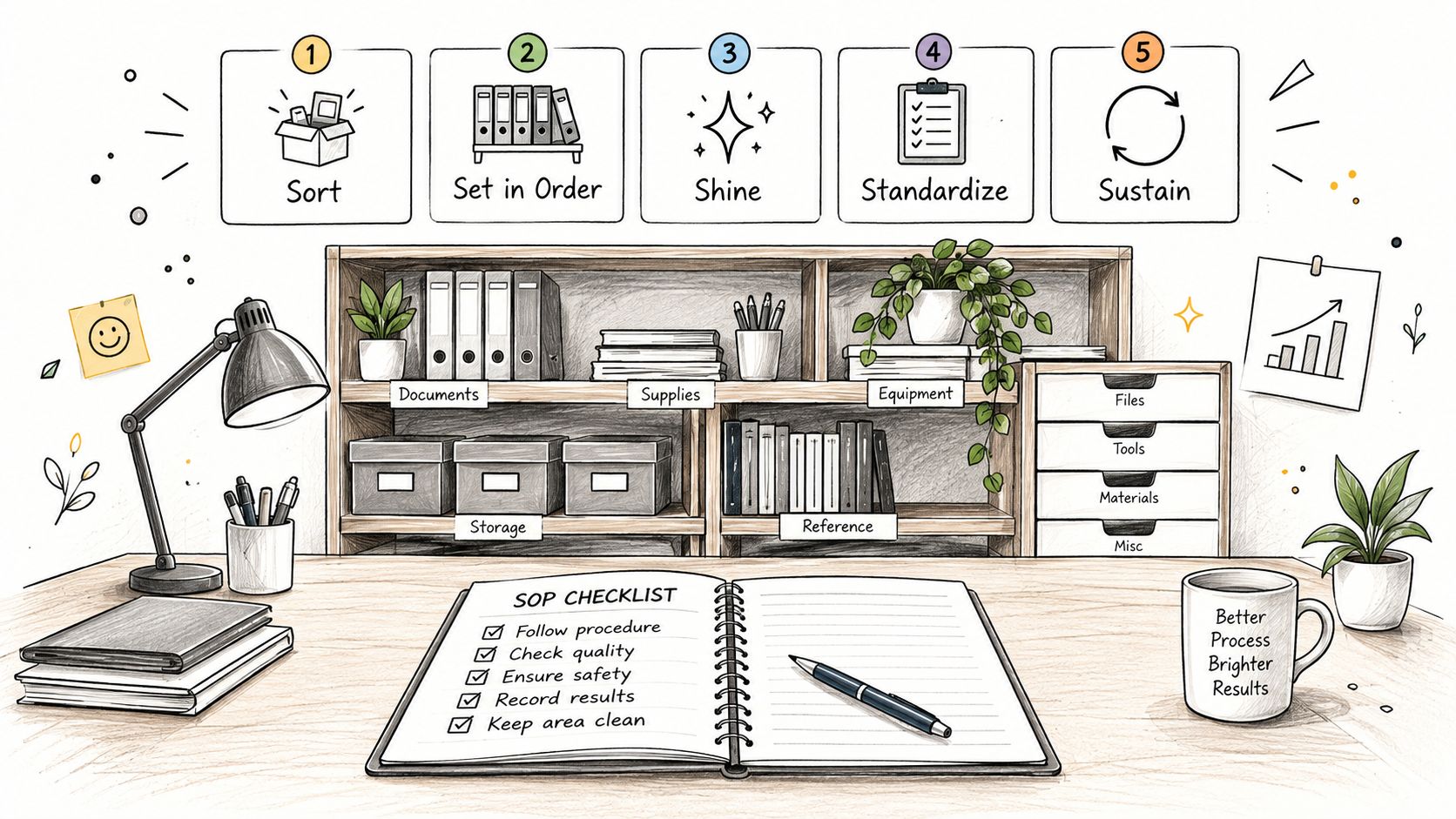
5S organizes the environment in which work happens. SOPs preserve the agreed way of working. Together, they address a common L&D failure: teams know the method, but can't find the current template, don't know which version is approved, and rely on individual memory to complete routine steps.
Apply the five 5S practices to your content environment:
- Sort: Archive obsolete scripts, duplicate videos, unused templates, and superseded policy files.
- Set in order: Organize assets by program, audience, content type, and status, with consistent naming.
- Shine: Clean shared drives, remove broken links, and check that documentation reflects actual work.
- Standardize: Define script structures, review gates, accessibility checks, and publishing conventions.
- Sustain: Schedule audits, train new team members, and make ownership visible.
Turn procedures into usable support
An SOP shouldn't describe an ideal workflow that nobody follows. Observe the actual process, document the decision points, identify exceptions, and show the required inputs and outputs. Use job aids for SOPs when a task needs quick workplace reference rather than a long course.
A concise SOP might explain how to request a video, select a template, route a factual review, verify captions, assign a version number, publish to the LMS, and record the release. Add decision trees for urgent compliance changes, sensitive content, and materials requiring legal approval. Keep the source of truth central and link training assets to the current procedure.
Use the video below as a visual prompt for discussing workspace organization with the team.
5S and SOPs fail when teams treat them as cleanup projects. The sustain step requires audits, onboarding, version control, and periodic removal of rules that no longer fit the workflow. Organization is valuable because it makes the correct action easier to find and repeat.
10. Feedback Loops and Iterative Refinement
A training asset is unfinished until its use produces evidence for the next revision. Learners may report confusing explanations, facilitators may hear the same question repeatedly, managers may identify workplace barriers, and stakeholders may judge whether the lesson supports the intended process. Each signal covers a different failure point, so the review process must combine them rather than rely on a single survey.
Start with one clear question at each relevant stage. A short usefulness prompt after a lesson can expose immediate friction. An open response can reveal a missing topic. LMS behavior can show where learners pause, replay, or abandon content. Interviews and focus groups help explain patterns that usage data cannot interpret.
Make feedback operational
Feedback earns trust when the team records the decision and shows the response. Maintain a lightweight change log containing the issue, supporting evidence, decision, owner, release, and follow-up measure. If a confusing example changes, tell stakeholders. If a request belongs to a product defect, manager communication gap, or policy ambiguity, route it to that owner instead of forcing a content revision.
Use a review rule that connects signals to action:
- Ask one focused question: “Was this explanation clear?” usually produces more usable input than a long survey.
- Compare signals: Review comments alongside completion, assessment, and support data.
- Set an action threshold: Define which recurring patterns require a content change, workflow change, or no change.
- Publish the decision: State what changed, what stayed unchanged, and why.
A simple workflow is: collect, interpret, decide, release, and check again. Content performance tracking can support recurring reviews of training assets and help teams distinguish a local issue from a broader pattern.
Capacity determines whether the loop works. Limit the questions, assign an owner, and reserve time for review. Microlearning supports faster refinement because a team can revise one focused lesson or job aid without rebuilding an entire learning path. That speed matters only when the revised asset is tested against learner behavior and workplace outcomes, not merely published and forgotten.
Continuous Improvement Methods: 10-Point Comparison
| Method | 🔄 Implementation complexity | ⚡ Resource requirements | ⭐ Effectiveness | 📊 Expected outcomes | 💡 Ideal use cases & tips | |---|---:|---:|---:|---|---| | Lean Six Sigma | High, structured DMAIC, needs statistical expertise | High, analytics tools, trained Green/Black Belts | ⭐⭐⭐⭐⭐, excellent at reducing variation | Measurable cycle-time reduction, consistent quality, clear KPI gains | Best for large/complex pipelines; start with high‑impact workflows and train belts | | Kaizen (Continuous Improvement) | Low–Medium, cultural change, ongoing small steps | Low, staff engagement, low-cost experiments | ⭐⭐⭐⭐, steady cumulative improvements | Continuous small gains, higher team engagement, incremental quality gains | Ideal for template refinement; use suggestion channels, celebrate quick wins | | Agile Methodology | Medium, sprint cadence, roles and discipline required | Medium, cross-functional teams, project tools (Jira/Asana) | ⭐⭐⭐⭐, fast iterative delivery and adaptation | Faster time-to-market, validated content, rapid pivots | Use 1–2 week sprints for new modules; prioritize backlog and use analytics | | Total Quality Management (TQM) | High, organization-wide commitment and documentation | High, systems, training, audits, long-term investment | ⭐⭐⭐⭐⭐, strong improvement in learner outcomes | Consistent high-quality videos, reduced rework, improved satisfaction | Best for compliance/enterprise scale; set clear standards and review checklists | | PDCA Cycle | Low, simple four-step iterative framework | Low, pilot tests and basic measurement | ⭐⭐⭐⭐, reliable for frequent refinement | Rapid test-and-learn cycles, documented improvements, scalable | Use for quick template tests; run cycles every 2–4 weeks and document results | | Benchmarking | Medium, requires external research and analysis | Medium, data access, industry reports, time to analyze | ⭐⭐⭐, effective if quality comparative data available | Identifies performance gaps, realistic targets, best-practice adoption | Benchmark completion/engagement rates; join industry groups for data | | Root Cause Analysis (RCA) | Medium, structured facilitation (Five Whys/Fishbone) | Low–Medium, cross-functional workshops and data gathering | ⭐⭐⭐⭐, prevents recurrence when done well | Root causes identified, targeted fixes, fewer repeat failures | Use when programs underperform; include diverse stakeholders and document actions | | Performance Metrics & KPIs | Medium, requires metric design and governance | Medium–High, analytics platforms, dashboards, data hygiene | ⭐⭐⭐⭐⭐, essential for data-driven decisions | Visibility into ROI, quick problem detection, trend forecasting | Define leading/lagging metrics; build dashboards and track template usage | | 5S Methodology & SOPs | Medium, heavy initial setup, ongoing discipline | Medium, documentation effort, audits, version control | ⭐⭐⭐⭐, boosts efficiency and consistency | Faster production, standardized templates, simpler onboarding | Organize assets, create SOPs, schedule regular audits and updates | | Feedback Loops & Iterative Refinement | Low, straightforward channels but needs follow-through | Low, surveys/tools, analysis time; moderate if analytics required | ⭐⭐⭐⭐, aligns content to learner needs quickly | Improved engagement, faster corrections, stakeholder responsiveness | Embed micro-surveys, track viewer behavior, close the loop and act on feedback |
Build a Practical Improvement System for L&D
The ten continuous improvement methods work best as connected parts of one operating system. Lean Six Sigma helps remove waste and reduce variation. Kaizen turns improvement into a participatory habit. Agile supports rapid delivery when requirements change. TQM spreads quality responsibility across the organization. PDCA gives teams a controlled way to test a change. Benchmarking provides an external reference point. Root Cause Analysis prevents symptom-based fixes. KPIs make performance visible. 5S and SOPs create operational consistency. Feedback loops keep refinement connected to learner experience.
Don't launch all ten at once. Start with one measurable problem that affects learners or the team's ability to deliver. Examples include repeated review rework, inconsistent course quality, a backlog of outdated procedures, or a module that learners regularly abandon. Write down the current process, define the baseline, identify the owner, and select the smallest intervention that can generate useful evidence.
Your first pilot should have a clear boundary. Choose one content type, one workflow, one audience, or one release cycle. Define what the team will change, what it won't change, which measures matter, and when the group will decide whether to standardize, revise, or stop. This keeps continuous improvement from becoming a broad promise with no operational commitment.
The infrastructure matters as much as the framework. A 2026 report summary identified standard work as the clearest gap for 47% of organizations and noted an 11-point gap between leadership modeling and daily engagement (report summary on standard work and engagement). The implication for L&D is direct. Teaching people the names of Lean, Kaizen, or PDCA won't sustain adoption if leaders don't model the routines, teams can't access the current SOP, and improvement actions have no owner.
Use microlearning to reinforce the system
Short learning assets can turn a process change into an observable behavior. Create a brief lesson for the new review path, a quick demonstration of the updated template, or a scenario that shows when an exception requires escalation. Place the asset where the work happens, connect it to the SOP, and refresh it when the procedure changes.
VideoLearningAI is a relevant production option for this workflow because it can turn existing course materials, procedures, and templates into bite-sized training videos. That can help an L&D team standardize reinforcement without adding heavy editing overhead to every small improvement. Keep the content focused on one objective, publish it with the current procedure, measure how learners use it, and feed the findings into the next cycle.
The most effective process improvement solutions aren't defined by the number of frameworks displayed in a strategy document. They're defined by whether people can identify a problem, test a better way, measure what changed, and continue using the improved process after the workshop ends. Build that rhythm deliberately, then let each validated change become the baseline for the next one.
---
VideoLearningAI helps educators, course creators, and corporate trainers turn existing materials into polished, bite-sized training videos without requiring editing skills. Visit VideoLearningAI to create microlearning assets that support SOP adoption, method training, workflow reinforcement, and iterative improvement across your L&D operation.