
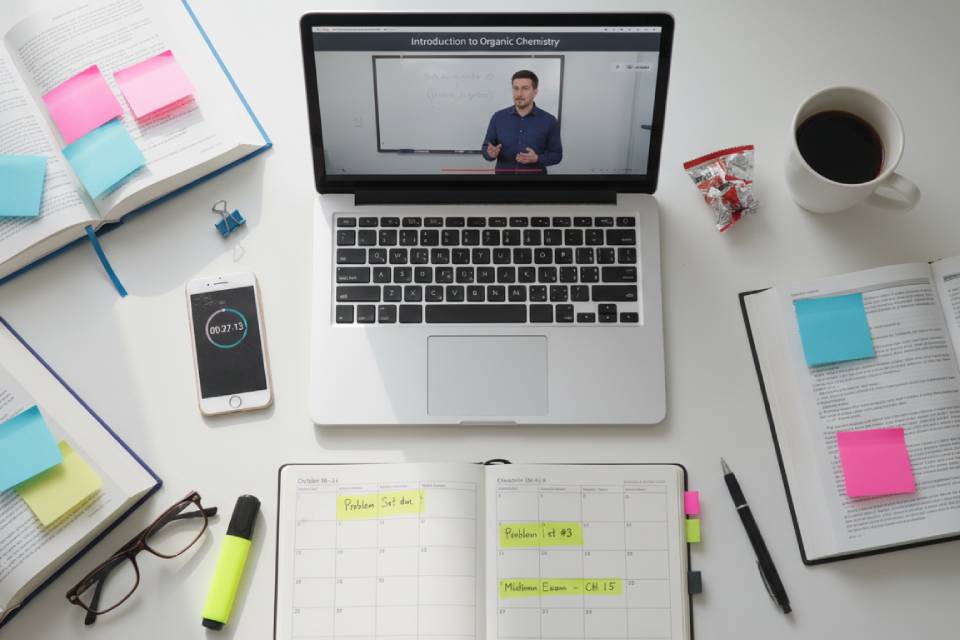
A packed semester means competing priorities everywhere: back-to-back lectures, overlapping assignment deadlines, group projects, exams — and a limited number of hours in the day. Choosing how to study and consume course material isn't just a preference; it directly affects what you retain and how efficiently you use your time.
Below is a breakdown of when microlearning beats long-form content (and vice versa) specifically for the reality of a heavy academic semester — whether you're a student trying to survive finals or an educator designing courses for overloaded learners.
What counts as microlearning vs. long-form content?
Microlearning delivers focused content in short bursts — typically 2 to 10 minutes — covering a single concept, skill, or problem. Think: a 5-minute video explaining one theorem, a flashcard deck for key vocabulary, or a quick quiz on a single chapter section.
Long-form content spans 20 minutes to an hour or more. It covers broader topics with depth and narrative: a full lecture recording, a textbook chapter, a detailed case study walkthrough, or a comprehensive video tutorial.
Neither format is inherently superior. The question is which one fits your situation — and during a packed semester, situation changes week to week.
Why format choice matters more during heavy workloads
During a light semester, you can afford to sit through a 50-minute lecture recording twice or read a dense chapter slowly. During a packed one, every minute of study time competes with something else. The wrong format at the wrong time leads to:
- Diminishing returns — watching a long lecture while exhausted means absorbing very little
- Context switching costs — jumping between unrelated deep-dive materials fragments attention
- Procrastination triggers — a 90-minute recording feels daunting, so you delay starting it entirely
- Shallow processing — skimming long content to save time often backfires on exams
Cognitive load theory predicts exactly this: when mental resources are stretched thin, shorter and more focused material reduces extraneous load and improves encoding.
When microlearning wins during a packed semester
1. Filling gaps between classes
The 15–30 minute windows between lectures, while commuting, or waiting for a lab to start are too short for deep study but perfect for micro-sessions. A 5-minute video reviewing yesterday's key concepts or a quick practice problem set turns dead time into productive review.
2. Spaced repetition before exams
Cramming long-form material the night before an exam is tempting but ineffective for long-term retention. Microlearning shines for spaced repetition: short daily reviews of previously covered concepts, spread across weeks, dramatically improve recall. Even 10 minutes a day of targeted review outperforms a 3-hour cram session for retention.
3. Catching up on multiple subjects
When you're behind in three courses at once, a stack of hour-long recordings feels insurmountable. Breaking catch-up into micro-chunks — one key concept per subject per day — makes the workload psychologically manageable and prevents the "I'll do it all this weekend" trap that rarely works.
4. Active recall practice
Short quizzes, flashcard sessions, and single-problem exercises are inherently micro-format. Research consistently shows that active recall (testing yourself) beats passive review (re-reading or re-watching) for learning efficiency — exactly what you need when time is scarce.
5. Just-in-time learning for assignments
Working on a statistics assignment and can't remember how to run a specific test? A focused 3-minute video on that exact procedure is more efficient than scrubbing through a 45-minute lecture to find the relevant segment.
When long-form content is still the better choice
1. First exposure to complex topics
Some subjects require building understanding layer by layer. Learning organic chemistry reaction mechanisms, understanding constitutional law arguments, or following a mathematical proof often needs sustained attention and narrative flow. Chopping these into 3-minute fragments can strip away the connections that make the material make sense.
2. Deep work sessions
Not every moment of a packed semester is fragmented. When you can carve out a 2-hour focused study block on a Saturday morning, that's the time for long-form engagement: reading a full chapter, working through an extended case study, or watching a complete lecture while taking detailed notes. Deep work sessions produce qualitatively different understanding than microlearning alone.
3. Essay and thesis writing preparation
Writing a research paper or extended argument requires synthesizing multiple sources into a coherent whole. Long-form reading and analysis builds the integrated understanding needed for this kind of work. Micro-chunks of disconnected facts won't give you the narrative threads you need.
4. Lab and studio work
Hands-on sessions — chemistry labs, design studios, clinical practicums — are inherently long-form. You can't meaningfully "micro-learn" your way through a 3-hour organic chemistry lab. Preparation materials can be micro (a 5-minute protocol review), but the doing requires sustained engagement.

A practical framework: matching format to your week
Rather than committing to one format, use a weekly planning approach:
| Situation | Best format | Example | |---|---|---| | 10-min gaps between classes | Microlearning | Flashcard review, quick concept video | | Commuting or walking | Microlearning (audio) | Podcast-style concept summaries | | Evening after a long day | Microlearning | Short quiz or single-problem practice | | Dedicated 2-hour study block | Long-form | Full chapter reading, lecture viewing with notes | | Weekend deep work session | Long-form + micro follow-up | Case study analysis, then micro-review of key points | | Night before an exam | Microlearning | Spaced repetition review, targeted weak-spot drills | | Falling behind in a course | Microlearning first | Catch up on core concepts via short summaries, then backfill with long-form |
The pattern: use long-form when you have focus and time; use microlearning when you're fragmented, fatigued, or need reinforcement.
Research-backed strategies for combining both formats
The sandwich method
Start a study session with a 5-minute micro-review of previous material (activates prior knowledge), do your long-form study in the middle, and close with a 5-minute micro-quiz or summary (consolidates new learning). This approach leverages the testing effect at both ends.
The chunking strategy
Break a long lecture into self-contained segments. Watch 15 minutes, pause to write a one-sentence summary, do a quick self-test, then continue. You're converting long-form material into a microlearning rhythm while maintaining the narrative flow of the original content.
The interleaving approach
Instead of studying one subject for 3 hours, alternate between two or three subjects in shorter blocks (20–30 minutes each). Interleaving feels harder in the moment but produces stronger long-term retention and better transfer — critical during exam weeks when you're tested on multiple subjects.
The pre-study micro-prime
Before a lecture, spend 5 minutes watching a short overview video or reviewing key terms. This "priming" gives your brain a scaffold to hang new information on, making the full lecture more efficient. Students who pre-study with micro-content consistently report better comprehension during class.
Duration guidelines for academic microlearning
Not all micro-content needs to be the same length. Match duration to purpose:
- Concept review / flashcards: 2–3 minutes
- Single-problem worked example: 3–5 minutes
- Procedure or technique demo: 4–7 minutes
- Topic summary / recap: 5–8 minutes
- Mini case study or scenario: 7–10 minutes
Anything beyond 10 minutes starts functioning as short-form rather than micro-format. That's fine — just be intentional about what you're doing.
Common mistakes students make
Going all-micro when depth is needed. Microlearning is great for reinforcement, but it can't replace the initial deep engagement with genuinely complex material. If you only ever skim surfaces, exams that test application and synthesis will expose the gaps.
Using long-form passively. Re-watching a 50-minute lecture while half-asleep doesn't count as studying. If you don't have the energy for active engagement with long-form content, switch to micro-format active recall instead — it's more effective per minute spent.
Ignoring the forgetting curve. One exposure to any content — short or long — fades rapidly. Without spaced review, you'll lose roughly 70% within 48 hours. Build micro-review sessions into your weekly schedule regardless of how you initially learn the material.
Mistaking content consumption for learning. Watching a video, even a great one, is not the same as learning. Active engagement — pausing to predict, summarize, question, or apply — is what converts watching into knowing.
For educators: designing for packed semesters
If you're creating course content for students who are juggling heavy loads, consider these principles:
Offer both formats. Provide full lectures for students who want depth, but also create short summary videos hitting the core concepts. Students will self-select based on their current bandwidth.
Make content scannable. Add timestamps to long videos. Write clear learning objectives at the top of each module. Use descriptive titles so students know exactly what a 4-minute clip covers.
Design micro-assessments. Short, low-stakes quizzes after each micro-unit help students gauge understanding without the pressure of a major exam. These also provide spaced retrieval practice naturally.
Modularize ruthlessly. Structure your course so each concept can stand alone as a micro-unit while still fitting into the larger narrative. This gives students flexibility in how they consume and review material.
Tools like VideoLearningAI can help educators quickly convert lecture notes, slides, or documents into short, focused video lessons — making it practical to offer both micro and long-form content without doubling production time.
Building your semester study system
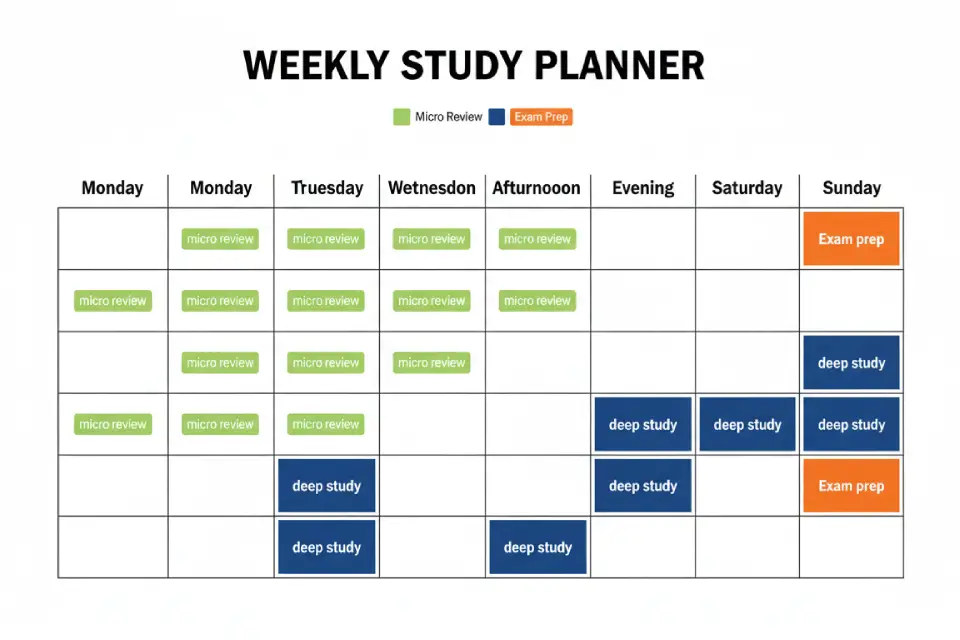
Here's a practical weekly template for a student carrying a heavy course load:
Monday–Friday (fragmented time)
- Morning commute: 10 min audio review of yesterday's key concepts
- Between classes: 5–10 min flashcard or quiz sessions
- Evening wind-down: 10 min micro-review of weakest topic from the day
Weekday evenings (30–60 min blocks)
- One focused study block per subject using long-form material
- Close each block with a 5-minute self-test
Weekends (dedicated deep work)
- 1–2 longer sessions (90–120 min) for complex topics, readings, or assignments
- Followed by micro-review to consolidate
Exam weeks
- Shift almost entirely to micro-format: targeted review, practice problems, spaced repetition
- Reserve long-form only for topics you haven't covered at all
This isn't rigid — the point is to deliberately match format to context rather than defaulting to whatever feels easiest.
The bottom line
During a packed semester, the answer to "microlearning or long-form?" is almost always both — but at the right times. Microlearning handles the fragmented, high-pressure, review-heavy moments that dominate busy academic life. Long-form content handles the deep, first-exposure, synthesis-heavy work that builds real understanding.
The students and educators who thrive during heavy semesters aren't the ones who pick a single format — they're the ones who strategically match format to moment, energy level, and learning goal. Use microlearning to stay consistent when time is scarce, and protect focused blocks for the long-form work that builds lasting knowledge.
If you're an educator looking to offer students flexible content formats, consider creating short-form video lessons alongside your traditional materials. Platforms like VideoLearningAI let you quickly generate focused video content from your existing notes and slides — giving students the micro-option they need during the weeks when everything is due at once.